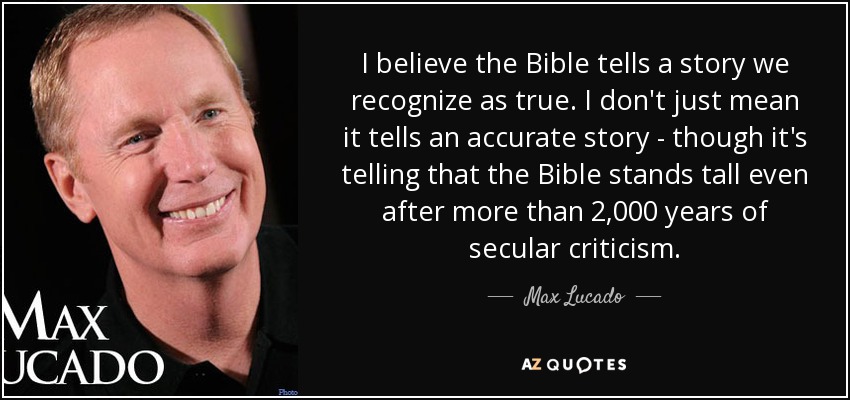
I believe the Bible tells a story we recognize as true. I don't just mean it tells an accurate story - though it's telling that the Bible stands tall even after more than 2,000 years of secular criticism.
The basic assumption of the secular society is that modernity overcomes religion.
Christ is still in Christmas, and for one brief season the secular world broadcasts the message of Christ over every radio station and television channel in the land. Never does the church get as much free air time as during the Christmas season.
I hold conferences, and the result of that was that the secular community also started picking up my stuff, and pretty soon they wanted more. So I realized I could not only minister to the Christian community, but I could also minister to the corporate community. So my books started crossing over, and then I began to intentionally have them cross over.
Jesus communicated parables to the secular people around him and he used stories that were very relevant to their lives, and He was taking heaven's truth and packaging it in an earthly context.
Moral theory develops from the divine command theory of medieval Christian philosophy, mixed up with a bit of ancient pagan virtue theory, to the purely secular moral sentiment and interpersonal reaction theories of Smith and Hume, to Kant's attempt to restore command theory but with something supersensible in the individual rather than God as the source of authority.
Louis Brandeis started off by embracing the Theodore Roosevelt notion that hyphenated Americanism was unpatriotic. You couldn't have dual loyalties. But then he thinks and he reads and he becomes the head of the American Zionist movement after having previously been a secular Jew in this amazing intellectual evolution.
Ideally, I'd like everybody to be secular.
For Pakistan, Kashmir represents the infeasibility of secular nationalism and underscores the need for an Islamic theocracy in the subcontinent.
I kept saying to myself, this is a calling that God has given me. And so with intention I said, "Okay I'm going to write books not only for the Christian community, but also for the secular community." I found it really rewarding because the last one to use my gifts and advantages to people who look at church as not on their radar screen at all, it gives me favor with - I do a lot with Fortune 500 companies now.
My audience is made up of two groups of people. The first group includes people whose roots are deep in the Christian faith, but for whom the traditional symbols, as traditionally understood, no longer make sense. The other audience is the audience that has left. I call them the Church Alumni Association, citizens of the secular city. They are a bit nostalgic about this faith of their childhood, but they aren't really interested in trotting it out or becoming involved with it again as it is presently organized.
The loss of the religious understanding of the human condition—that Man is a fallen creature for whom virtue is necessary but never fully attainable—is a loss, not a gain, in true sophistication. The secular substitute—the belief in the perfection of life on earth by the endless extension of a choice of pleasures—is not merely callow by comparison but much less realistic in its understanding of human nature.
We don't say that we don't have it, we're still secular in Syria, but with the time, this secularism will be eroded.
When the Chinese government tells its citizens that they can worship in a certain building on a certain day, but once they leave that building they must bow to the secular orthodoxy of the state, you have a cynical lie at work. They’ve substituted a toothless ‘freedom of worship’ for ‘freedom of religion’.
I grew up in a very secular home with no religion at all, so I was starting from zero.
Independent of the critique I'm making, I'm just trying to paint a more comprehensive portrait of American religion than you get from a right versus left, religious conservatives versus secular liberal, believer versus atheist, binary. Too often, we just look at religion in America through that kind of either/or lens. I think it's much more complicated than that.
Humanism cannot survive on a purely secular platform.
There's a culture war in this country. Americans in recent years, as you know, have become more secular. They don't go to church as often. Bible reading, prayers in public are now frowned upon. And, of course, in addition to that, a lot of people have become much more supportive of LGBT rights. And in reaction to that, biblically conservative Americans feel that their faith is under assault.
Arab nationalism, which tended to be until relatively recent somewhat secular in motivation, has now become increasingly religious and fundamentalist. And that makes it more pervasive, more difficult to deal with.
The question of identity has separated from the issue of 'assimilation', having lost much of its drama and become, so to speak, a secular problem.
Marriage is a unified institution. Marriage means a committed, legally sanctioned relationship between a man and a woman. That's what it means. That's what it means in the revelations. That's what it means in the secular law. You cannot have that marriage coexisting institutionally with something else called same-gender marriage. It simply is a definitional impossibility.
Even secular humanism has great spiritual resources; it is almost like a religion to me.
The rise of what's called Islamic fundamentalism is to a significant extent a result of the collapse of secular nationalist alternatives which were either discredited internally or destroyed, leaving few other options. Something like that may be true of American society.
The goal of this office will not be to favor one religious group over another - or even religious groups over secular groups. It will simply be to work on behalf of those organizations that want to work on behalf of our communities, and to do so without blurring the line that our founders wisely drew between church and state.
The Church is her true self only when she exists for humanity. As a fresh start, she should give away all her endowments to the poor and needy. The clergy should live solely on the freewill offerings of their congregations, or possibly engage in some secular calling.
Follow AzQuotes on Facebook, Twitter and Google+. Every day we present the best quotes! Improve yourself, find your inspiration, share with friends
or simply: