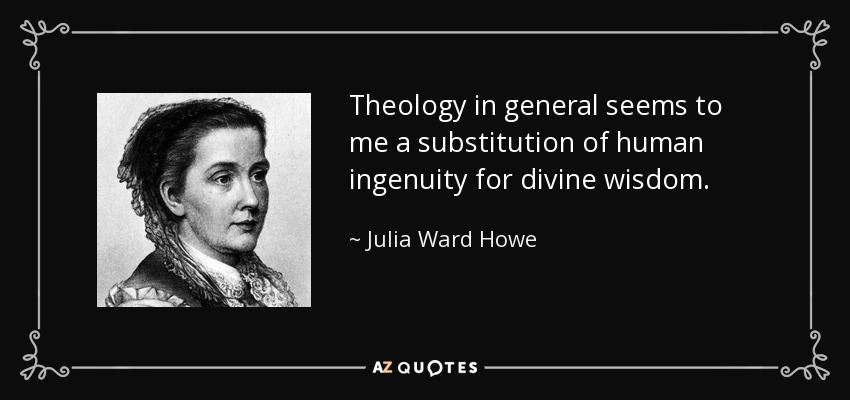
Theology in general seems to me a substitution of human ingenuity for divine wisdom.
Nothing seems to me more doubtful than Aristotle's remark that it is probable the arts and philosophy have several times been discovered and several times lost.
When your principles seem to be demanding suicide, clearly it's time to check your premises
What does it mean to be a self-conscious animal? The idea is ludicrous, if it is not monstrous. It means to know that one is food for worms. This is the terror: to have emerged from nothing, to have a name, consiousness of self, deep inner feelings, an excruciating inner yearning for life and self-expression and with all this yet to die. It seems like a hoax, which is why one type of cultural man rebels openly against the idea of God. What kind of deity would crate such a complex and fancy worm food?
In a few more days we will celebrate Xmas, the day we commemorate the birth of you-know-who. ...It seems the modern consensus of enlightened people that his name should be used in polite society only when cursing.... [P]oliticians are often eager to associate themselves personally with you-know-who, even -- and especially -- when they rather flagrantly ignore his injunctions.... He was out of step then, and he is out of step now. He is eternally out of step, and eternally more powerful than those who keep in step. You know who I mean.
As the Hindu gods are 'immortal' only in a very particular sense - for they had born and they die - they experience most of the great human dilemmas and often seem to differ from mortals in a few trivial details... and from demons even less. Yet they are regarded by the Hindus as a class of beigns by definition totally different from any other; they are symbols in a way that no human beign, however 'archetypal' his life story, can ever be. They are actors playing parts that are real only for us; they are masks behind which we see our own faces.
My life is kinda like a story that if I told you about it, you probably wouldn't believe. It would seem like fiction. That's me.
I follow Coach Spurrier because he seems to have an entertaining way of communicating.
If a close examination of the evidences of Christianity may be expected of one class of men more than another, it would seem incumbent upon lawyers who make the law of evidence one of our peculiar studies. Our profession leads us to explore the mazes of falsehood, to detect its artifices, to pierce its thickest veils, to follow and expose its sophistries, to compare the statements of different witnesses with severity, to discover truth and separate it from error.
On the one hand, we are faced with the stewardship of this beautiful, subtle, incredibly delicate, fragile planet. On the other, we confront the destiny of our fellow man, our brothers. How can we say that we are followers of Christ if this dual responsibility does not seem to us the essence and heart of our religion?
Progress is the exploration of our own error. Evolution is a consolidation of what have always begun as errors. And errors are of two kinds: errors that turn out to be true and errors that turn out to be false (which are most of them). But they both have the same character of being an imaginative speculation. I say all this because I want very much to talk about the human side of discovery and progress, and it seems to me terribly important to say this in an age in which most non-scientists are feeling a kind of loss of nerve.
Somehow it just don't seem fittin' for a bridegroom to spend his weddin' night in a tree.
At another location, we found barrels of chemical material that was intended for use as biochemical weapons. Everyone talks about there being no weapons of mass destruction in Iraq, but they seem to be referring to completed nuclear bombs, not the many deadly chemical weapons or precursors that Saddam had stockpiled.
The difference between a great soul and an ordinary man is this: the latter weeps while leaving this body, whereas the former laughs. Death seems to him a mere play.
Superstition would seem to be simply cowardice in regard to the supernatural.
The best thing I ever learned in life was that things have to be worked for. A lot of people seem to think there is some sort of magic in making a winning football team. There isn't, but there's plenty of work.
When the Turkish authorities gave the orders for these deportations, they were merely giving the death warrant to a whole race; they understood this well, and, in their conversations with me, they made no particular attempt to conceal the fact… I am confident that the whole history of the human race contains no such horrible episode as this. The great massacres and persecutions of the past seem almost insignificant when compared to the sufferings of the Armenian race in 1915.
I have said this many times, that there seems to be enough room in the world for mediocre men, but not for mediocre women, and we really have to work very, very hard.
It is not enough for me to ask question; I want to know how to answer the one question that seems to encompass everything I face: What am I here for?
To offer no resistance to life is to be in a state of grace, ease, and lightness. This state is then no longer dependent upon things being in a certain way, good or bad. It seems almost paradoxical, yet when your inner dependency on form is gone, the general conditions of your life, the outer forms, tend to improve greatly.
Most photographers seem to operate with a pane of glass between themselves and their subjects. They just can't get inside and know the subject.
In history and in life one sometimes seems to glimpse a ferocious law which states: to he that has, will be given; from he that has not, will be taken away.
Force yourself to write down what is of no interest, what is most obvious, most common, most colourless...antique shops, clothes, hi-fi, etc. Don't say, don't write 'etc'. Make an effort to exhaust the subject, even if that seems grotesque, or pointless, or stupid. You still haven't looked at anything, you've merely picked out what you've long ago picked out.
Although the noise of the chattering clientele is much more significant than the topics of their chatter, it does finally constitute that type of social and indistinct expression that we refer to as rhubarb. The very particular volume in which people tell each other their news seems to generate all by itself that acoustic chiaroscuro, a sounding murk, in which every communication seems to lose its edges, truth projects the shadow of a lie, and a statement seems to resemble its opposite.
Doubts raced through my mind as I considered the feasibility of enforcing a law which the majority of honest citizens didn't seem to want.
Follow AzQuotes on Facebook, Twitter and Google+. Every day we present the best quotes! Improve yourself, find your inspiration, share with friends
or simply: