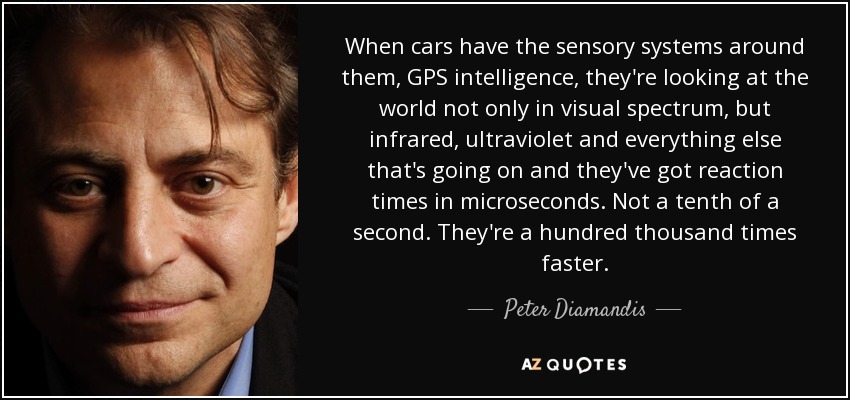
When cars have the sensory systems around them, GPS intelligence, they're looking at the world not only in visual spectrum, but infrared, ultraviolet and everything else that's going on and they've got reaction times in microseconds. Not a tenth of a second. They're a hundred thousand times faster.
You know, mind allows us to portray in different sensory modalities, visual, auditory, olfactory, you name it, what we are like and what the world is like. But this very, very important quality of subjectivity, this quality that allows us to take a distant view and say, "I am here, I exist, I have a life and there are things around me that refer to me." That me-ness, M-E-hyphen, that is what really constitutes consciousness.
I feel that the change, the mutation in consciousness, will occur spontaneously once certain pressures now in operation are removed. I feel that the principal instrument of monopoly and control that prevents expansion of consciousness is the word lines controlling thought, feeling and apparent sensory impressions of the human host.
How do we awaken to this true Self? By going within and putting our attention on the silent presence in our heart - the silent witness that is detached from sensory experience and at the same time enjoys that experience in complete freedom.
In Lords of Rainbow I start out by taking away color from the world, and in the process show color's vital place in our lives. At least I hope that by the end of the book it's a portion of what the reader comes away with - a sense of how much color perception enriches our lives and how its lack can make our sensory experience incomplete.
One Spirit Medicine allows you to experience communion with Spirit and understand the workings of creation. This understanding is not academic or intellectual; it’s kinesthetic and sensory-a knowingness that pervades every cell of your body...you experience a transcendent awareness that penetrates your whole being. You truly grasp that energy and consciousness can never be destroyed, only transformed into myriad shapes and forms, one of which happens to be you.
Tools arm the man. One can well say that man is capable of bringing forth a world; he lacks only the necessary apparatus, the corresponding armature of his sensory tools. The beginning is there. Thus the principle of a warship lies in the idea of the shipbuilder, who is able to incorporate this thought by making himself into a gigantic machine, as it were, through a mass of men and appropriate tools and materials. Thus the idea of a moment often required monstrous organs, monstrous masses of materials, and man is therefore a potential, if not an actual creator.
Computer mediation seems to bathe action in a more conditional light: perhaps it happened; perhaps it didn't. Without the layeredrichness of direct sensory engagement, the symbolic medium seems thin, flat, and fragile.
Our talk of external things, our very notion of things, is just a conceptual apparatus that helps us to foresee and control the triggerings of our sensory receptors in the light of previous triggering of our sensory receptors.
We can study various psychic functions and also the more primitive sensory functions, such as seeing, hearing, and so on, which constitute our image of our everyday world. They have a material side and the psychic side. And that is a gap which you cannot explain.
We are all born with extraordinary powers of imagination, intelligence, feeling, intuition, spirituality, and of physical and sensory awareness. For the most part, we use only a fraction of these powers, and some not at all.
Feeling, in the broad sense of whatever is felt in any way, as sensory stimulus or inward tension, pain, emotion or intent, is the mark of mentality.
[Television viewing] is a one-way transaction that requires the taking in of particular sensory material in a particular way, no matter what the material might be. There is, indeed, no other experience in a child's life that permits quite so much intake while demanding so little outflow.
Predating the Internet and predating videos, you had an active imagination. You would hear sounds and then get mental pictures of what these sounds felt like to you. It engaged you and made you more invested in it. It made you want to get tickets to the show, buy the album, put the poster on the wall. Now it's sensory overload.
Sensory experience does not offset the intense pain or pleasure we feel on a mental level; it may distract us, but doesn't overcome it. On the other hand, if we have peace of mind, even negative experiences do not upset us. Peace of mind is also good for our physical health. Medical experts have found that anger, hatred and fear eat into our immune system. Being calm and relaxed is better for our physical well-being.
... two men could be just alike in all their dispositions to verbal behavior under all possible sensory stimulations, and yet themeanings or ideas expressed in their identically triggered and identically sounding utterances could diverge radically, for the two men, in a wide range of cases.
Epicureanism did inspire libertine culture in isolated sects, but Epicurus himself rejected an ethics of sensory indulgence, and he would have disowned latter-day 'Epicureanism' as a fussy, expensive, unphilosophical approach to eating and drinking.
What happened during the minutes before? That's the realm of sensory stimuli of the nervous system.
I keep thinking of Robert Stone making the distinction between the word sublime and the word beautiful. He described being in a battle as sublime. Because even though people were dying, it was such a huge sensory experience that it became sublime.
The deep secret of the brain is that not only the spinal cord but the entire central nervous system works this way: internally generated activity is modulated by sensory input. In this view, the difference between being awake and being asleep is merely that the data coming in from the eyes anchors the perception.
Esse est percipi, to be is to be perceived, said good old Berkeley; but, according to most philosophers, he was wrong. Yet, obviously, there are things for which the adage holds. Perception, trivially, to begin with. If elements of conscious awareness--pains, tickles, feelings of heat and cold, sensory qualia of colors, sounds, and the like--have any existence, it must consist in their being perceived by a subject.... This shows, of course, that such experiences are epiphenomenal, at least with respect to the physical world.
Even in intake, the one steadfast thought is said to be the natural state. Nirvikalpa Samadhi will result when the sensory objects are not present.
What happens behind your eyes is more important than what happens in front of them. This is a reversal from the way that we have been taught and the way that we had experienced the world as five sensory humans.
In the dream state, the mind and soul are set free to create as they please, to imagine vast worlds not tied to gross sensory realities but reaching out, almost magically, to touch other souls, other people and far-off places, wild and radiant images cascading to the rhythm of the heart's desire.
The acknowledgment that God is always with us - even when we are least aware of it in our sensory being - requires discipline. To acknowledge the Unseen Real requires a concerted effort of our will at first. This is why the term practicing the presence is so useful.
Follow AzQuotes on Facebook, Twitter and Google+. Every day we present the best quotes! Improve yourself, find your inspiration, share with friends
or simply: