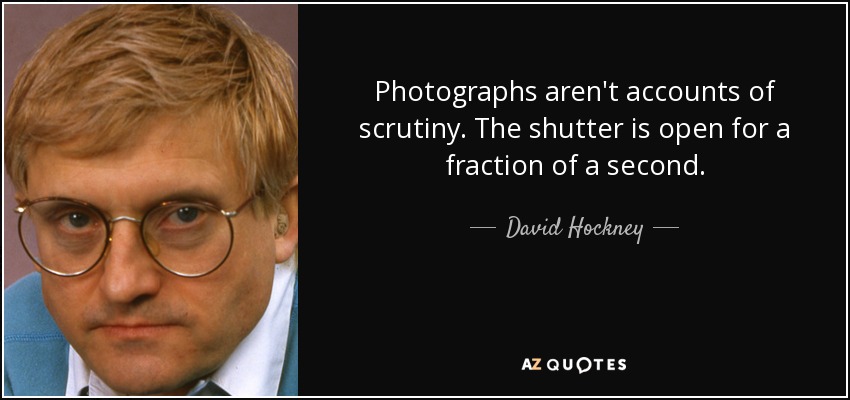
Photographs aren't accounts of scrutiny. The shutter is open for a fraction of a second.
So they all went away from the little log house. The shutters were over the windows, so the little house could not see them go. It stayed there inside the log fence, behind the two big oak trees that in the summertime had made green roofs for Mary and Laura to play under.
He owned an expensive camera that required thought before you pressed the shutter, and I quickly became his favorite subject, round-faced, missing teeth, my thick bangs in need of a trim. They are still the pictures of myself I like best, for they convey that confidence of youth I no longer possess, especially in front of a camera.
On my Instagram, I'm always keeping a record of things being pulled down in Soho and shutters being closed. Every city - and London more than anywhere - has got to be a vibrant mix of all different things. We can't allow it to become a monoculture.
Philologically, the word Kodak is as meaningless as a child's first goo. Terse, abrupt to the point of rudeness, literally bitten off by firm and unyielding consonants at both ends, it snaps like a camera shutter in your face. What more would one ask. (Explaining why he named his company Kodak.)
Photography is a medium of formidable contradictions. It is both ridiculously easy and almost impossibly difficult. It is easy because its technical rudiments can readily be mastered by anyonwith a few simple instructions. It is difficult because, while while the artist working in any other medium begins with a blank surface and gradually brings his conception into being, the photographer is the only imagemaker who begins with the picture completed. His emotions, his knowledge, and his native talent are brought into focus and fixed beyond recall the moment the shutter of his camera has closed.
You have a lifetime to learn technique. But I can teach you what is more important than technique, how to see; learn that and all you have to do afterwards is press the shutter.
The surface of the quieted river, as I think now, is like a window looking into another world that is like this one except that it is quiet. Its quietness makes it seem perfect. The ripples are like the slates of a blind of a shutter through which we see imperfectly what is perfect. Though that other world can be seen only momentarily, it looks everlasting. As the ripples become more agitated, the window darkens and the other world is hidden.the surface of the river is like a living soul, which is easy to disturb, is often disturbed, but, growing calm, shows what it was, is, and will be.
Opening day. All you have to do is say the words and you feel the shutters thrown wide, the room air out, the light pour in. In baseball, no other day is so pure with possibility. No scores yet, no losses, no blame or disappointment. No hangover, at least until the game's over.
Now stir the fire, and close the shutters fast, Let fall the curtains, wheel the sofa around, And while the bubbling and loud-hissing urn Throws up a steamy column, and the cups That cheer but not inebriate, wait on each, So let us welcome peaceful evening in
When hopes and dreams are loose in the streets, it is well for the timid to lock doors, shutter windows and lie low until the wrath has passed. For there is often a monstrous incongruity between the hopes, however noble and tender, and the action which follows them. It is as if ivied maidens and garlanded youths were to herald the four horsemen of the apocalypse .
In a still photograph you basically have two variables, where you stand and when you press the shutter. That's all you have.
Be pleased with your real garden, don't persue the perfection of a picture. What you see in a photo lasted only as long as the shutter snap.
What is truth in photography? It can be told in a hundred different ways. Every thirtieth of a second when the shutter snaps, its capturing a different piece of information.
I learned quickly enough when to click the shutter, but what I was becoming aware of more slowly was a story-writer's truth: The thing to wait on, to reach for, is the moment in which people reveal themselves... I learned from my own pictures, one by one, and had to; for I think we are the breakers of our own hearts.
Every time we click the shutter, it's like a new day, a new chance to make a clean start, to be original. It's a very exciting and exhausting thing to do.
In my years of photography I have learned that many things can be sensed, seen, shaped, or resolved in a realm of quiet, well in advance of, or between, the actual clicking of shutters and the sloshing of films and papers in chemical solutions. I work to attain a state of heart, a gentle space offering inspirational substance that could purify one's vision. Photography, like music, must be born in the unmanifest world of the spirit.
I think essentially if you look at British public debate around the issues of our interconnectedness with the global economy you do not find a ready audience, of any large scale, for pulling up the shutters.
I've always thought of characters like advent calendars. You have Christmas and you have all the little doors over the windows and every day you're allowed to open one more as it gets towards Christmas and you see more and more about what's inside that house.I remember as a kid being fascinated by that and I've always thought of my character as a little bit like that. I like to have secrets and slowly let those secrets out to the audience, sometimes never let them out, but let them see as you open the shutters, open and see a little bit more of a character.
You must photograph where you are involved; where you are overwhelmed by what you see before you; where you hold your breath while releasing the shutter, not because you are afraid of jarring the camera, but because you are seeing with your guts wide open to the sweet pain of an image that is part of your life.
Cinematography was incredibly foreign to me, so I read as much as I could about it. Once I figured out that it was just photography with a set shutter speed, I got some slide film and I just went about storyboarding the script and taking snapshots. I took a ton of time doing it just to make sure I knew exactly what I was doing. By the end of it I knew what the film was going to look like - my exposure and the composition and everything. I wasn't scared of cinematography anymore.
My mom had bought this camera to take classes herself and I remember working with her on it, understanding how the stop-motion [worked], having a high shutter speed and things like that. Long before I picked it up myself, I remember being on a slide at a country club going into the water and wanting my mother to put in on a high shutter speed so she could catch me on the slide without it being blurred. I remember having fun with her: "Let me go on the slide and you'll catch me in motion!" Those are some of the little moments in my artistic making.
The moment when I press the shutter is fantastic, orgasmic, so charged with the hope that this will be a great, original, interesting, and perfectly composed photo. But like any other exciting thing in life, it is usually spoiled by some ridiculous, unpredictable, and annoying detail.
Joy and grief are never far apart. In the same street the shutters of one house are closed, while the curtains of the next are brushed by shadow of the dance. A wedding-party returns from church, and a funeral winds to its door. The smiles and the sadness of life are the tragi-comedy of Shakespeare. Gladness and sighs brighten and dim the mirror he beholds.
I loved to press the shutter, to freeze time, to turn little slices of life into rectangle rife with metaphor.
Follow AzQuotes on Facebook, Twitter and Google+. Every day we present the best quotes! Improve yourself, find your inspiration, share with friends
or simply: