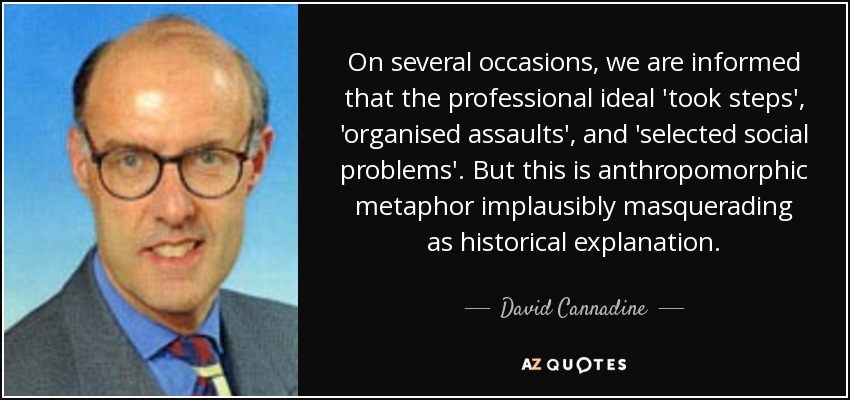
On several occasions, we are informed that the professional ideal 'took steps', 'organised assaults', and 'selected social problems'. But this is anthropomorphic metaphor implausibly masquerading as historical explanation.
As Mazzini said ... it is around the standard of duty rather than around the standard of self-interest that men must rally to win the rights of man. And herein may we see the deep philosophy of Him who bade men love their neighbors as themselves. In that spirit, and in no other, is the power to solve social problems and carry civilization onward.
Based on technological research and the transformation of nature, industrialization constantly goes forward, giving proof of incessant creativity. While certain enterprises develop and are concentrated, others die or change their location. Thus new social problems are created: professional or regional unemployment, redeployment and mobility of persons, permanent adaptation of workers and disparity of conditions in the different branches of industry.
For all the advances in technology, science and communications, there are signs that we are failing in areas where it matters most: our personal relationships and society in general. The atomisation of society evidenced by the startling increase in recent decades of single person households and the identification of loneliness and isolation as one of our most pressing new social problems, should give us cause for concern.
Every novel deals with social problems. It can't help it because the protagonist must come in conflict with his group. So the author has to offer an analysis of how the group and the protagonist fit. Otherwise, the reader will just say, "This makes no sense," and will put it away.
Under the notion that unregulated market-driven values and relations should shape every domain of human life, the business model of governance has eviscerated any viable notion of social responsibility while furthering the criminalization of social problems and cutbacks in basic social services, especially for the poor, young people and the elderly.
Perhaps I can also add something about the rural setting of Remember You're a One-Ball! The countryside is a place - in mythological and perhaps in very real terms - of mixed innocence and sin. It is seen by townsfolk as idyllic, lazy, free of urban crime and social problems. But those who grow up in the country can tell stories that often surprise those who grow up in the towns.
Reductionist ideology not only hinders biologists from thinking adequately about the phenomena we wish to understand: it has two important social consequences: it serves to relocate social problems to the individual rather than exploring the societal roots and determinants of a phenomenon; and second, it diverts attention and funding from the social to the molecular.
I see being a woman in the world as a social problem. That's very urgently problematic in terms of it still being a man's world, and women's identities still being shaped by the way men look at them, and the way men can control what kinds of opportunities they can get based on how desirable the men find them, or how compliant. I don't think that's really changed a lot.
I used to watch 10 hours of television a night, my entire childhood. And I don't think it did all good things to me. I certainly still have social problems that are a result of being in my room alone too much.
I like developing characters who I find to have interesting psychology. Like politics and sex, but I'm really looking at bigger social problems that interest me, and that I can obsess over for a while.
If you happen to live in Korea, you might always suffer from anger towards people in power, because of political and social problems. I felt gloomy under this social dictatorship. Looking back, I feel like I never saw a sunrise in Seoul.
Many people just won't connect the social problems with the history of dispossession of the aboriginals. There is one problem with pro-Palestinian activists in Europe and the U.S. with the way they portray Israel as though it were an island of evil in an ocean of goodwill. Unfortunately we are not. This world is not made of benign, progressive states with Israel as the one exception.
Currently, U.S. society has been encouraged by its political and subsidized mass-media intelligentsia to view U.S. life as a continual "morning in America" paradise, where the only social problems occur in the inner cities. Psychologists call this denial.
If you happen to live in Korea, you might always suffer from anger towards people in power, because of political and social problems. I felt gloomy under this social dictatorship. Looking back, I feel like I never saw a sunrise in Seoul. When I was at university, the policemen used to measure how short the women's mini-skirts were and how long guys' hair was. We were living under a government that considers her people to be soldiers.
South Africans have no concept of time and this is also why we can't solve poverty and social problems… It's now 10 years since the fall of the Apartheid government and we cannot blame Apartheid for being tardy.
Stairway to Wisdom”) David Brooks detailed the needed ingredients to gaining a deep understanding of a social problem, beginning with the data and moving on to first-hand accounts. The highest rung on his stairway, though, went beyond those: “Empathy opens you up to absorb the good and the bad. Love impels you not just to observe but to seek union—to think as another thinks and feel as another feels.
The physicians are the natural attorneys of the poor, and the social problems should largely be solved by them.
Gangsta rap often reaches higher than its ugliest, lowest common denominator, misogyny, violence, materialism and sexual transgression are not its exclusive domain. At its best, this music draws attention to complex dimensions of ghetto life ignored by most Americans. Indeed, gangsta rap's in-your-face style may do more to force America to confront crucial social problems than a million sermons or political speeches.
The idea that the State is capable of solving social problems is now viewed with great skepticism - which foretells a coming change. As soon as skepticism is applied to the State, the State falls, since it fails at everything except increasing its power, and so can only survive on propaganda, which relies on unquestioning faith.
If we expected self-reliance of family groups, if we expected hardiness and resilience and initiative on the part of individuals, and if we rewarded initiative instead of dependence on government, we would not only ameliorate many of the family-related social problems we see at present, but we would also reduce our vulnerability to terrorism. People who are hardy, resilient, and self reliant are a lot harder to terrorize.
One of the most fashionable notions of our times is that social problems like poverty and oppression breed wars. Most wars, however, are started by well-fed people with the time on their hands to dream up half-baked ideologies or grandiose ambitions, and to nurse real or imagined grievances.
We know, for instance, that there is a direct, inverse relationship between frequency of family meals and social problems. Bluntly stated, members of families who eat together regularly are statistically less likely to stick up liquor stores, blow up meth labs, give birth to crack babies, commit suicide, or make donkey porn. If Little Timmy had just had more meatloaf, he might not have grown up to fill chest freezers with Cub Scout parts.
Now a Protestant confronting a Catholic ghost is exactly Shakespeare's way of grappling with what was not simply a general social problem but one lived out in his own life.
When the Promise of American life is conceived as a national ideal, whose fulfillment is a matter of artful and laborious work, the effect thereof is substantially to identify the national purpose with the social problem.
Follow AzQuotes on Facebook, Twitter and Google+. Every day we present the best quotes! Improve yourself, find your inspiration, share with friends
or simply: