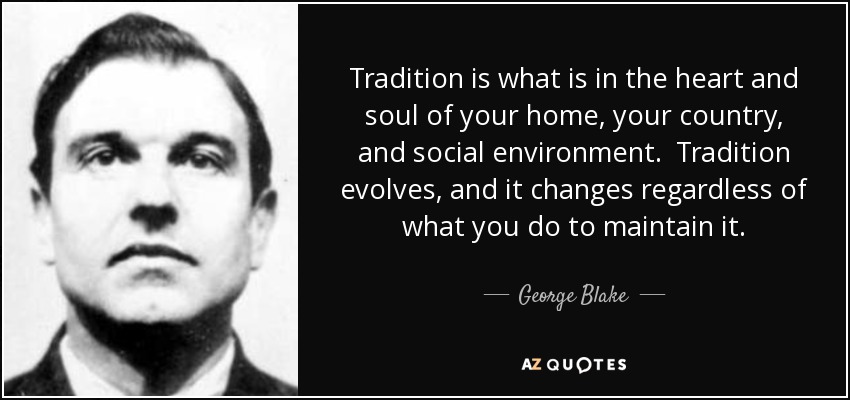
Tradition is what is in the heart and soul of your home, your country, and social environment. Tradition evolves, and it changes regardless of what you do to maintain it.
We need to reverse three centuries of walling the for-profit and non-profit sectors off from one another. When you think for-profit and non-profit, you most often think of entities with either zero social return or zero return on capital and zero social return. Clearly, there's some opportunity in the spectrum between those extremes. What's missing is the for-profit finance industry coming in to that area. Look at the enormous diversity of the for-profit financial industry as opposed to monolithic nature of the non-profit world; it's quite astonishing.
Humans socialize in the largest groups of all primates because we are the only animals with brains large enough to handle the complexities of that social arrangement.
The Rule of 150 says that congregants of a rapidly expanding church, or the members of a social club, or anyone in a group activity banking on the epidemic spread of shared ideals needs to be particularly cognizant of the perils of the bigness. Crossing the 150 line is a small change that can make a big difference.
We think of Craigslist as a form of Social Media.We provide a simple service that is mostly free and we leave money in the community, instead of taking it away. Shared values, nothing fancy, treating people like we want to be treated. What works on the net works for people in general. The net has very little to do with technology, what matters is how people use the technology.
There is nothing wrong with being well off as long as money has a social and ethical value and is not the object of one's own greed.
Villages are small and personal, and their inhabitants have names, characters, and personalities. What more appropriate concept on which to base our institutions of the future than the ancient social unit whose flexibility and strength substained human society through millenia?
Man is more social within than without.
I'm outgoing. I like being social. But when I think I should be quiet, I am. And I don't think quiet is the right word. Respectful is more accurate. I want to be respectful of people and their space.?
All of us are subject to being passive to the social ills around us. It's a struggle not to become, by staying silent, an accomplice.
The divine science of government is the science of social happiness, and the blessings of society depend entirely on the constitutions of government.
Competing against each other leaves little space for reciprocity and the growth of social capital. Running against another in a race may benefit our speed, but jointly organising the sports day produces cooperation and trust. There are many situations where cooperation and reciprocity are more effective than competition. Civic virtues come from building on what we have in common rather than by using our differences to create in-groups, outgroups and fear driven competition
Self abuse is anti-social, aggression still natural.
Religion is a disease. It is born of fear; it compensates through hate in the guise of authority, revelation. Religion, enthroned in a powerful social organization, can become incredibly sadistic. No religion has been more cruel than the Christian.
Evolution is always the work of pioneers, and their followers are always small in number. This following is not a clique; it is the result of all the existing social forces; it is composed of all those who through innate or acquired capacity are ready to represent the existing degree of human revolution.
All failures are so because they lack social interest.
I can't help but react to the painful realities of the two-tiered society we live in, where the signs of poverty and inequity are everywhere. Almost twenty five percent of our children live at or below the poverty line. We expect the no-option life cycle of the poor to be interrupted by the weak social safety net and then wonder why building more jails doesn't solve the problems.
One of the great ironies of the social media era is that some of the least social people in the world created it.
I am drawn, as a reader, to detail-drenched stories about human lives affected as much by the internal as by the external, the kind of fiction that Jane Smiley nicely describes as 'first and foremost about how individuals fit, or don't fit, into their social worlds.'
We have reached a crossroads in human evolution where the only road which leads forward is towards a common passion. . . To continue to place our hopes in a social order achieved by external violence would simply amount to our giving up all hope of carrying the Spirit of the Earth to its limits.
There's some people who are just very dynamic about social life, and it can be some pretty crazy stuff, but you end up meeting people you like.
I have lived through the best years of this country's history. The next generations are going to see war and social calamities. I am glad I don't have to live on into them.
[While] physically traveling someplace or experiencing someplace firsthand, physically versus - which is what a lot of young people do - the experience is mitigated through technology and through social media.
....there are three prerequisites to going out into the world to walk for pleasure. One must have free time, a place to go, and a body unhindered by illness or social restraints.
Collectivism takes on many guises and seldom uses its own real name. Words like 'community' and 'social' soothe us into thinking that collectivist decision-making is somehow higher and nobler than individual or 'selfish' decision-making. But the cold fact is that communities do not make decisions. Individuals who claim to speak for the community impose their decisions on us all.
Follow AzQuotes on Facebook, Twitter and Google+. Every day we present the best quotes! Improve yourself, find your inspiration, share with friends
or simply: