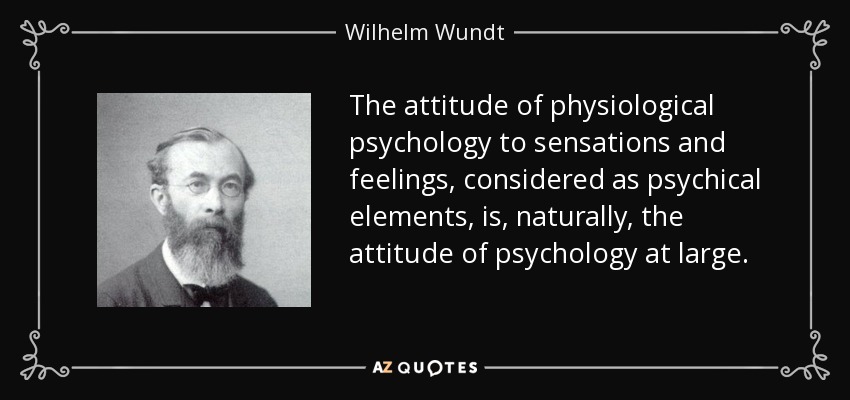
The attitude of physiological psychology to sensations and feelings, considered as psychical elements, is, naturally, the attitude of psychology at large.
But insensate Time is nothing if not cruel and heartless. It corrodes then destroys, so that the man you literally and figuratively looked up to with your chubby face, who scooped you up to cross the street and patted you on the head to laughter, will later look through you from a crooked hospital bed then blindly up at you while wearing makeup in a bargain casket. The people who now surround you generating warmth will disappear leaving only an empty chill; the body you own and the brain it houses will malfunction.
We are mindful of desire when we experience it with an embodied awareness, recognizing the sensations and thoughts of wanting as arising and passing phenomena. While this isn't easy, as we cultivate the clear seeing and compassion of Radical Acceptance, we discover we can open fully to this natural force, and remain free in its midst.
The singular point of beautiful objects, and people, is that they are experienced not as parts, or ratios between cheekbones and chin, but as wholes. The experience of beauty is a perception, but it is one that mixes up various other sensations and makes them converge in a particular way.
Knowledge, the object of knowledge and the knower are the three factors which motivate action; the senses, the work and the doer comprise the threefold basis of action.
Few of us have lost our minds, but most of us have long ago lost our bodies.
Acting for screen is very different from acting on stage, and then obviously when you dance... everything is a physical embodiment. But the discipline is the same approach. You have to take both things seriously; nothing well-crafted is by mistake.
Touch is the mother of the senses. Not only are women more sensitive when they touch, but they're also more sensitive to being touched.
Mindfulness helps us freeze the frame so that we can become aware of our sensations and experiences as they are, without the distorting coloration of socially conditioned responses or habitual reactions.
The thirst for powerful sensations takes the upper hand both over fear and over compassion for the grief of others.
We don't know where our first impressions come from or precisely what they mean, so we don't always appreciate their fragility.
Mental states of every kind, - sensations, feelings, ideas, - which were at one time present in consciousness and then have disappeared from it, have not with their disappearance absolutely ceased to exist.
Energy is eternal delight.
The plain man is familiar with blindness and deafness, and knows from his everyday experience that the look of things is influenced by his senses; but it never occurs to him to regard the whole world as the creation of his senses.
The task of physiological psychology remains the same in the analysis of ideas that it was in the investigation of sensations: to act as mediator between the neighbouring sciences of physiology and psychology.
The mind is inherently embodied. Thought is mostly unconscious. Abstract concepts are largely metaphorical.
At present, I am mainly observing the physical motion of mountains, water, trees and flowers. One is everywhere reminded of similar movements in the human body, of similar impulses of joy and suffering in plants.
There is no perfect knowledge which can be entitled ours, that is innate; none but what has been obtained from experience, or derived in some way from our senses.
Philosophy is common sense with big words.
How individuals of the same species surpass each other in these sensations and in other bodily faculties is universally known, but there is a limit to them, and their power cannot extend to every distance or to every degree.
Every decently-made object, from a house to a lamp post to a bridge, spoon or egg cup, is not just a piece of 'stuff' but a physical embodiment of human energy, testimony to the magical ability of our species to take raw materials and turn them into things of use, value and beauty.
Favor comes because for a brief moment in the great space of human change and progress some general human purpose finds in him a satisfactory embodiment.
When the shriveled skin of the ordinary is stuffed out with meaning, it satisfies the senses amazingly.
If the clockwork universe equated the human body with the mechanics of the clock, the digital universe now equates human consciousness with the processing of the computer. We joke that things don't compute, that we need a reboot, or that our memory has been wiped.
The human body and mind are tremendous forces that are continually amazing scientists and society. Therefore, we have no choice but to keep an open mind as to what the human being can achieve.
Follow AzQuotes on Facebook, Twitter and Google+. Every day we present the best quotes! Improve yourself, find your inspiration, share with friends
or simply: