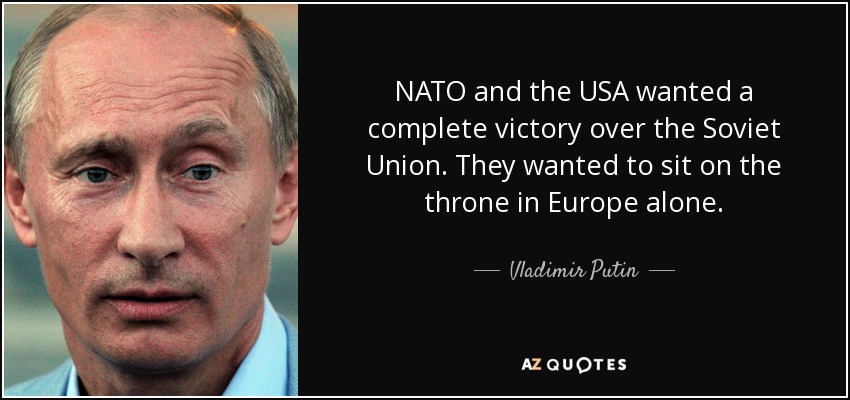
NATO and the USA wanted a complete victory over the Soviet Union. They wanted to sit on the throne in Europe alone.
Nowadays, there are plans to separate the Baltic states from the common power system of the former Soviet Union and to integrate them into the European system. What does it mean for us in practice? In practice, it means that a number of zones will emerge between several regions of the Russian Federation, where we will have no power transmission lines, since previously we used to have a loop transition through the Baltic countries.
Growing up, I didn't know very much about my heritage and the Soviet Union and things of that nature. But when I saw the Soviet Union play hockey for the first time, to me, it was profound.
There is no way to avoid the reality that the American government in the past years has been the most spectacularly hypocrisy-driven government in the world. We rival the Soviet Union in some stages, in some ways, in hypocrisy.
In the West, since the collapse of communism and the fall of the Soviet Union, the one discipline both the official and unofficial cultures have united in casting aside has been history.
I certainly wouldn't say that we loved the arms race. Trillions of dollars were used to stoke it. For our economy, which was smaller in size than the American economy, it was a burden. But one cannot agree with the statement that the arms race played the key role in the collapse of the Soviet Union.
Ronald Reagan reignited the American economy, rebuilt the Military, bankrupted the Soviet Union and defeated Soviet Communism. I will do the same thing.
If you go through all the structures and features of this emerging European monster you will notice that it more and more resembles the Soviet Union.
It is sometimes said that one of the casualties of the general suspicion and mistrust that permeated the old Soviet Union was that the distinction between truth and other motivations to believe tended to break down. Upon hearing a purported piece of information, the reaction was not 'Is this true?' but 'Why is this person saying this? - What machinations or manipulations are going on here?' The question of truth did not, as it were, have the social space in which it could breath.
Japan's diplomatic efforts could have had a broader international perspective. Relations with the U.S. are, of course, the cornerstone of Japan's diplomacy, but the U.S. acts on its global strategy. For instance, Washington suddenly got closer to China in the early 1970s as part of its strategy against the Soviet Union.
We had in the West a very romantic vision of Russia back in 1991, when the Soviet Union died and whatever is Russia began to emerge. And we began to think of it as a democracy. We're going to bring it into the West. All is going to be wonderful. That was never in the cards.
When you think of power, you think the state has power. When you look at it in terms of revolution, in terms of the state, you think of it in terms of Russia, the Soviet Union, and how those who struggled for power actually became victims of the state, prisoners of the state, and how that led to the dissolution of the Soviet Union. We have to think of revolution much more in terms of transitions from one epoch to another. Talk about Paleolithic and Neolithic.
Of course, socialism is just evil now. It's completely discredited supposedly by the collapse of the Soviet Union, but I can't help noticing that my grandchildren are heavily in hock to Communist China now which is evidently a whole lot better at business than we are.
When I looked into the story of Soviet hockey and its players, I realized that it has nothing to do with hockey. It was a larger story using hockey as a window into the story of the rise and fall of the Soviet Union, the Russian people, with friendships and betrayals, paranoia and oppression, and the meaning of sports to people and nations around the world, and how sports was used as a political tool.
Soviet Union foreign policy is a puzzle inside a riddle wrapped in an enigma, and the key is Russian nationalism.
25 million of Russian people suddenly turned out to be outside the borders of the Russian Federation. They used to live in one state; the Soviet Union has traditionally been called Russia, the Soviet Russia, and it was the great Russia. Then the Soviet Union suddenly fell apart, in fact, overnight, and it turned out that in the former Soviet Union republics there were 25 million Russians. They used to live in one country and suddenly found themselves abroad. Can you imagine how many problems came out?
What I found interesting about Slava Fetisov was that he went through three different generations of Soviet hockey. In the late 70's, he experienced the Miracle on Ice, and then in the 80's became with his teammates the Russian Five, the most dominant team in the history of hockey, and then helped bring down the hockey system when the Soviet Union collapsed and became one of the first players to play in the NHL, and then ultimately came back to Russia.
There (in the Soviet Union) it was a science. In order to be a coach, you had to study in school.
Why were the Europeans bothered about the Soviet Union at all? It was nothing to do with us. China had nothing to do with us. Why were we not building, without reference to the Soviet Union, a good society in our own countries? But no, we were all - in one way or another - obsessed with the bloody Soviet Union, which was a disaster. What people were supporting was failure. And continually justifying it.
The Russian revolution did not occur until a generation after Marx's death. He was not involved with it, or with what came after it. His works do not describe post-capitalist society, and a fortiori they do not recommend any part of what the Soviet Union did.
It shall be the policy of this nation to regard any nuclear missile launched from Cuba as an attack by the Soviet Union on the United States.
My parents are from the former Soviet Union, from Ukraine, and I grew up wanting to be a professional hockey player.
The Soviet Union is going to have a human-rights explosion. You'll have hundreds of thousands of dissidents.
One ironic thing is that although (the Soviet Union) was one of the most oppressive systems, with no respect for the individual, it somehow produced the freest hockey on the planet. These guys, when they got on the ice, it was like watching jazz. They could do anything. I find that a paradox. It's interesting because I think the North American style was a lot less free. It was not encouraged to be creative.
In the past, foreign intervention was obviously a major problem. Foreign domination, or if not domination, interference. But that has ended. There is no foreign domination; there is minimal foreign interference. The Cold War has ended. The Soviet Union no longer exists. The United States is showing minimal and diminishing interest in the Muslim world. They now have to confront their own problems. The old excuses are gone. The old justifications are gone and therefore the anger of people is turning increasingly against their own rulers.
Follow AzQuotes on Facebook, Twitter and Google+. Every day we present the best quotes! Improve yourself, find your inspiration, share with friends
or simply: