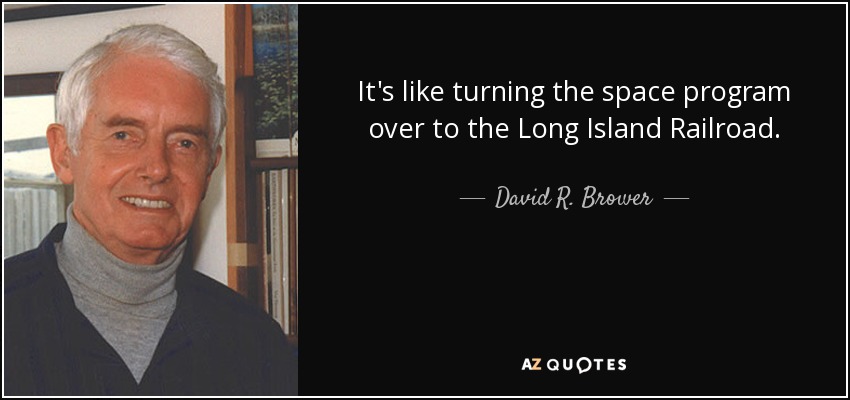
It's like turning the space program over to the Long Island Railroad.
But even in elementary school and junior high, I was very interested in space and in the space program.
'Anthony and the Magic Picture Frame' tells it like it really was in America's early space program - the adventure, the risks, and the rewards.
Asteroids have us in our sight. The dinosaurs didn't have a space program, so they're not here to talk about this problem. We are, and we have the power to do something about it. I don't want to be the embarrassment of the galaxy, to have had the power to deflect an asteroid, and then not, and end up going extinct.
The urge to miniaturize electronics did not exist before the space program. I mean our grandparents had radios that was furniture in the living room. Nobody at the time was saying, 'Gee, I want to carry that in my pocket.' Which is a non-thought.
(Space programs are) a force operating on educational pipelines that stimulate the formation of scientists, technologists, engineers and mathematicians... They're the ones that make tomorrow come. The foundations of economies... issue forth from investments we make in science and technology.
If we die, do not mourn for us. This is a risky business we're in, and we accept those risks. The space program is too valuable to this country to be halted for too long if a disaster should ever happen.
I've led a life of such structured discipline and always had a goal in mind of knowing what I was doing, from West Point to the Air Force combat, MIT, looking for new things to study and get involved in. And then I got into the space program, and how disciplined can you get?
The inspirational value of the space program is probably of far greater importance to education than any input of dollars... A whole generation is growing up which has been attracted to the hard disciplines of science and engineering by the romance of space.
I suspect that even though the various questions are difficult and many, they are not as difficult and many as those we faced when we started the Apollo [space program] in 1961.
I think in the long run the money that s been put into the space program is one of the best investments this country has ever made . . .This is a downpayment on the future of mankind. It's as simple as that.
A reflection of my feelings about the space program is found in a quotation from Charles A. Lindbergh's "Autobiography of Values." It reads, "Whether outwardly or inwardly, whether in space or time, the farther we penetrate the unknown, the vaster and more marvelous it becomes."
Women are strong, strong, terribly strong. We don't know how strong until we are pushing out our babies. We are too often treated like babies having babies when we should be in training, like acolytes, novices to high priestesshood, like serious applicants for the space program.
I've always loved airplanes and flight. The space program was really important to me as a kid. I still have a photo of Armstrong and Aldrin on the moon in my living room.
The value of the space program is beyond science, it's beyond military; it's a cultural shift in how we think of our place in the universe.
I'm hoping that the suspension of the space program is just that, a suspension, and that it's not the final say in the matter, because I think we need it.
One of my first experiences with the space program was with the memorial that was built for the Challenger. When I was in 7th grade my entire class spent the entire school year preparing to launch a spaceship all together. We all had our different jobs that we had to learn how to do, we learned the math that you needed, we learned the practical skills that you needed, and I thought that was really cool. So I think that if you can take a tragedy and find the gold in it and turn it into something positive, that's great.
If I could get one message to you it would be this: the future of this country and the welfare of the free world depends upon our success in space. There is no room in this country for any but a fully cooperative, urgently motivated all-out effort toward space leadership. No one person, no one company, no one government agency, has a monopoly on the competence, the missions, or the requirements for the space program.
The greatest fallout of the space program, ... was not the close-up view of the moon, but a look at spaceship Earth from afar. For the first time in the history of humanity, we were able to see our planet for what it really is.
I grew up watching a lot of the coverage of the early U.S. space program, all the way back starting with Mercury and then through Gemini and Apollo and of course going to the moon as the main part of the Apollo program.
Evolution doesn't care whether you believe in it or not, no more than gravity does. I want to rekindle excitement over what we've achieved as a species with the space program. We can't afford to regress back to the days of superstition.
If you could really guarantee that the money would be spent on something more worthwhile, I'd say, absolutely, scrap the space program, but it never works that way.
Since the Columbia accident, the Russian space agency, or the Russian space program, has been literally carrying the load bringing us all the supplies we need on the Progress vehicle, smaller amounts on the Soyuz vehicles.
To use a Southern euphemism, our space program has been snake-bit.
NASA is moving the space program to Starkville because it has no atmosphere.
Follow AzQuotes on Facebook, Twitter and Google+. Every day we present the best quotes! Improve yourself, find your inspiration, share with friends
or simply: