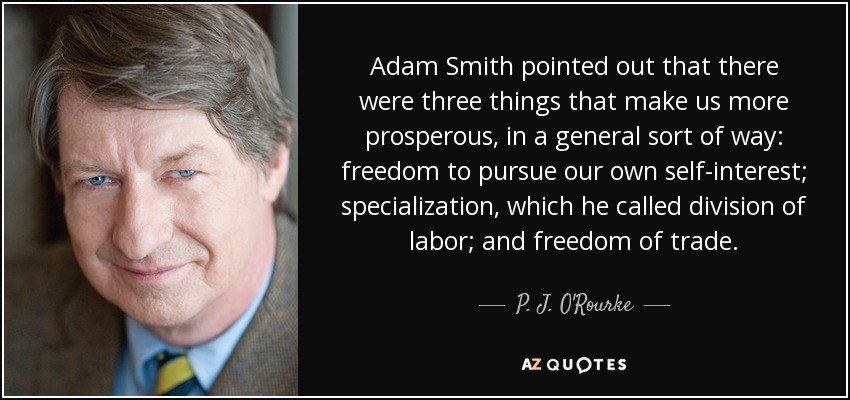
Adam Smith pointed out that there were three things that make us more prosperous, in a general sort of way: freedom to pursue our own self-interest; specialization, which he called division of labor; and freedom of trade.
But while I accept specialization in the practice, I reject it utterly in the theory of science.
In 1600 the specialization of games and pastimes did not extend beyond infancy; after the age of three or four it decreased and disappeared. From then on the child played the same games as the adult, either with other children or with adults. . . . Conversely, adults used to play games which today only children play.
It is an ancient belief, going back to classical antiquity, that specialization of any kind is illiberal in a freeman. A man willing to bury himself in the details of some small endeavor has been considered lost to these larger considerations which must occupy the mind of the ruler.
contempt for the degradation of specialization and pedantry. Specialization develops only part of a man; a man partially developed is deformed.
How could any entrepreneur, confronted by such amazing opportunities to help transform the world and to do so with such extraordinary colleagues, be tempted to lose focus? Especially since the work involves such breadth that the boredom of routine or specialization does not exist.
The history of clothing practices provides guidance for fashioning a new ethic that emphasizes quality over quantity, longevity over novelty, and versatility over specialization. With such an ethic, consumers would demand a shift toward more timeless design, away from fast-moving trends. Clothes could become more versatile in terms of what they can be used for, their ability to fit differently shaped bodies and to be altered.
The daily grinding of evolution, as accelerated by technology, churns out more and more complex organisms, with higher rates of energy use, and with increasing specialization. Minds are the ideal way to express complexity, energy density, increasing specialization, expanding diversity -- all in one system. Mindedness is what evolution produces. Mindedness is what technology wants, too.
We are lucky in the United States to have our liberal arts system. In most countries, if you go to university, you have to decide for all English literature or no literature, all philosophy or no philosophy. But we have a system that is one part general education and one part specialization. If your parents say you've got to major in computer science, you can do that. But you can also take general education courses in the humanities, and usually you have to.
We know the "great men" and a handful of heavily cited papers in our specialization. When there is a historical frame around a paper it's often a caricature that has become canonical.
The standardization and specialization of industrialization was being undermined by globalization. When people in Bangladesh could produce things much more cheaply than anybody could produce them in Detroit, we no longer were the world capital of industrialization.
We think of history as another specialization, like philosophy of language, rather than as something that informs everything we do and think.
The modern spirit is a hesitant one. Spontaneity has given way to cautious legalisms, and the age of heroes has been superseded by a cult of specialization. We have no more giants; only obedient ants.
The greatest cost of the specialization of technological life - and out of which all other damages are birthed - is arguably our separation from the practical and enriching sense of ourselves as embodied beings. When we are alienated from the wisdom of the body, our lives become theoretical and abstract, and we are distanced from the direct, felt sense of living.
There are divisions between a culinary chef and a dessert chef, also called a pastry chef. There are specializations within the pastry chef field. Some pastry chefs specialize in baking breads, while others are master cake designers. Each field requires an exceptional level of creativity and attention to detail.
The average student emerges at the end of the Ph.D. program, already middle-aged, overspecialized, poorly prepared for the world outside, and almost unemployable except in a narrow area of specialization. Large numbers of students for whom the program is inappropriate are trapped in it, because the Ph.D. has become a union card required for entry into the scientific job market.
Specialization breeds biases that ultimately aggregate as international and ideological discord, which, in turn, leads to war.
All research in the cultural sciences in an age of specialization, once it is oriented towards a given subject matter through particular settings of problems and has established its methodological principles, will consider the analysis of the data as an end in itself.
There must be bands of enthusiasts for everything on earth-fanatics who shared a vocabulary, a batch of technical skills and equipment, and, perhaps, a vision of some single slice of the beauty and mystery of things, of their complexity, fascination, and unexpectedness.
We develop all our sciences, archeology, cosmology, psychology, we tabulate and classify and cling to our sacred definitions, our divisions, without any attempt to synthesis, without the humility to see that these are only parts of a total knowledge. ... But somehow we ought to be able to keep the idea of the totality of experience and knowledge at the back of our minds even though the front's busy from morning til night with the life cycle of the liver fluke.
Truth and Truthfulness is an ambitious work, and its journeys into history give it a breadth unusual in these days of increased academic specialization. . . . William's book combines real history and fictional constructs to tell a revealing story that makes us reconsider the meaning of familiar concepts.
If it is to be effective as a tool of thought, a notation must allow convenient expression not only of notions arising directly from a problem, but also of those arising in subsequent analysis, generalization, and specialization.
When profits are pursued by geographic interchange of goods, so that commerce for profit becomes the central mechanism of the system, we usually call it "commercial capitalism." In such a system goods are conveyed from ares where they are more common (and therefore cheaper) to areas where they are less common (and therefore less cheap). This process leads to regional specialization and to division of labor, both in agricultural production and in handicrafts.
Let us admit that most of us writers feel an essential aversion to politics. By taking such a position, however, we accept the perverted principle of specialization, according to which some are paid to write about the horrors of the world and human responsibility and others to deal with those horrors and bear the human responsibility for them.
Literacy, the visual technology, dissolved the tribal magic by means of its stress on fragmentation and specialization and created the individual.
Follow AzQuotes on Facebook, Twitter and Google+. Every day we present the best quotes! Improve yourself, find your inspiration, share with friends
or simply: