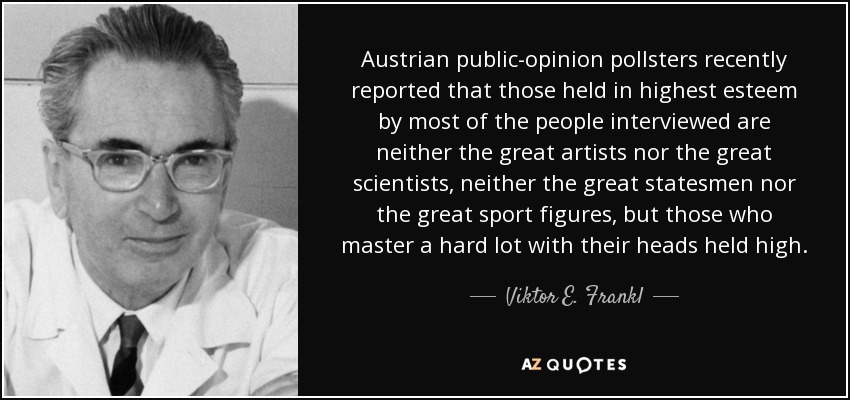
Austrian public-opinion pollsters recently reported that those held in highest esteem by most of the people interviewed are neither the great artists nor the great scientists, neither the great statesmen nor the great sport figures, but those who master a hard lot with their heads held high.
I wonder if you encountered this dictum first spoken by a twentieth-century statesman: "An abyss cannot be crossed in two steps.
The role of the scholar is to destroy chimeras, that of the statesman is to make use of them.
History shows that great economic and social forces flow like a tide over communities only half conscious of that which is befalling them. Wise statesmen foresee what time is thus bringing, and try to shape institutions and mold men's thoughts and purposes in accordance with the change that is silently coming on. The unwise are those who bring nothing constructive to the process, and who greatly imperil the future of mankind by leaving great questions to be fought out between ignorant change on one hand and ignorant opposition to change on the other.
Viewed from the genuine abolition ground, Mr. Lincoln seemed tardy, cold, dull, and indifferent; but measuring him by the sentiment of his country, a sentiment he was bound as a statesman to consult, he was swift, zealous, radical, and determined.
There are certain basic principles regarding the proper role of government. If principles are correct, then they can be applied to any specific proposal with confidence... The true statesman values principle above popularity, and works to create popularity for those political principles which are wise and just.
Warned by the disaster of the last great war, the statesmen of all nations have been taking measures to prevent the return of another such calamity.
Whatever the world thinks, he who hath not much meditated upon God, the human soul, and the summum bonum, may possibly make a thriving earthworm, but will most indubitably make a sorry patriot and a sorry statesman.
If you have a grateful heart (which is a miracle amongst you statesmen), show it by directing the bearer to the best wine in town, and pray let not this highest point of sacred friendship be performed slightly, but go about it with all due deliberation and care, as holy priests to sacrifice, or as discreet thieves to the wary performance of burglary and shop-lifting. Let your well-discerning palate (the best judge about you) travel from cellar to cellar and then from piece to piece till it has lighted on wine fit for its noble choice and my approbation.
Viewing the man from the genuine abolitionist ground, Mr. Lincoln seemed cold, tardy, weak and unequal to the task. But, viewing him from the sentiments of his people, which as a statesman he was bound to respect, then his actions were swift, bold, radical and decisive. Taking the man in the whole, balancing the tremendous magnitude of the situation, and the necessary means to ends, Infinite Wisdom has rarely sent a man into the world more perfectly suited to his mission than Abraham Lincoln.
He has given ample evidence of qualities hardly any other living statesman has demonstrated to the same degree: the courage to look facts in the face and to seek flexible solutions, respect for others, give-and-take in dialog situations, absence of hypocrisy, a complete absence of grandeur in the conduct of his personal life. He has never been driven by blind self-assertion to make absurd decisions.
The opposition is indispensable. A good statesman, like any other sensible human being, always learns more from his opponents than from his fervent supporters. For his supporters will push him to disaster unless his opponents show him where the dangers are. So if he is wise he will often pray to be delivered from his friends, because they will ruin him. But though it hurts, he ought also to pray never to be left without opponents; for they keep him on the path of reason and good sense.
On September 17, 1914, Erzberger, the well-known German statesman, an eminent member of the Catholic Party, wrote to the Minister of War, General von Falkenhayn, "We must not worry about committing an offence against the rights of nations nor about violating the laws of humanity. Such feelings today are of secondary importance"? A month later, on October 21, 1914, he wrote in Der Tag, "If a way was found of entirely wiping out the whole of London it would be more humane to employ it than to allow the blood of A SINGLE GERMAN SOLDIER to be shed on the battlefield!"
A man who is a politician at forty is a statesman at three score and ten. It is at this age, when he would be too old to be a clerk or a gardener or a police-court magistrate, that he is ripe to govern a country.
It is seldom that statesmen have the option of choosing between a good and an evil.
Those who see and observe kings, heroes, and statesmen, discover that they have headaches, indigestion, humors and passions, just like other people; every one of which in their turns determine their wills in defiance of their reason.
Thus I live in the world rather as a Spectator of mankind, than as one of the species, by which means I have made myself a speculative statesman, soldier, merchant, and artisan, without ever meddling with any practical part of life.
It will not be any European statesman who will unite Europe: Europe will be united by the Chinese.
Some statesmen go to Congress and some go to jail. It is the same thing, after all.
Statesman only talk of fate when they have blundered
[Among the books he chooses, a statesman] ought to read interesting books on history and government, and books of science and philosophy; and really good books on these subjects are as enthralling as any fiction ever written in prose or verse.
The great events of history are often due to secular changes in the growth of population and other fundamental economic causes, which, escaping by their gradual character the notice of contemporary observers, are attributed to the follies of statesmen or the fanaticism of atheists .
The great genius does not let his work be determined by the concrete finite conditions that surround him, whilst it is from these that the work of the statesman takes its direction and its termination. ... It is the genius in reality and not the other who is the creator of history, for it is only the genius who is outside and unconditioned by history.
Whatever statesman or sage will effect reforms upon a gigantic or godlike scale must begin with the young.
Statesmen remember things selectively.
Follow AzQuotes on Facebook, Twitter and Google+. Every day we present the best quotes! Improve yourself, find your inspiration, share with friends
or simply: