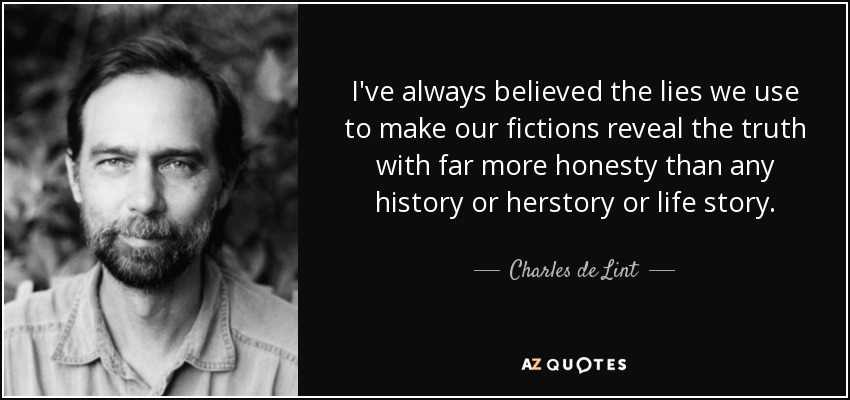
I've always believed the lies we use to make our fictions reveal the truth with far more honesty than any history or herstory or life story.
The only real reason for self-referencing is the fun factor. It's fun for the writer, getting little peeks at what old characters might be up to. And it's fun for readers to spot a familiar face, or pick up on a made-up book title or something from an earlier story. I don't know that it does -- or even should -- contribute to the story in hand being any better than it would have been without it.
For those that have said I seemed dickish to some of the nuttier guests on Joe Rogan Questions Everything - guilty as charged. As the season wore on I lost my patience with some of those folks unfortunately. I think I overdosed on ridiculous/likely fake stories. I certainly learned a lot about the kind of people that invest a large portion of their life on fringe subjects - they're all white. I think there's something interesting about the subjects, (UFOS, etc) but the study of them has often been overrun by silly thinking.
Every great story deserves a great ending
Most of my stuff is just a series of false leads. I'll approach a story as a subject and then make a whole bunch of different runs at the lead. They're all good writing but they don't connect. So I end up having to string leads together.
As for 'story' I never yet did enjoy a novel or play in which someone didn't tell me afterward that there was something wrong with the story, so that's going to be no drawback as far as I'm concerned. "Good Lord, why am I so bored" "I know; it must be the plot developing harmoniously." So I often reply to myself, and there rises before me my special nightmare that of the writer as craftsman, natty and deft.
The story does what no theorem can quite do. It may not be "like real life" in the superficial sense: but it sets before us an image of what reality may well be like at some more central region.
Of course all children's literature is not fantastic, so all fantastic books need not be children's books. It is still possible, even in an age so ferociously anti-romantic as our own, to write fantastic stories for adults: though you will usually need to have made a name in some more fashionable kind of literature before anyone will publish them.
What do my science fiction stories have in common with pornography? Fantasies of an impossibly hospitable world, I'm told.
I should say that, in addition to my tree-love (it was originally called The Tree), it arose from my own pre-occupation with the Lord of the Rings, the knowledge that it would be finished in great detail or not at all, and the fear (near certainty) that it would be 'not at all'. The war had arisen to darken all horizons. But no such analyses are a complete explanation even of a short story.
Though my short stories are the more readable, my novels do have more to say; and they will, if anyone has the patience for it, repay a rereading.
The best time to write a story is yesterday. The next best time is today.
If all stories are fiction, fiction can be true -- not in detail or fact, but in some transformed version of feeling. If there is a memory of paradise, paradise can exist, in some other place or country dimensionally reminiscent of our own. The sad stories live there too, but in that country, we know what they mean and why they happened. We make our way back from them, finding the way through a bountiful wilderness we begin to understand. Years are nothing: Story conquers all distance.
The word 'risk' derives from the early Italian risicare, which means 'to dare'. In this sense, risk is a choice rather than a fate. The actions we dare to take, which depend on how free we are to make choices, are what the story of risk is all about. And that story helps define what it means to be a human being.
If you aren't telling a good story, nobody thinks you died too soon; they just think you died.
Tell me how many songs that I must sing before I can see you in your glory, hear your whole entire story, bathe inside your golden, golden sea?
A foreign correspondent is someone who lives in foreign parts and corresponds, usually in the form of essays containing no new facts. Otherwise he's someone who flies around from hotel to hotel and thinks that the most interesting thing about any story is the fact that he has arrived to cover it.
The highest morality may prove also to be the highest wisdom when the half-told story comes to be finished.
I use colors to bring fine points of story and character.
As project chief you are creating a narrative, a story, a good yarn. If you look at the process-journey that way, you and your gang will ... dramatically up the odds of a WOW outcome!
Even a dream as inspiration doesn't mean anything unless you then find that it's sparked an actual story with a plot.
You can write when you're dyslexic, you just can't read it. But I started writing short stories as a child and I found the short story format a real nice one. I love short stories and I love short documentaries or short films of any kind.
I've heard stories about me as a kid. My dad got me a T-shirt that said "here comes trouble," and when I ask my mom what I was like, she just sighs with this weary tone and says, "Oh, you were really busy."
No victim wants their record, or their minor story to be told. Every victim should have the right to tell their own story.
When you play a character that's someone real, when you're playing a true story, it's really great, 'cause you're not pretending to make up some silly thing.
Follow AzQuotes on Facebook, Twitter and Google+. Every day we present the best quotes! Improve yourself, find your inspiration, share with friends
or simply: