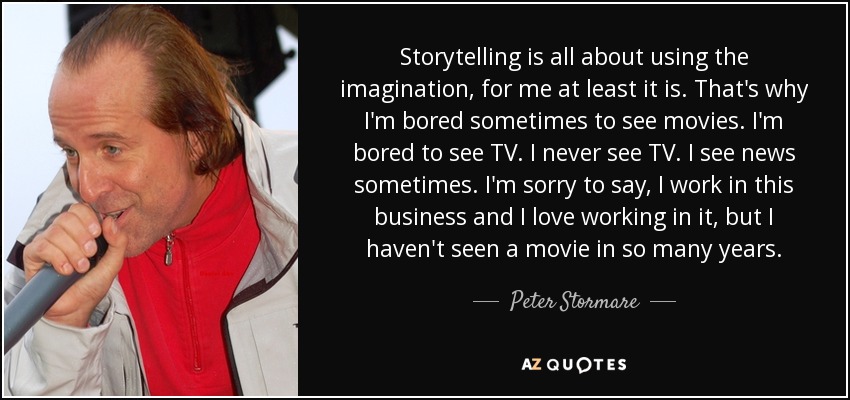
Storytelling is all about using the imagination, for me at least it is. That's why I'm bored sometimes to see movies. I'm bored to see TV. I never see TV. I see news sometimes. I'm sorry to say, I work in this business and I love working in it, but I haven't seen a movie in so many years.
When we make films - even 2D films - you're always trying to create this illusion of 3D, anyway. You're trying to create a believable world with characters walking, in and out of the perspective, to create the illusion that there's a world. The desire and drive to create this illusion of three-dimensional space is something that is true about every kind of film because you want the audience to really be experiencing it, first hand. It's a natural extension of the storytelling and the process of filmmaking.
My concern 99% is about the storytelling, the emotion and all this. I never think about the format of anything until way far in the process and when we arrive to the fabrication of the thing then we start to say, "Okay right, what is the best thing we can do." I choose the car before to choose the color.
Directing is all about storytelling. It's not about equipment, or anything else.
Horror is great storytelling with scary elements on top of it, but if you don't have great storytelling, you can have all the scares in the world, but the movie won't work.
My work is basically images set to my particular voice. It's the way the images rhyme and the rhythm. It's a way of economical storytelling for me.
All your clear and pleasing sentences will fall apart if you don't keep remembering that writing is linear and sequential, that logic is the glue that holds it together, that tension must be maintained from one sentence to the next and from one paragraph to the next and from one section to the next, and that narrative - good old-fashioned storytelling - is what should pull your readers along without their noticing the tug.
I so love the animation process. Interesting, everything that I do in animation, the kind of crafting and skills of storytelling, totally work within the structure of the Disney nature films. In a weird way, I like to think that animation is like painting, and Disney nature is like sculpting. Animation you start with a blank canvas and you paint. With Disney nature, you start with a big block of imagery and you hone it down into your final story. Somewhere you end up with something kind of pretty to watch.
Film is such a director's medium; you're really in their hands in terms of the real storytelling. As an actor, you can give a performance moment to moment and some of your takes will be used and some of them won't. I think there are great films you can make with bad performances, and vice versa. There are all combinations of those things. It's really down to the director what happens, I think, so that's why it's really good to work with very talented, bold directors.
To achieve the intimacy between performer and audience in storytelling, I feel like I have to let the audience in on my emotional state, not just, "Here's a story I'm going to tell by rote, and you're just going to listen to it, because I'm such a wonderfully entertaining fellow." It's the idea of sharing enough of myself that it's not just all about, "Look at me, look at me." There's an element to it of, "You understand what I'm talking about, right? You've been in this place that I've been in," which makes it a richer experience.
Some people feel like you need to have a very specialized understanding of music to have the authority to talk about it. They are such good directors that it's perfectly possible to have conceptual and directorial and storytelling conversations about music without needing to know all the technical pieces.
Anything that happens on any show is a plot contrivance because that's just storytelling.
I'm a big believer in pairing classics with contemporary literature, so students have the opportunity to see that literature is not a cold, dead thing that happened once but instead a vibrant mode of storytelling that's been with us a long time - and will be with us, I hope, for a long time to come.
I like to apply storytelling methods and techniques to try to frame the story in an interesting way, but you can never control what's happening.
Me and Biggie share a storytelling ability--he was an actor on wax, too. His stories were so vivid and torrid, he made you feel them. And we both have the hardness. When I come out on the mic, you know it's me.
Honestly, I don't try to guess at what most people want. I don't think I'd guess right, and I just think that that's not a good recipe for storytelling. I try to write what I like, what I think my friends would like.
I fell in love with poetry through storytelling, so my poetry tends to be fairly narrative. I like characters, I like having a beginning, middle, and ending, though not necessarily in that order.
I love literature, the English language and storytelling. I also have thirty horses and seventy foxhounds to feed.
There are two magic acts I want to pull off when I write. One is creating a feeling that when you're inside a book, you believe everything you're reading even when you know it's not true. And the second is an extension of that, which is you know it's not true, you know it's not real, but you believe it anyway. And it's that believing of the story that isn't real that attracted me to writing and storytelling in general.
I don't procrastinate because I love the English language and the process of storytelling, and I'm always curious to see what will come to me next. If you procrastinate a lot, you might be one who loves having written, but doesn't so much like writing.
Begin your story with a sentence that will immediately grab hold of your listener's ears like a surly nun in a Catholic school.
If you're doing a big spectacle film, you've got to be mindful of large masses. Even then, you've got to be responsible only to your storytelling.
One of the most intriguing things in management and in business is the role of storytelling - people need the anecdotes to do the work that they do.
If you're writing a book where you want to make a positive truth claim, then you should absolutely call it nonfiction or memoir. If you don't want to make that claim - if that's not what's important to you; if you're more interested in storytelling and interiority and interpersonal relationships than in objective, checkable facts about the world - then why wouldn't you call it a novel, and take advantage of what that gets you, of the extra freedom, of belonging to the tradition of the novel?
It's a foreground of my feeling. That place moves me. And I don't mean my country; it's part of our shared natural world that happens to be particular to a sense of wherever my storytelling inclinations come from and my own history of kind of being a road rat and travelling.
Follow AzQuotes on Facebook, Twitter and Google+. Every day we present the best quotes! Improve yourself, find your inspiration, share with friends
or simply: