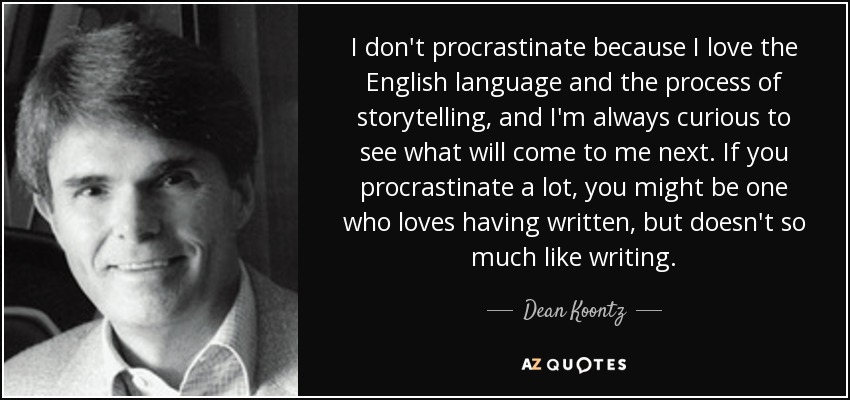
I don't procrastinate because I love the English language and the process of storytelling, and I'm always curious to see what will come to me next. If you procrastinate a lot, you might be one who loves having written, but doesn't so much like writing.
At the end of the day, storytelling is actually very simple in its origin as long as there are people who want to tell stories and there are people who want to hear them.
If you're doing a big spectacle film, you've got to be mindful of large masses. Even then, you've got to be responsible only to your storytelling.
One of the most intriguing things in management and in business is the role of storytelling - people need the anecdotes to do the work that they do.
It's a foreground of my feeling. That place moves me. And I don't mean my country; it's part of our shared natural world that happens to be particular to a sense of wherever my storytelling inclinations come from and my own history of kind of being a road rat and travelling.
There is a part of me that likes things that are epic, that's why I think a lot of my songs go to these soundscapes that are cinematic, because I really like the epic storytelling.
I love REAL set construction and think that sets are very important part of the storytelling and scope of a film.
We are storytelling animals, and cannot bear to acknowledge the ordinariness of our daily lives.
The only thing I would want to say is that storytelling is ancient; it's something that everybody does. Kids mustn't be in awe of it. Reading should be a joy - fun, fun, fun - not a responsibility, not something you do because society demands it, but something you do because it's a pleasure.
My real purpose in telling middle-school students stories was to practice telling stories. And I practiced on the greatest model of storytelling we've got, which is "The Iliad" and "The Odyssey." I told those stories many, many times. And the way I would justify it to the head teacher if he came in or to any parents who complained was, look, I'm telling these great stories because they're part of our cultural heritage. I did believe that.
I get some flak for and some resistance from colleagues for because I'm interested in storytelling. I mean what I like about songwriting is songs used to tell a story.
I meet a number of people as a writer of fiction who say "Oh, I don't read much fiction," as if the history of the United States, just as an example, isn't an exercise in storytelling and myth-making.
I've been making 16mm urban landscape films about San Francisco for many years. I choose different nonfiction themes to investigate and am generally interested in surfacing lesser-known histories. I like to investigate and illuminate these histories, combining them with my own unconventional storytelling style, which is generally a stream-of-consciousness voiceover involving a steady stream of personal reflections on pining over unavailable women.
The thing that's interesting about storytelling is people will say, "How do I write a movie I can get sold in this category?" For God's sake, the first movie that you can get made will be your personal story, because nobody's heard it before.
You imagine a reader and try to keep the reader interested. That's storytelling. You also hope to reward the reader with a sense of a completed design, that somebody is in charge, and that while life is pointless, the book isn't pointless. The author knows where he is going. That's form.
Storytelling is like sex. We all do it naturally. Some of us are better at it than others.
Having certain limits - not too many, but certain limits on an ability to tell a story - makes us work harder, me and my writers. Sometimes I watch a giant movie with a $250 million budget and I think they feel kind of bloated, and that if they'd been leaner and meaner they might've had better storytelling.
I like storytelling, and for storytelling you need a drama. And for there to be drama, you need twists, and by twists I mean the ability to constantly change the trajectory of the story.
If you're writing a book where you want to make a positive truth claim, then you should absolutely call it nonfiction or memoir. If you don't want to make that claim - if that's not what's important to you; if you're more interested in storytelling and interiority and interpersonal relationships than in objective, checkable facts about the world - then why wouldn't you call it a novel, and take advantage of what that gets you, of the extra freedom, of belonging to the tradition of the novel?
The bedrock thing of country music is, it's about storytelling. I feel like I was able to find a niche because I connected to that in some way.
There is an extraordinary power in storytelling that stirs the imagination and makes an indelible impression on the mind.
Individual storytelling is incredibly powerful. We as journalists know intuitively what scientists of the brain are discovering through brain scans, which is that emotional stories tend to open the portals, and that once there's a connection made, people are more open to rational arguments.
What you demand from storytelling is a moral - even political - import. I tend to shun that didactic aspect.
Storytelling, a primitive art, is as old as the beginning of mankind. People want to receive what's out there in the form of stories, not just facts, opinion, analysis.
To me good storytelling is about journeys. It's about people's journeys, people's discoveries and how they deal with those discoveries; circumstances that put people in different situations.
Follow AzQuotes on Facebook, Twitter and Google+. Every day we present the best quotes! Improve yourself, find your inspiration, share with friends
or simply: