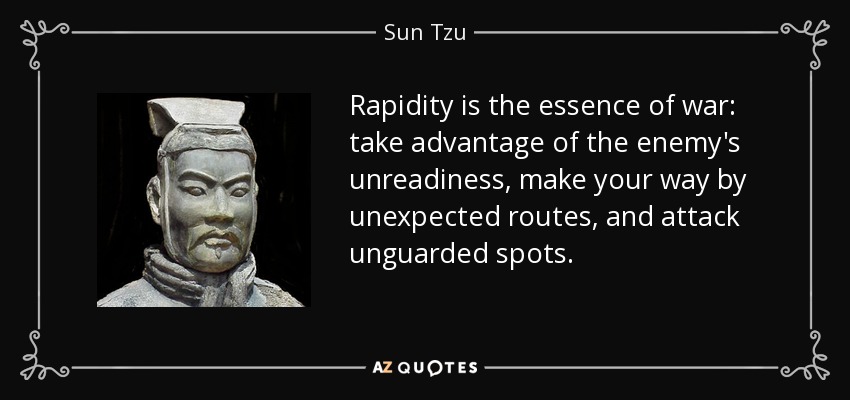
Rapidity is the essence of war: take advantage of the enemy's unreadiness, make your way by unexpected routes, and attack unguarded spots.
They [spies] cannot be properly managed without benevolence and straightforwardness.
Spies cannot be usefully employed without a certain intuitive sagacity.
Attack him where he is unprepared, appear where you are not expected.
If it is to your advantage, make a forward move; if not, stay where you are.
Hence the saying: The enlightened ruler lays his plans well ahead; the good general cultivates his resources.
No ruler should put troops into the field merely to gratify his own spleen; no general should fight a battle simply out of pique.
All warfare is based on deception. Hence, when able to attack, we must seem unable; when using our forces, we must seem inactive; when we are near, we must make the enemy believe we are far away; when far away, we must make him believe we are near.
Should the enemy strengthen his van, he will weaken his rear; should he strengthen his rear, he will weaken his van; should he strengthen his left, he will weaken his right; should he strengthen his right, he will weaken his left. If he sends reinforcements everywhere, he will everywhere be weak.
The art of war teaches us to rely not on the likelihood of the enemy's not coming, but on our own readiness to receive him; not on the chance of his not attacking, but rather on the fact that we have made our position unassailable.
Bring war material with you from home, but forage on the enemy... use the conquered foe to augment one's own strength.
Making no mistakes is what establishes the certainty of victory, for it means conquering an enemy that is already defeated.
Military tactics are like unto water; for water in its natural course runs away from high places and hastens downwards... Water shapes its course according to the nature of the ground over which it flows; the soldier works out his victory in relation to the foe whom he is facing. Therefore, just as water retains no constant shape, so in warfare there are no constant conditions. He who can modify his tactics in relation to his opponent and thereby succeed in winning, may be called a heaven-born captain.
Maneuvering with an army is advantageous; with an undisciplined multitude, most dangerous.
You can ensure the success of your attacks if you only attack places that are undefended. You can ensure the safety of your defense if you only hold positions that cannot be attacked. Therefore, that general is skillful in attack whose opponent does not know what to defend; and he is skillful in defense whose opponent does not know what to attack.
If you know yourself but not the enemy, for every victory gained you will also suffer a defeat.
In making tactical dispositions, the highest pitch you can attain is to conceal them.
No ruler should put troops into the field merely to gratify his own spleen; no general should fight a battle simply out of pique. If it is to your advantage, make a forward move; if not, stay where you are. Anger may in time change to gladness; vexation may be succeeded by content. But a kingdom that has once been destroyed can never come again into being; nor can the dead ever be brought back to life.
The general who wins a battle makes many calculations in his temple ere the battle is fought. The general who loses a battle makes but few calculations beforehand. Thus do many calculations lead to victory, and few calculations to defeat: how much more no calculation at all! It is by attention to this point that I can foresee who is likely to win or lose.
Thus the highest form of generalship is to balk the enemy's plans, the next best is to prevent the junction of the enemy's forces, the next in order is to attack the enemy's army in the field, and the worst policy of all is to besiege walled cities.
The good fighters of old first put themselves beyond the possibility of defeat, and then waited for an opportunity of defeating the enemy. To secure ourselves against defeat lies in our own hands, but the opportunity of defeating the enemy is provided by the enemy himself. Thus the good fighter is able to secure himself against defeat, but cannot make certain of defeating the enemy.
Whoever is first in the field and awaits the coming of the enemy, will be fresh for the fight; whoever is second in the field and has to hasten to battle will arrive exhausted.
The clever combatant imposes his will on the enemy, but does not allow the enemy's will to be imposed on him.
All men can see these tactics whereby I conquer, but what none can see is the strategy out of which victory is evolved.
When you surround an army, leave an outlet free. Do not press a desperate foe too hard.
Follow AzQuotes on Facebook, Twitter and Google+. Every day we present the best quotes! Improve yourself, find your inspiration, share with friends
or simply: