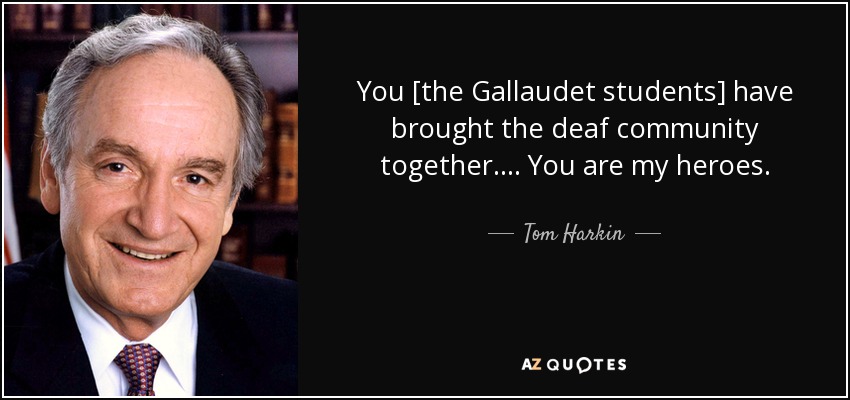
You [the Gallaudet students] have brought the deaf community together.... You are my heroes.
The students of Gallaudet have sent a powerful message across this country!
Finally, I was no longer a student and was making music for myself.
It was lovely when you found students who responded to things you were enthusiastic about.
The details of our struggle to survive and prosper, in what has been a difficult and sometimes bitter relationship with a system of laws and practices that deny us access to the tools necessary for productive and industrious life, are available to any serious student of history or sociology.
The woodchopper reads the wisdom of the ages recorded on the paper that holds his dinner, then lights his pipe with it. When we ask for a scrap of paper for the most trivial use, it may have the confessions of Augustine or the sonnets of Shakespeare, and we not observe it. The student kindles his fire, the editor packs his trunk, the sportsman loads his gun, the traveler wraps his dinner, the Irishman papers his shanty, the schoolboy peppers the plastering, the belle pins up her hair, with the printed thoughts of men.
Those things for which the most money is demanded are never the things which the student most wants. Tuition, for instance, is an important item in the term bill, while for the far more valuable education which he gets by associating with the most cultivated of his contemporaries no charge is made.
And above all, I will argue the necessity for preserving, against all shame, a demanding question of revolution itself, a question about utopia that keeps pushing its way through a field of failed aspirations, like a student at the back of the room who gets suddenly, violently, tired of being invisible.
When teachers are forced to teach to the test, students get bored and genuine education ceases, no matter what the test scores may say… The examination as a test of the past is of no value for increased learning ability. Like all external motivators, it can produce a short term effect, but examinations for the purpose of grading the past do not hook a student on learning for life.
I have tried to put myself in the position of someone seeing economics for the first time. My goal is to emphasize the material that students should and do find interesting about the study of the economy.
Before I went on stage at Kyle Hutton's Real Life Real Music Festival, I heard one of his songwriting students, Abbey Hirvela, sing; she was in the poet's saddle and riding that horse like she owned it. She was good! I probably ruined her by showing her how to make an E chord without the 3rd though.
Ibn Firnas was a polymath: a physician, a rather bad poet, the first to make glass from stones (quartz), a student of music, and inventor of some sort of metronome.
When the uncapped potential of a student meets the liberating art of a teacher, a miracle unfolds.
Exegetical commentaries on the books of the Bible come in all shapes and sizes. Harold Hoehner's new volume on Ephesians has both a distinctive shape and a monumental size. Its value lies in its attention to detail and its full discussion of all relevant and disputed points. The volume will be an invaluable resource for scholars and students. Not all Hoehner's conclusions will command consent, but he has produced a stout and readable volume that all will turn to for guidance and help.
I was a student at Peking University for close to a decade, while a so-called 'knowledge explosion' was rapidly expanding. I was searching for not just knowledge, but also to mold a temperament, to cultivate a scholarly outlook.
On the one hand, we had great filmic spectacles that brought in big audiences, adults as well as primary and secondary school students. On the other hand, there were attempts to create contemporary Polish film.
A person of mature years and ripe development, who is expecting nothing from literature but the corroboration and renewal of past ideas, may find satisfaction in a lucidity so complete as to occasion no imaginative excitement, but young and ambitious students are not content with it. They seek the excitement because they are capable of the growth that it accompanies.
So our student will flit like a busy bee through the entire garden of literature, light on every blossom, collect a little nectar from each, and carry it to his hive.
To all my friends, readers, and students: I apologize for not being able to write you directly, however the God and Goddess have given me new challenges to face. Upon hearing of all the support you are giving me, I am unimaginably grateful. I have no doubt that while there will be challenges to come, the God and Goddess will not be bringing me to the Summerland anytime soon. In perfect love and in perfect trust, Donald Michael Kraig
Political journalists love graduate student intelligence, the ability to make clever allusions in seminars, and in 1999-2000, they hassled George W Bush for not having it. They didn't realise what this book succinctly displays: that the president has something far more important - CEO intelligence, the ability to ask tough questions, garner essential information and make discerning decisions.
Every good teacher and every good parent has somehow learned to negotiate the paradox of freedom and discipline. We want our children and our students to become people who think and live freely, yet at the same time we know that helping them become free requires us to restrict their freedom in certain situations.
I had some of the students in my finance class actually do some empirical work on capital structures, to see if we could find any obvious patterns in the data, but we couldn't see any.
Contrary to what some folks would have us believe, it is not tragic, even if undesirable, for a person to leave a liberal arts education not having read major works from this canon. Their lives are not ending. And the exciting dimension of knowledge is that we can learn a work without formally studying it. If a student graduates without reading Shakespeare and then reads or studies this work later, it does not delegitimize whatever formal course of study that was completed.
How to Stay Christian in Seminary should be placed in the hands of every first-year seminarian. It provides a much-needed balance as they navigate the beautiful but treacherous waters of a seminary education. I plan to use this powerful little book with great profit for my students in the years ahead.
The only person who can fix education is the student.
Follow AzQuotes on Facebook, Twitter and Google+. Every day we present the best quotes! Improve yourself, find your inspiration, share with friends
or simply: