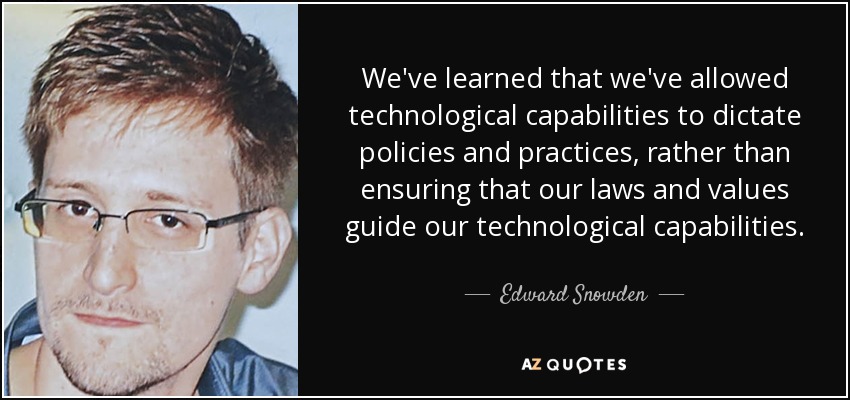
We've learned that we've allowed technological capabilities to dictate policies and practices, rather than ensuring that our laws and values guide our technological capabilities.
I reject the peak oil theory insofar as it refers to technological limits on human ingenuity.
I think markets are mechanisms that determine prices that are necessary for mass heterogenous populations, and markets do generate levels of technological innovation and productivity that is crucial. But when unregulated, they often generate levels of vast inequality and ugly isolation that makes it difficult for people to relate and connect with one another.
What does interest me is how difficult my culture seems to find it to look the dark side of life directly in the eye. It seems to me that if we look back at mediaeval culture, for example, we see a society which faces the reality of death and pain and limitation, because it has to. Our society, which is progressive and technological and seems to have a slightly fanatical utopian edge to it, gets very uncomfortable when anybody highlights the dark side of humanity, or the world we have built, or what we are doing to the rest of life on Earth.
There are days when you might enjoy being an editor a little less, due to one crisis or another. It is absolutely vital, to me, in a period of technological evolution and sometimes financial stress that I and my colleagues not only put out a fantastic magazine and Web site and all the rest, but also that we are smart enough about what we are doing.
Man's civility is lagging behind his technological ability. It could mean disaster and catastrophe for the whole world. We're all sinners, everyone of us, and a radical change is needed for all of us.
The economic and technological changes are real, but I just can't bring myself to wax apocalyptic about the future of books.
think there's a culture of Silicon Valley that seems to have the attitude that you can have it both ways, that you can be an insurgent but also, ultimately, it's paid for by advertising, when in fact advertising is totally retrograde. Now that's an industry we should be disrupting, and maybe you disrupt it by funding public media. None of this is technological destiny; there are only social choices.
I liked the idea of working outside, using my body and my mind together. I haven't been disappointed! Land surveying can be very physical work, but there is a strong intellectual and technological component as well.
Ambition wants us to improve our lot, basically, but I can't help thinking we're pursuing a return to a technological Eden. We do try to create a paradise on Earth, because we are hubristic and we want to surpass this notion of God and then ourselves become gods.
Because of the disruption phenomenon - technological progress outstripping the ability of customers to utilize it - the general tendency is for the money to migrate toward the subsystems.
Science is my JAM. I am very excited to see where science and technological advancements will take us in the next few decades.
While we generally believe in free speech and giving everyone as much ability to speak as possible, in practice there are lots of barriers to that, whether it's legal restrictions, technological restrictions or you can't share what you want if you don't have access to the internet.
It wasn't openly talked about very much, in the sense that people said they wanted to beat GB at this or that, but there would however be sidelong comparisons frequently in press commentary. And it was also pretty quickly obvious that no other countries were developing the kind of technological depth of industry as were the US and the UK.
I think one thing people forget is that every technological advance we fetishize had its place in time.
I'm working with wind, solar, and biofuels companies as well as with organizations like ACORE [American Council On Renewable Energy], Growth Energy, and AREDAY to raise public awareness and seek practical technological solutions to reduce our reliance on fossilized carbon. My book Don't Wait for the Next War will be out in October, where I will offer my prescription for America's growth, responsible development, and security.
When we first started Fear factory, we asked ourselves what Fear Factory means, it was a cool name, but what did it mean? We obviously embraced the technological side of a factory, as a factory can be anything from something that insights fear, like a government machine, to something of futuristic technology, or it could be religion. So we embraced the technological side of it back in the early days.
For so long, companies were run using a command-and-control, 'top down' hierarchical method that involved dictating down the command chain and maintaining order. What I've witnessed in our time is evolving democratization, a shift to a demand economy accelerated by technological advancements like social media.
A lot has been written about the Internet bust. From my point of view, it's quite clear the Internet isn't a category; the Internet is a technological infrastructure that can be deployed to facilitate a disruptive business model or a sustaining business model.
Because we live in a condition of ubiquitous music and media, and near infinite technological memory, it is much easier for local cultures to find an audience that resonates with their music, whether local or globally.
Technological rationality reveals its political character as it becomes the great vehicle of better domination, creating a truely totalitarian universe in which society and nature, mind and body are kept in a state of permanent mobilization for the defense of this universe.
We have progressed in a technological sense, but I'm not so sure whether we have progressed in a civilizational matter - the quality of the civilization has not improved. It's a civilization that's in love with technology but forgetting about the human side of it and the destructive tendency in human civilization has not been faced.
Let me go out on a limb and suggest that those who see hints of a new class ideology developing around information technology are not necessarily wild-eyed. "Bit-twiddlers" are neither exactly proletariat nor bourgeoisie. They may not own the means of production in the sense that Marx argued, but they certainly do have significantly control over those means, in a more profound way than the term "symbols analysts" or "knowledge workers" captures. As a rough generalization, they value science and technological problem-solving elegance equally at least with profit.
I don't. We've had three technological revolutions that have changed the course of human history, all driven by physics. In the first, the industrial revolution, physicists developed Newtonian mechanics and thermodynamics, which gave us the steam engine and machine power. The second technological revolution was the electricity revolution. That gave us radio, television, and telecommunications. Then, physicists developed the laser and the transistor.
I'm first and foremost a biological explorer. I've looked all over the world for answers. Secondly, I'm an ecological designer, and by that I mean I attempt to work with constellations of nature to create technological forms. So I'm part engineer, part ecologist, part inventor, really.
Follow AzQuotes on Facebook, Twitter and Google+. Every day we present the best quotes! Improve yourself, find your inspiration, share with friends
or simply: