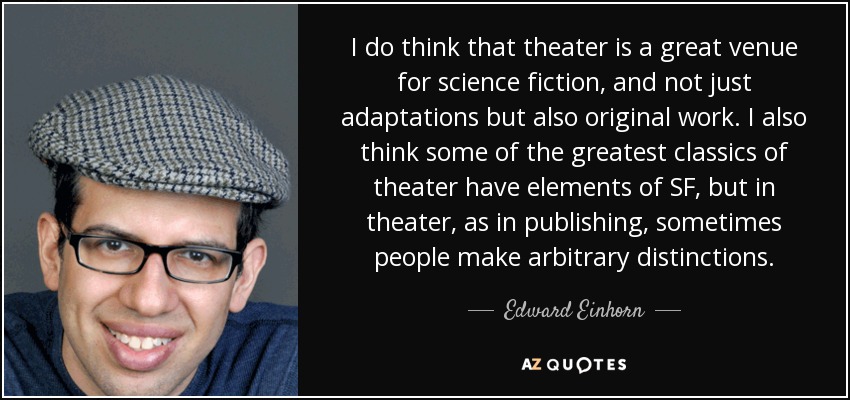
I do think that theater is a great venue for science fiction, and not just adaptations but also original work. I also think some of the greatest classics of theater have elements of SF, but in theater, as in publishing, sometimes people make arbitrary distinctions.
I never thought of myself as a comedic actor. I didn't go to Second City, that's not my background, I'm not a comic, I studied theater and my career when I started was a lot of dramatic stuff.
My goal for Actress is to have it play more traditional theaters.
Movie theaters barely make any money. A movie can make a couple of thousand dollars, or could get lucky and make ten or fifteen thousand dollars, but theatrical releases don't really sustain the work. For me, it's the best sort of advertisement for anything else you'd want to do.
I am a product of the "Hippie" theater movement of the '60s.
I was a gay kid in high school in the late '90s, and I was in theater club. I was never a thespian. I was much more of a lighting guy or a backstage guy. Because I wanted to do something easy for the rest of my life, I thought, "Maybe I'll go and apply to colleges that specialize in theater set design. I'll do that. That's what I want to do". With theater, really, I'd be around the gays.
I've been doing theaters like the Warner for about a year and we've found the earlier you get the tickets on sale the better idea you get on how many shows we will be doing.
I'm somebody who grew up listening to a lot of musical theater, so getting to finally write musical theater songs and songs that sound that way - the emphasis being on the storytelling, but the arrangements and the orchestrations can be really varied - I found that to be, actually, a really joyful discovery.
I grew up in such a small area that there really weren't any acting classes. So I had to wait till I got to college, at the University of Washington. I was a theater major there and got my training. Then after college, I packed up my Honda Civic and kind of fulfilled the cliché of driving down to Los Angeles, and literally, brick by brick - you know, the slow and painful way - I built my career.
My grandmother took me to a lot of theater. I was exposed to performance quite a bit - everything from Broadway to off-Broadway and dance and music as well. I was very lucky that way. It was a very rich childhood.
In the theater, which is a sort of jungle, one does have to be a little bit careful. One mustn't be so rigid or egotistical to think that every comma is sacrosanct. But at the same time there is the danger of losing control and finding that somebody else has opened a play and not you.
Even with Dream Theater, we track in a big studio and everything. But when it comes to doing leads, I don't really require a lot of studio to do that. I need a good sounding room and a Pro Tools rig, and some Neve mic-pres, and I'm good.
As soon as people enter a theater they must become moron consumers who must be fed information.
Those same people, when they leave the theater, when they look behind the curtains they are curious about their neighbors, they can guess if their neighbors are siblings or a couple, how old they are, what their occupation is. They are curious about each other and they can understand each other without being fed information. Why should it be different in cinema?
I grew up doing theater when I was very young - always enjoyed it. Studied it in college, got my degree in it, and never really had the guts to do it professionally. But one summer, a friend of mine was with an extras agency and asked me if I wanted to be an extra with him in a movie, and I was, like, "Sure." At lunch, the writer came up to me and asked me to audition for a role. I got it, and it sort of snowballed from there.
I saw some musicals at dinner theaters where I grew up. But I didn’t go to a big theater to see one until probably after I graduated from high school when I took myself to see Tommy when it was on tour. I absolutely loved it.
I think the wonderful thing about doing theater is that it's more of an actor's medium. I think that film is more of a director's medium. You can't edit something out on stage. It's there.
I used to buy into a former Supreme Court justice's argument that you can't scream fire in a crowded theater. Well, I think you can.
The oldest form of theater is the dinner table. It's got five or six people, new show every night, same players. Good ensemble; the people have worked together a lot.
I've done classical theaters. I played Hamlet myself and Romeo.
I'm a very shy person and I never tried to do theater.
As soon as white folks say a play's good, the theater is jammed with blacks and whites.
I first got involved in theater in 1968, at the height of a social tumult. I was a poet.
One of the Age of Enlightenment's most hypnotic images is Ledoux's rendering of his neoclassical theater of 1775 - 1784 in Besancon, surreally reflected in the colossal eye of an unidentified cosmic being.
I love Back Stage. I have lots of theater friends and actors who depend on Back Stage.
Follow AzQuotes on Facebook, Twitter and Google+. Every day we present the best quotes! Improve yourself, find your inspiration, share with friends
or simply: