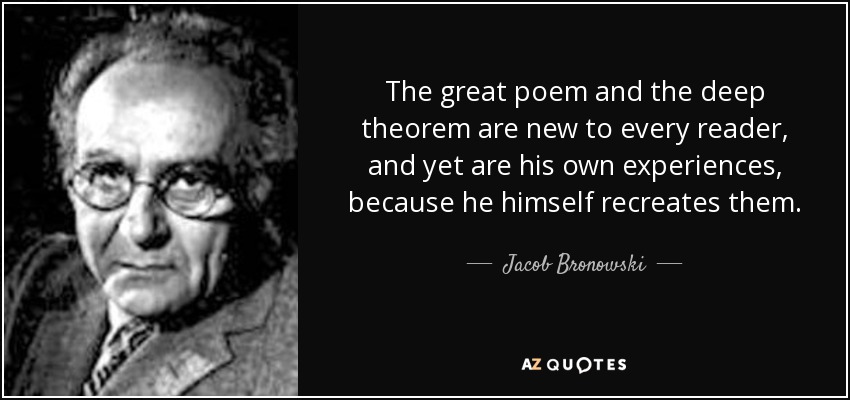
The great poem and the deep theorem are new to every reader, and yet are his own experiences, because he himself recreates them.
How many theorems in geometry which have seemed at first impracticable are in time successfully worked out!
The primes are the raw material out of which we have to build arithmetic, and Euclid's theorem assures us that we have plenty of material for the task.
...contemporary physicists come in two varieties. Type 1 physicists are bothered by EPR and Bell's Theorem. Type 2 (the majority) are not, but one has to distinguish two subvarieties. Type 2a physicists explain why they are not bothered. Their explanations tend either to miss the point entirely (like Born's to Einstein) or to contain physical assertions that can be shown to be false. Type 2b are not bothered and refuse to explain why.
Humanism . . . is not a single hypothesis or theorem, and it dwells on no new facts. It is rather a slow shifting in the philosophic perspective, making things appear as from a new centre of interest or point of sight.
Papers should include more side remarks, open questions, and such. Very often, these are more interesting than the theorems actually proved. Alas, most people are afraid to admit that they don't know the answer to some question, and as a consequence they refrain from mentioning the question, even if it is a very natural one. What a pity! As for myself, I enjoy saying 'I do not know'.
Toward the end of his life, Gödel feared that he was being poisoned, and he starved himself to death. His theorem is one of the most extraordinary results in mathematics, or in any intellectual field in this century. If ever potential mental instability is detectable by genetic analysis, an embryo of someone with Kurt Gödel's gifts might be aborted.
This skipping is another important point. It should be done whenever a proof seems too hard or whenever a theorem or a whole paragraph does not appeal to the reader. In most cases he will be able to go on and later he may return to the parts which he skipped.
Heaven is angered by my arrogance; my proof [of the four-color theorem] is also defective.
An axiomatic system comprises axioms and theorems and requires a certain amount of hand-eye coordination before it works. A formal system comprises an explicit list of symbols, an explicit set of rules governing their cohabitation, an explicit list of axioms, and, above all, an explicit list of rules explicitly governing the steps that the mathematician may take in going from assumptions to conclusions. No appeal to meaning nor to intuition. Symbols lose their referential powers; inferences become mechanical.
The scientist has to take 95 per cent of his subject on trust. He has to because he can't possibly do all the experiments, therefore he has to take on trust the experiments all his colleagues and predecessors have done. Whereas a mathematician doesn't have to take anything on trust. Any theorem that's proved, he doesn't believe it, really, until he goes through the proof himself, and therefore he knows his whole subject from scratch. He's absolutely 100 per cent certain of it. And that gives him an extraordinary conviction of certainty, and an arrogance that scientists don't have.
How can you shorten the subject? That stern struggle with the multiplication table, for many people not yet ended in victory, how can you make it less? Square root, as obdurate as a hardwood stump in a pasturenothing but years of effort can extract it. You can't hurry the process. Or pass from arithmetic to algebra; you can't shoulder your way past quadratic equations or ripple through the binomial theorem. Instead, the other way; your feet are impeded in the tangled growth, your pace slackens, you sink and fall somewhere near the binomial theorem with the calculus in sight on the horizon.
We re-make nature by the act of discovery, in the poem or in the theorem. And the great poem and the deep theorem are new to every reader, and yet are his own experiences, because he himself re-creates them. They are the marks of unity in variety; and in the instant when the mind seizes this for itself, in art or in science, the heart misses a beat.
I have found a very great number of exceedingly beautiful theorems.
There are infinitely many variations of the initial situation and therefore no doubt indefinitely many theorems of moral geometry.
Mystery is an inescapable ingredient of mathematics. Mathematics is full of unanswered questions, which far outnumber known theorems and results. It's the nature of mathematics to pose more problems than it can solve. Indeed, mathematics itself may be built on small islands of truth comprising the pieces of mathematics that can be validated by relatively short proofs. All else is speculation.
What philosophy worthy of the name has truly been able to avoid the link between poem and theorem?
Those who have more power are liable to sin more; no theorem in geometry is more certain than this.
I took a break from acting for four years to get a degree in mathematics at UCLA, and during that time I had the rare opportunity to actually do research as an undergraduate. And myself and two other people co-authored a new theorem: Percolation and Gibbs States Multiplicity for Ferromagnetic Ashkin-Teller Models on Two Dimensions, or Z2.
Do people believe in human rights because such rights actually exist, like mathematical truths, sitting on a cosmic shelf next to the Pythagorean theorem just waiting to be discovered by Platonic reasoners? Or do people feel revulsion and sympathy when they read accounts of torture, and then invent a story about universal rights to help justify their feelings?
Bells theorem dealt a shattering blow to Einsteins position by showing that the conception of reality as consisting of separate parts, joined by local connections, is incompatible with quantum theory... Bells theorem demonstrates that the universe is fundamentally interconnected, interdependent, and inseparable.
He knew by heart every last minute crack on its surface. He had made maps of the ceiling and gone exploring on them; rivers, islands, and continents. He had made guessing games of it and discovered hidden objects; faces, birds, and fishes. He made mathematical calculations of it and rediscovered his childhood; theorems, angles, and triangles. There was practically nothing else he could do but look at it. He hated the sight of it.
MacPherson told me that my theorem can be viewed as blah blah blah Grothendieck blah blah blah, which makes it much more respectable.
Can the difficulty of an exam be measured by how many bits of information a student would need to pass it? This may not be so absurd in the encyclopedic subjects but in mathematics it doesn't make any sense since things follow from each other and, in principle, whoever knows the bases knows everything. All of the results of a mathematical theorem are in the axioms of mathematics in embryonic form, aren't they?
In the "commentatio" (note presented to the Russian Academy) in which his theorem on polyhedra (on the number of faces, edges and vertices) was first published Euler gives no proof. In place of a proof, he offers an inductive argument: he verifies the relation in a variety of special cases. There is little doubt that he also discovered the theorem, as many of his other results, inductively.
Follow AzQuotes on Facebook, Twitter and Google+. Every day we present the best quotes! Improve yourself, find your inspiration, share with friends
or simply: