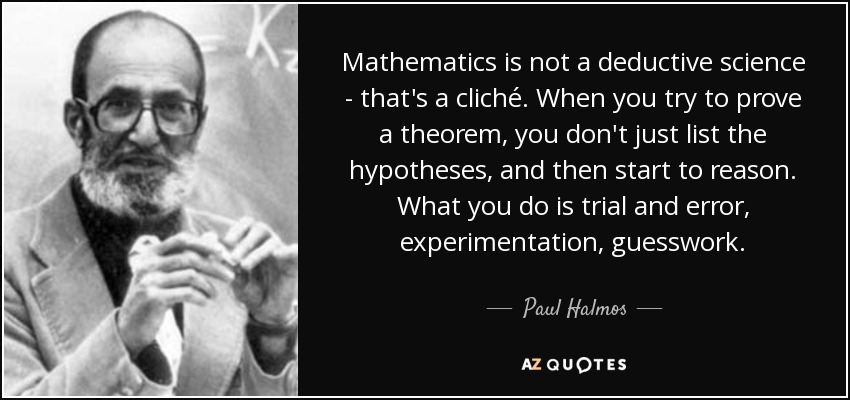
Mathematics is not a deductive science - that's a cliché. When you try to prove a theorem, you don't just list the hypotheses, and then start to reason. What you do is trial and error, experimentation, guesswork.
In 1975, ... [speaking with Shiing Shen Chern], I told him I had finally learned ... the beauty of fiber-bundle theory and the profound Chern-Weil theorem. I said I found it amazing that gauge fields are exactly connections on fiber bundles, which the mathematicians developed without reference to the physical world. I added, "this is both thrilling and puzzling, since you mathematicians dreamed up these concepts out of nowhere." He immediately protested: "No, no. These concepts were not dreamed up. They were natural and real."
For what is important when we give children a theorem to use is not that they should memorize it. What matters most is that by growing up with a few very powerful theorems one comes to appreciate how certain ideas can be used as tools to think with over a lifetime. One learns to enjoy and to respect the power of powerful ideas. One learns that the most powerful idea of all is the idea of powerful ideas.
My favourite fellow of the Royal Society is the Reverend Thomas Bayes, an obscure 18th-century Kent clergyman and a brilliant mathematician who devised a complex equation known as the Bayes theorem, which can be used to work out probability distributions. It had no practical application in his lifetime, but today, thanks to computers, is routinely used in the modelling of climate change, astrophysics and stock-market analysis.
Murphy's Law, that brash proletarian restatement of Godel's Theorem.
The axiom of conditioned repetition, like the binomial theorem, is nothing but a piece of insolence.
Paul Erdos has a theory that God has a book containing all the theorems of mathematics with their absolutely most beautiful proofs, and when he wants to express particular appreciation of a proof he exclaims, "This is from the book!"
Geometry has two great treasures; one is the Theorem of Pythagoras; the other, the division of a line into extreme and mean ratio. The first we may compare to a measure of gold; the second we may name a precious jewel.
Before beginning [to try to prove Fermat's Last Theorem] I should have to put in three years of intensive study, and I haven't that much time to squander on a probable failure.
Any effect, constant, theorem or equation named after Professor X was first discovered by Professor Y , for some value of Y not equal to X.
Isolated, so-called "pretty theorems" have even less value in the eyes of a modern mathematician than the discovery of a new "pretty flower" has to the scientific botanist, though the layman finds in these the chief charm of the respective sciences.
Thus, be it understood, to demonstrate a theorem, it is neither necessary nor even advantageous to know what it means.
What we do may be small, but it has a certain character of permanence; and to have produced anything of the slightest permanent interest, whether it be a copy of verses or a geometrical theorem, is to have done something utterly beyond the powers of the vast majority of men.
It is a melancholy experience for a professional mathematician to find himself writing about mathematics. The function of a mathematician is to do something, to prove new theorems, to add to mathematics, and not to talk about what he or other mathematicians have done. Statesmen despise publicists, painters despise art-critics, and physiologists, physicists, or mathematicians have usually similar feelings: there is no scorn more profound, or on the whole more justifiable, than that of the men who make for the men who explain. Exposition, criticism, appreciation, is work for second-rate minds.
The analysis of variance is not a mathematical theorem, but rather a convenient method of arranging the arithmetic.
There's no answer for my offense, just like the polythagorean theorem.
A peculiarity of the higher arithmetic is the great difficulty which has often been experienced in proving simple general theorems which had been suggested quite naturally by numerical evidence.
An axiomatic system establishes a reverberating relationship between what a mathematician assumes (the axioms) and what he or she can derive (the theorems). In the best of circumstances, the relationship is clear enough so that the mathematician can submit his or her reasoning to an informal checklist, passing from step to step with the easy confidence the steps are small enough so that he cannot be embarrassed nor she tripped up.
Now, one of my beliefs, one of my theorems that I have evolved over the years is that when it comes to Democrats and the media they will always tell us who they fear. And all we have to do to learn that is look at who they're trying to damage and/or destroy.
...One of the most important lessons, perhaps, is the fact that SOFTWARE IS HARD. From now on I shall have significantly greater respect for every successful software tool that I encounter. During the past decade I was surprised to learn that the writing of programs for TeX and Metafont proved to be much more difficult than all the other things I had done (like proving theorems or writing books). The creation of good software demand a significiantly higher standard of accuracy than those other things do, and it requires a longer attention span than other intellectual tasks.
Mathematics is not arithmetic. Though mathematics may have arisen from the practices of counting and measuring it really deals with logical reasoning in which theorems-general and specific statements-can be deduced from the starting assumptions. It is, perhaps, the purest and most rigorous of intellectual activities, and is often thought of as queen of the sciences.
The pursuit of pretty formulas and neat theorems can no doubt quickly degenerate into a silly vice, but so can the quest for austere generalities which are so very general indeed that they are incapable of application to any particular.
Men propound mathematical theorems in besieged cities, conduct metaphysical arguments in condemned cells, make jokes on the scaffold, discuss a new poem while advancing to the walls of Quebec, and comb their hair at Thermopylae. This is not panache; it is our nature.
For hundreds of pages the closely-reasoned arguments unroll, axioms and theorems interlock. And what remains with us in the end? A general sense that the world can be expressed in closely-reasoned arguments, in interlocking axioms and theorems.
I confess that Fermat's Theorem as an isolated proposition has very little interest for me, because I could easily lay down a multitude of such propositions, which one could neither prove nor dispose of.
Follow AzQuotes on Facebook, Twitter and Google+. Every day we present the best quotes! Improve yourself, find your inspiration, share with friends
or simply: