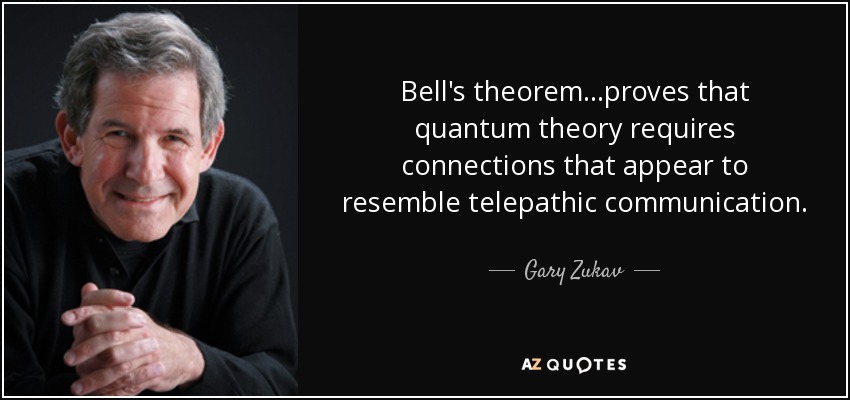
Bell's theorem...proves that quantum theory requires connections that appear to resemble telepathic communication.
Less depends upon the choice of words than upon this, that their introduction shall be justified by pregnant theorems.
The Open Source theorem says that if you give away source code, innovation will occur. Certainly, Unix was done this way... However, the corollary states that the innovation will occur elsewhere. No matter how many people you hire. So the only way to get close to the state of the art is to give the people who are going to be doing the innovative things the means to do it. That's why we had built-in source code with Unix. Open source is tapping the energy that's out there.
Bells theorem dealt a shattering blow to Einsteins position by showing that the conception of reality as consisting of separate parts, joined by local connections, is incompatible with quantum theory... Bells theorem demonstrates that the universe is fundamentally interconnected, interdependent, and inseparable.
Phyllis explained to him, trying to give of her deeper self, 'Don't you find it so beautiful, math? Like an endless sheet of gold chains, each link locked into the one before it, the theorems and functions, one thing making the next inevitable. It's music, hanging there in the middle of space, meaning nothing but itself, and so moving...'
MacPherson told me that my theorem can be viewed as blah blah blah Grothendieck blah blah blah, which makes it much more respectable.
In the "commentatio" (note presented to the Russian Academy) in which his theorem on polyhedra (on the number of faces, edges and vertices) was first published Euler gives no proof. In place of a proof, he offers an inductive argument: he verifies the relation in a variety of special cases. There is little doubt that he also discovered the theorem, as many of his other results, inductively.
He knew by heart every last minute crack on its surface. He had made maps of the ceiling and gone exploring on them; rivers, islands, and continents. He had made guessing games of it and discovered hidden objects; faces, birds, and fishes. He made mathematical calculations of it and rediscovered his childhood; theorems, angles, and triangles. There was practically nothing else he could do but look at it. He hated the sight of it.
Math does come easily to me, but I was always much more interested in what theorems imply about the world than in proving them.
There is a theorem that colloquially translates, You cannot comb the hair on a bowling ball. ... Clearly, none of these mathematicians had Afros, because to comb an Afro is to pick it straight away from the scalp. If bowling balls had Afros, then yes, they could be combed without violation of mathematical theorems.
Professor Eddington has recently remarked that 'The law that entropy always increases - the second law of thermodynamics - holds, I think, the supreme position among the laws of nature'. It is not a little instructive that so similar a law [the fundamental theorem of natural selection] should hold the supreme position among the biological sciences.
Do people believe in human rights because such rights actually exist, like mathematical truths, sitting on a cosmic shelf next to the Pythagorean theorem just waiting to be discovered by Platonic reasoners? Or do people feel revulsion and sympathy when they read accounts of torture, and then invent a story about universal rights to help justify their feelings?
A theorem is a proposition which is a strict logical consequence of certain definitions and other propositions.
That's the problem with false proofs of true theorems; it's not easy to produce a counterexample.
The story does what no theorem can quite do. It may not be "like real life" in the superficial sense: but it sets before us an image of what reality may well be like at some more central region.
What philosophy worthy of the name has truly been able to avoid the link between poem and theorem?
Gradually, at various points in our childhoods, we discover different forms of conviction. There's the rock-hard certainty of personal experience ("I put my finger in the fire and it hurt,"), which is probably the earliest kind we learn. Then there's the logically convincing, which we probably come to first through maths, in the context of Pythagoras's theorem or something similar, and which, if we first encounter it at exactly the right moment, bursts on our minds like sunrise with the whole universe playing a great chord of C Major.
There was a seminar for advanced students in Zürich that I was teaching and von Neumann was in the class. I came to a certain theorem, and I said it is not proved and it may be difficult. Von Neumann didn't say anything but after five minutes he raised his hand. When I called on him he went to the blackboard and proceeded to write down the proof. After that I was afraid of von Neumann.
Now, one of my beliefs, one of my theorems that I have evolved over the years is that when it comes to Democrats and the media they will always tell us who they fear. And all we have to do to learn that is look at who they're trying to damage and/or destroy.
Carnal embrace is sexual congress, which is the insertion of the male genital organ into the female genital organ for purposes of procreation and pleasure. Fermat’s last theorem, by contrast, asserts that when x, y and z are whole numbers each raised to power of n, the sum of the first two can never equal the third when n is greater than 2.
The Limbaugh Theorem was not about me giving me credit for something. It was simply sharing with you when the light went off.
What we do may be small, but it has a certain character of permanence; and to have produced anything of the slightest permanent interest, whether it be a copy of verses or a geometrical theorem, is to have done something utterly beyond the powers of the vast majority of men.
It is a melancholy experience for a professional mathematician to find himself writing about mathematics. The function of a mathematician is to do something, to prove new theorems, to add to mathematics, and not to talk about what he or other mathematicians have done. Statesmen despise publicists, painters despise art-critics, and physiologists, physicists, or mathematicians have usually similar feelings: there is no scorn more profound, or on the whole more justifiable, than that of the men who make for the men who explain. Exposition, criticism, appreciation, is work for second-rate minds.
The analysis of variance is not a mathematical theorem, but rather a convenient method of arranging the arithmetic.
An axiomatic system establishes a reverberating relationship between what a mathematician assumes (the axioms) and what he or she can derive (the theorems). In the best of circumstances, the relationship is clear enough so that the mathematician can submit his or her reasoning to an informal checklist, passing from step to step with the easy confidence the steps are small enough so that he cannot be embarrassed nor she tripped up.
Follow AzQuotes on Facebook, Twitter and Google+. Every day we present the best quotes! Improve yourself, find your inspiration, share with friends
or simply: