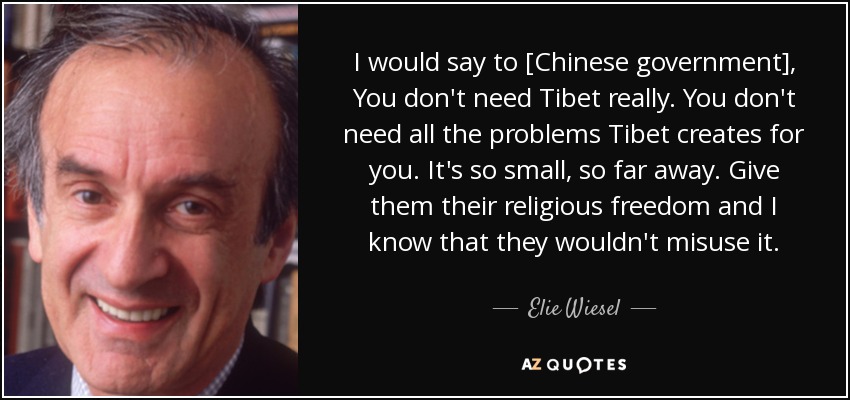
I would say to [Chinese government], You don't need Tibet really. You don't need all the problems Tibet creates for you. It's so small, so far away. Give them their religious freedom and I know that they wouldn't misuse it.
The Vietnam War ended because of the campus situation. And so many other injustices have been corrected in the World today only thanks to the young people. So, young people especially have a responsibility for Tibet.
Yet [Dalai Lama] has said very strongly that basic freedoms of thought and speech have to be respected in Tibet and they're not at the moment. Tolerance doesn't mean accepting what's unfair.
I wanted to bring the book out right now because I think anyone who cares about Tibet knew there would be disturbances in the run up to the Olympics [2008]. Many Tibetans feel it's their last chance to broadcast their suffering and frustration and pain to the world before the Olympics take place and China is accepted as a modern nation and the world forgets about Tibet.
The air they breathe, being a living element with both physical and psychical properties, carries a subtle vital energy. This in India is named by the Sanskrit word prana; in Tibet it is called sugs, in Aikido, Japan, ki, and in China, chi. By controlling its circulation throughout the body, man is able to attain spiritual enlightenment or illumination.
In Tibet there is no marriage, and there is no jealousy, yet we know that marriage is a much higher state. The Tibetans have not known the wonderful enjoyment, the blessing of chastity, the happiness of having a chaste, virtuous wife, or a chaste, virtuous husband. These people cannot feel that. And similarly they do not feel the intense jealousy of the chaste wife or husband, or the misery caused by unfaithfulness on either side, with all the heart-burnings and sorrows which believers in chastity experience. On one side, the latter gain happiness, but on the other, they suffer misery too.
Shambhala existed in Tibet and has been continued over the years, and now it is in the West. At its core, it is very much dedicated to the basic theme of benefiting others.
I find hope in the darkest of days, and focus in the brightest. I do not judge the universe.
My religion is very simple. My religion is kindness.
When I was two years old, I heard about his [Dalai Lama] flight from Tibet. Being very little, I said, "Oh, good Tibetans, bad Chinese." Those were the black-and-white ways that I thought.
China can keep her troops on the external frontiers of Tibet, and Tibetans will pledge to accept the appropriate form of union with China.
Self-rule means that China must stop its intensive effort to colonize Tibet with Chinese settlers and must allow Tibetans to hold responsible positions in the government of Tibet.
People in the West sometimes have these marvelous visions of India and Tibet. They assume that there are all these sadhus walking around and everybody is breathing enlightenment. Forget it. Don't look at it through rose-colored glasses.
I'm now nearly 79. At 16 I took responsibility for Tibet and lost my freedom. At 24 I lost my country and became a refugee. I've met difficulties, but as the saying goes: 'Wherever you're happy, you can call home, and whoever is kind to you is like your parents.' I've been happy and at home in the world at large. Living a meaningful life isn't just a matter of money; it's about dedicating your life to helping others.
Lord Rees-Mogg argues that the time for reconciliation in Tibet is passing with the looming departure of its spiritual leader.
[The Dalai Lama] told me some years ago, "I've made every concession to China, and I've been as open and tolerant as I could, and still things get worse in Tibet." If you look at it from one point of view, as he himself says, his monastic position of forbearance and nonviolence hasn't reaped any benefits. And yet, he's thinking in terms of the long term, of centuries.
Often when we think of exile we think of destruction or loss. But the Dalai Lama always says exile is reality, it's something we can make use of, and he has used it to get rid of everything that he thought was stifling and old, and to create a new, improved and much healthier Tibet.
You can continue your practice, you can exercise kindness, you can practice meditation whether you're in a prison or a millionaire's house, whether you're in India or Tibet.
Dalai Lama has made new opportunities for women that they never had in Tibet, introduced science into the monks' curriculum and had Tibetan students in exile take their classes in English after the age of ten so that they will know more about the outside world. But one of the great things he's done is to bring all the Tibetan groups together in exile, as perhaps they couldn't have been when they weren't in exile and they weren't under such pressure.
The buddha-dharma does not invite us to dabble in abstract notions. Rather, the task it presents us with is to attend to what we actually experience, right in this moment. You don't have to look "over there." You don't have to figure anything out. You don't have to acquire anything. And you don't have to run off to Tibet, or Japan, or anywhere else. You wake up right here. In fact, you can only wake up right here. So you don't have to do the long search, the frantic chase, the painful quest. You're already right where you need to be.
Members of the Rae Chorze-Fwaz order trace their origins back through Tibet, Japan, China, India, and ancient Egypt to the place the order was founded, the lost continent of Atlantis.
Tibet has a very proud people but it's culturally gone and overrun ever since the Chinese took over. It's like saving the rhino. When a species is endangered, it's gone.
They have their belief, these poor Tibet people, that Providence sends down always an Incarnation of Himself into every generation. At bottom some belief in a kind of Pope! At bottom still better, a belief that there is a Greatest Man; that he is discoverable; that, once discovered, we ought to treat him with an obedience which knows no bounds. This is the truth of Grand Lamaism; the "discoverability" is the only error here.
I have been clear in my position for quite a while, but the Chinese have not responded. Therefore, we are now in the process of holding a referendum on our policy among all the Tibetan community in exile and even inside Tibet, to check whether the majority thinks we are on the right track.
Many enlightened persons are never very well known. Many are reclusive. They live in little villages in India or up in the high Himalayas in Tibet. Some have no students at all. Some have a few.
Follow AzQuotes on Facebook, Twitter and Google+. Every day we present the best quotes! Improve yourself, find your inspiration, share with friends
or simply: