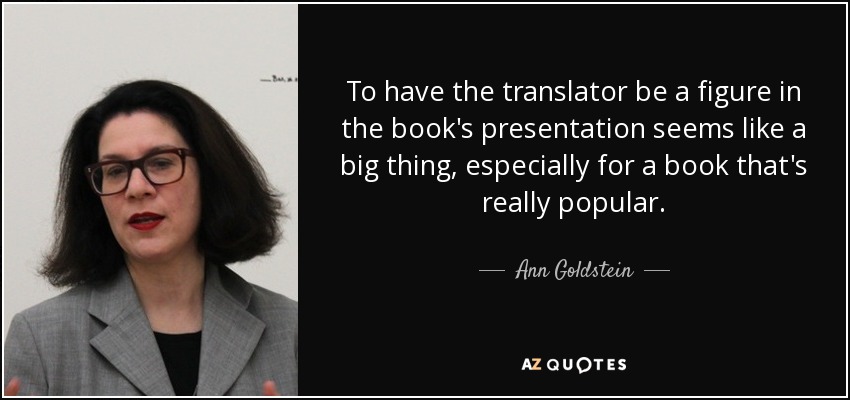
To have the translator be a figure in the book's presentation seems like a big thing, especially for a book that's really popular.
I was in the second year of my PhD when I first had the idea - I'd recently started working as a translator, which meant firstly that I was hearing about amazing-sounding books from other translators, and also that I was getting enough of an insider's view of the publishing industry to be aware of all the implicit biases that made it so difficult for these books to ever get published, especially if they weren't from European languages (harder to discover, editors can't read the original, lack of funding programmes, authors who don't speak English).
The translator ... Peculiar outcast, ghost in the world of literature, recreating in another form something already created, creating and not creating, writing words that are his own and not his own, writing a work not original to him, composing with utmost pains and without recognition of his pains or the fact that the composition really is his own.
In some sense the text and the translator are locked in struggle - 'I attacked that sentence, it resisted me, I attacked another, it eluded me' - a struggle in which, curiously, when the translator wins, the text wins too.
the translator, a lonely sort of acrobat, becomes confused in a labyrinth of paradox, or climbs a pyramid of dependent clauses and has to invent a way down from it in his own language.
Freud's translator accidentally omitted 'fashion' in the psychoanalytic list of primary instinctual drives; along with the drive to sexuality there is the drive to wear odd garments that may cut off circulation, occlude vision, make toes grow sideways, cause riots.
My upbringing was pretty interesting. It was a rigorous, intellectual upbringing, but with the idea that we were a part of an important and legitimate enterprise. What that meant was sitting around the dinner table from a really early age with people from all different backgrounds who believed in God. When I was reporting in the wake of September 11th in Iraq and elsewhere, I felt I had the capacity to talk to people whose beliefs might sound outlandish to more secular journalists. I felt like I could be a translator between those two worlds.
However, there is one great temptation and that is that you can forget that the aim of the writer was to reject all other worlds and to construct one of his own and that the aim of the translator is to re-embody himself into the world of the various writers.
My best friend Madison keeps a list on her phone of all of the different English slang that I say, so she has kind of like a translator so she can understand without having to ask me, "What on Earth are you talking about when you say 'nackered'?"
I've never translated more than one book by any author. But I'm fascinated by translators who have, like Richard Zenith, who's translated so much of Fernando Pessoa's work. I get restless for a new kind of influence. The books I've translated are books I want to learn from as a writer, to be intoxicated by. And translation is an act of writing in itself. It's an act of recreation - of a writer's cadence and tone and everything that distinguishes the voice in the book.
The impresario functions as a bridge and a translator. He or she is a bridge between the creative point of view - which is often very focused on the creative task itself - and the resource-allocation process. The impresario has to make certain the funds and people required to get that task completed are available.
When a translator translates my book, it is no longer just my book. It is the translator's book, too. So the book in another language is almost the work of two people. And that is quite interesting to me.
There is an old Italian proverb about the nature of translation: "Traddutore, traditore!" This means simply, "Translators-traitors!" Of course, as you can see, something is lost in the translation of this pithy expression: there is great similarity in both the spelling and the pronunciation of the original saying, but these get diluted once they are put in English dress. Even the translation of this proverb illustrates its truth!
These are crystalline - oftentimes incandescent - translations of Juarroz's powerful metaphysical poems where eternity and silence jut up against a world where “writing infects the landscape” and there are “more letters than leaves” - The kind of match one hopes for where both the translator and the poet are in luck; new poems which don't leak and yet old poems in which the original passion shines.
I have a deep love for the art of translation, and I couldn't find a novel that captured the fascinating, reckless adventure of it as I'd experienced it, or portrayed translators as the passionate risk-takers that so many of the translators I know are. So I wrote the book I couldn't find.
Judge: And what is your occupation in general? Brodsky: Poet, poet-translator. Judge: And who recognized you to be a poet? Who put you in the ranks of poet? Brodsky: No one. And who put me in the ranks of humanity? Judge: Did you study it?...How to be a poet? Did you attempt to finish an insitute of higher learning...where they prepare...teach Brodsky: I did not think that it is given to one by education. Judge: By what then? Brodsky: I think that it is from God.
I think that being an editor, someone who works with words, is very good training for being a translator because it trains you to be attentive to words in a very specific, very concrete, very literal way.
The most basic barrier was language itself, very few Americans in Iraq whether soldiers or diplomats or news paper reporters could speak more than a few words of Arabic. A remarkable number of them didn't even have translators. That meant for many Iraqis the typical 19 year old army corporal from South Dakota was not a youthful innocent carrying Americas good will, he was a terrifying combination of firepower and ignorance.
I think the close work I do as a translator pays off in my writing - I'm always searching for multiple ways to say things.
One of my favorite poets, Neruda, writes close to the bone. Though I know only a little Spanish, I like to compare the Spanish and English lines and see how the translator worked.
My mom's a translator, my dad's a woodworker; that's the world I grew up in, that's the world I'm most comfortable in. The whole idea of Hollywood or any of that other stuff that unfortunately goes along with film, that wasn't part of my upbringing, thankfully.
The CIA will only hire people with impeccable credentials to be a translator. 'Impeccable credentials' means you've never lived outside the United States.
Boys! Are they always this impossible? Do they always say cryptic, indecipherable things? (Note to self: work with Liz to adapt her boy-to-English translator into a more mobile form—like maybe a watch or necklace.)
The credulity of the church is decreasing, and the most marvelous miracles are not either 'explained,' or allowed to take refuge behind the mistakes of the translators, or hide in the drapery of allegory.
It was an epiphany when I realized you don't have to call yourself a linguist, a translator, a poet. You can call yourself an artist and you can do all these things.
Follow AzQuotes on Facebook, Twitter and Google+. Every day we present the best quotes! Improve yourself, find your inspiration, share with friends
or simply: