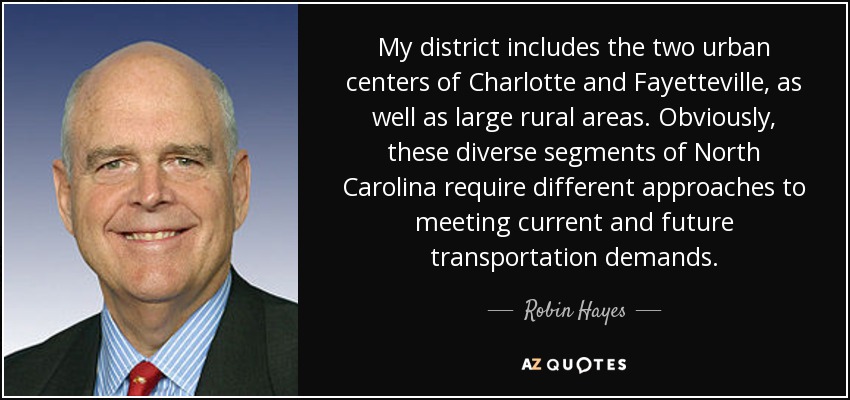
My district includes the two urban centers of Charlotte and Fayetteville, as well as large rural areas. Obviously, these diverse segments of North Carolina require different approaches to meeting current and future transportation demands.
And when these advances are made, hydrogen can fill critical energy needs beyond transportation. Hydrogen can also be used to heat and generate electricity for our homes. The future possibilities of this energy source are enormous.
I am accordingly ready; I have pressed as many Cabinet papers into trunks as to fill one carriage; our private property must be sacrificed, as it is impossible to procure wagons for its transportation.
A preventive war, to my mind, is an impossibility today. How could you have one if one of its features would be several cities lying in ruins, several cities where many, many thousands of people would be dead and injured and mangled, the transportation systems destroyed, sanitation implements and systems all gone? That isn't preventive war; that is war.
You have a transportation fetish. I have a Gideon fetish. It's been weeks.
The purpose behind terrorism is to instill fear in people - the fear that electrical power, for instance, will be taken away or the transportation system will be taken down.
Sergey and I founded Google because we're super optimisitc about the potential for technology to make the world a better place. Think about how many people are underserved by transportation today, like those with disabilities, and how self driving cars will transform their lives. Or the wasted time you sit in your car every day commuting to and from work. Or the deaths and injuries that could be avoided.
Hockey is probably one of the most expensive sports. You have to have a place to play. You have to have the proper equipment. You have to have the transportation to get there.
If transportation technology was moving along as fast as microprocessor technology, then the day after tomorrow I would be able to get in a taxi cab and be in Tokyo in 30 seconds.
Despite the dazzling successes of modern technology and the unprecedented power of modern military systems, they suffer from a common and catastrophic fault. While providing us with a bountiful supply of food, with great industrial plants, with high-speed transportation, and with military weapons of unprecedented power, they threaten our very survival.
We're told cars are wasteful. Wasteful of what? Oil did a lot of good sitting in the ground for millions of years. We're told cars should be replaced with mass transportation. But it's hard to reach the drive-through window at McDonald's from a speeding train. And we're told cars cause pollution. A hundred years ago city streets were ankle deep in horse excrement. What kind of pollution do you want? Would you rather die of cancer at eighty or typhoid fever at nine?
Upon the decease [of] my wife, it is my Will and desire th[at] all the Slaves which I hold in [my] own right, shall receive their free[dom] . . . . The Negroes thus bound, are (by their Masters or Mistresses) to be taught to read and write; and to be brought up to some useful occupation, agreeably to the Laws of the Commonwealth of Virginia, providing for the support of Orphan and other poor Children. And I do hereby expressly forbid the Sale, or transportation out of the said Commonwealth, of any Slave I may die possessed of, under any pretence whatsoever.
Intelligent transportation technology is key to better parking management. The adage that "You can't manage what you can't measure" fits parking perfectly.
Transportation is an essential part of our lives, and in New York City where driving is not a viable option most of the time, public transportation and taxis are the only way to get around.
One important role for the city is to conduct studies to document areas of greatest need, and to facilitate coordination between our public and private transportation options to weave it into a dense tapestry of accessible and reliable transportation.
When the toll upon carriages of luxury, upon coaches, post-chaises, etc. is made somewhat higher in proportion to their weight, than upon carriages of necessary use, such as carts, wagons, etc. the indolence and vanity of the rich is made to contribute in a very easy manner to the relief of the poor, by rendering cheaper the transportation of heavy goods to all the different parts of the country.
The United States as we know it today is largely the result of mechanical inventions, and in particular of agricultural machinery and the railroad. One transformed millions of acres of uncultivated land into fertile farms, while the other furnished the transportation which carried the crops to distant markets.
In the United States three new methods of transportation made their appearance at almost the same time - the steamboat, the canal boat, and the rail car
It is not to the moderation and justice of others we are to trust for fair and equal access to market with out productions, or for our due share in the transportation of them; but to our own means of independence, and the firm will to use them.
There is simply no room left for 'freedom from the tyranny of government' since city dwellers depend on it for food, power, water, transportation, protection, and welfare. Your right to live where you want, with companions of your choosing, under laws to which you agree, died in the eighteenth century with Captain Mission. Only a miracle or a disaster could restore it.
Making information free is survivable so long as only limited numbers of people are disenfranchised. As much as it pains me to say so, we can survive if we only destroy the middle classes of musicians, journalists, and photographers. What is not survivable is the additional destruction of the middle classes in transportation, manufacturing, energy, office work, education, and health care. And all that destruction will come surely enough if the dominant idea of an information economy isn't improved.
For carbon-neutral cities, there are things worth talking about in how our consumption patterns can change - sharing goods, etc. - but those are a fraction of the impacts of transportation and building energy use. If we need to choose priority actions, the most important things are to densify, provide transit, and green the buildings.
While greenies and their media flunkies continue to savage the gasoline-powered internal-combustion engine and rhapsodize about hybrids, hydrogen, electrics, natural gas, propane, nuclear, and God-knows-what-other panaceas, perhaps including bovine urine, there are no realistic, economically viable alternatives. None. Zero. Like it or not, as long as we remain dependent on the private automobile for transportation (roughly 80 percent of all movement in the nation is by car), we are harnessed to the IC gas engine.
In Chekhov, when people leave, a carriage is taking them away forever. The stakes are so high just for someone to make a simple exit. And now we have all this access to public transportation, automobiles and jets and the Internet; we're so easily distracted, but the world is still designed to destroy you. It just happens quicker and faster now.
The system of transportation is not coherent; it is not treated as integral. Roads compete with with railroads and airlines in chaotic fashion, and at immense cost to the nation.
Follow AzQuotes on Facebook, Twitter and Google+. Every day we present the best quotes! Improve yourself, find your inspiration, share with friends
or simply: