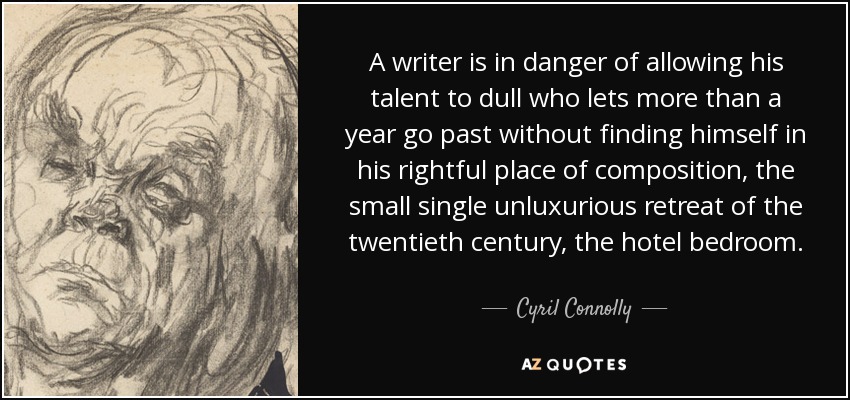
A writer is in danger of allowing his talent to dull who lets more than a year go past without finding himself in his rightful place of composition, the small single unluxurious retreat of the twentieth century, the hotel bedroom.
The shock of twentieth-century technology numbed our brains and we are just beginning to notice the spiritual and social debris that our technology has strewn about us.
In the twentieth century, the repellent, harrowing disease that is made the index of a superior sensitivity, the vehicle of "spiritual" feelings and "critical" discontent, is insanity.
It's becoming clearer and clearer to me that the world is there to be celebrated by writers, and in fact this is what all the good ones do, and that the great fashion for gloom and grimness was in fact a false path that certain writers took, I think in response to the horrors of the first half of the twentieth century.
Death of a Salesman' is a brilliant taxonomy of the spiritual atrophy of mid-twentieth-century white America.
Like the tail fins on fifties American cars or the parabolic shapes of Populuxe furniture, 'West Side Story' incarnates the dream of momentum in the golden age of the twentieth century.
It was only in the late nineteenth century and then the twentieth century, with the maturation of consumer capitalism, that a shift was made toward the cultivation of unbounded desire. We must appreciate this to realize that late modern consumption, consumption as we now know it, is not fundamentally about materialism or the consumption of physical goods. Affluence and consumer-oriented capitalism have moved us well beyond the undeniable efficiencies and benefits of refrigeration and indoor plumbing.
I've always thought photography was an art form, but it had very low appreciation in the beginning, except for some Europeans, and of course Stieglitz. Stieglitz always considered photography to be an art form and is the "father" of the creative concepts of the twentieth century.
We're facing growing climate change, more floods, more droughts, more crisis on a planetary level, and the systems we put in place in the twentieth century are just not going to work. We've run out of stuff. Our big problems are going to be energy supplies and food supplies. This is not a right-left issue.
Japan had a more radical experience of future shock than any other nation in the Nineteenth and Twentieth Centuries. They were this feudal place, locked in the past, but then they bought the whole Industrial Revolution kit from England, blew their cultural brains out with it, became the first industrialized Asian nation, tried to take over their side of the world, got nuked by the United States for their trouble, and discovered Steve McQueen! Their take on iconic menswear emerges from that matrix.
To have a great university library near you with plenty of archives of all the journals that you want to research in the twentieth century is a remarkable asset, and I spend a day, maybe two days a week in that library. I just plain love it.
The trouble with Christianity was that by about 150, there were hardly any Jews left in the Christian church, and so from that time until the last part of the twentieth century, the only people reading the gospels and interpreting the gospels and writing commentaries on the gospels were gentiles who were simply ignorant of the Jewish background, and I just thought they were prejudiced.
As the corporation's size and power grew, so did the need to assuage people's fears of it. The corporation suffered its first full-blown legitimacy crisis in the wake of the early-twentieth-century merger movement, when, for the first time, many Americans realized that corporations, now turned behemoths, threatened to overwhelm their social institutions and governments.
Since ancient times, the left side has stood for the side of the unconscious or the unknown; the right side, by contrast, has represented the side of consciousness or wakefulness. Through the late twentieth century, the movement of the Left limited themselves to a materialist understanding of reality- exemplified by Marxism- demanding social justice and economic equality but not the restoration of intuition and the recognition of the hidden, qualitative dimensions of being suppressed by the mental-rational consciousness, narrowly focused on the quantifiable.
Jack Vance's Lyonesse books are the greatest fairy tale of the twentieth century.
The effect of the discovery of printing was evident in the savage religious wars of the sixteenth and seventeenth centuries. Application of power to communication industries hastened the consolidation of vernaculars, the rise of nationalism, revolution, and new outbreaks of savagery in the twentieth century.
It has been a long road from Plato's Meno to the present, but it is perhaps encouraging that most of the progress along that road has been made since the turn of the twentieth century, and a large fraction of it since the midpoint of the century. Thought was still wholly intangible and ineffable until modern formal logic interpreted it as the manipulation of formal tokens. And it seemed still to inhabit mainly the heaven of Platonic ideals, or the equally obscure spaces of the human mind, until computers taught us how symbols could be processed by machines.
The twentieth century saw the emergence of a Churchless Mission and a Missionless Church
J.L. Moreno was a pioneer of twentieth-century theater and psychotherapy. A remarkable work, Impromptu Man should be required reading for therapists and dramatists alike.
Follow AzQuotes on Facebook, Twitter and Google+. Every day we present the best quotes! Improve yourself, find your inspiration, share with friends
or simply: