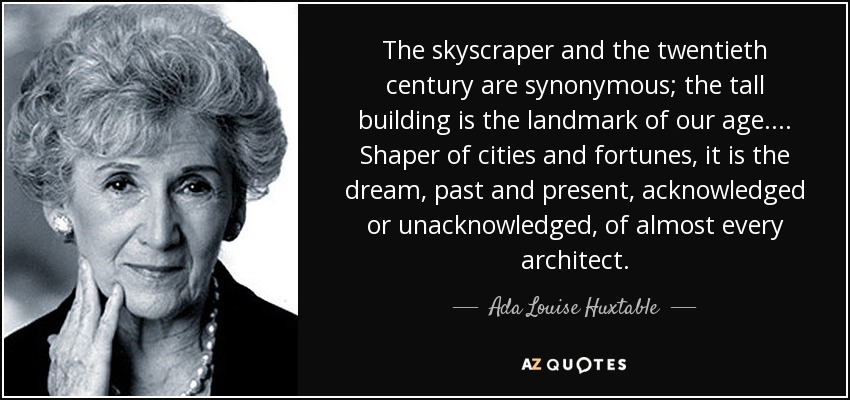
The skyscraper and the twentieth century are synonymous; the tall building is the landmark of our age. ... Shaper of cities and fortunes, it is the dream, past and present, acknowledged or unacknowledged, of almost every architect.
The advertising agency, as it stands today, is a peculiar manifestation of American business life of the twentieth century - glossy, brash, and insecure.
Should an anthropologist or a sociologist be looking for a bizarre society to study, I would suggest he come to Ulster. It is one of Europe's oddest countries. Here, in the middle of the twentieth century, with modern technology transforming everybody's lives, you find a medieval mentality that is being dragged painfully into the eighteenth century by some forward-looking people.
It is easy to be mindless in America, because dreaming of and living for a better tomorrow is the American way. ... The problem is, in the second half of the twentieth century, we have gotten so good at living for tomorrow that most of us spend very little time in the present.
I have no doubt that historians will conclude that we of the twentieth century had intelligence enough to create a great civilization but not the moral wisdom to preserve it.
Whoever takes it upon himself to write an honest intellectual history of twentieth-century Europe will need a strong stomach. But he will need something more. He will need to overcome his disgust long enough to ponder the roots of this strange and puzzling phenomenon.
The volumes which record the history of the human race are filled with the deeds and the words of great men ... [but] The Twentieth Century Woman ... questions the completeness of the story.
To ignore [the] great social facts -- political facts, if you please -- and over-emphasize the old moral responsibility of the 'domestic' mother is a hollow mockery and betrays a hopeless ignorance of industrial and urban conditions in the Twentieth Century. ... Everything that counts in the common life is political.
Early-twentieth-century abstraction is art's version of Einstein's Theory of Relativity. It's the idea that changed everything everywhere: quickly, decisively, for good.
It is not possible to overstate the influence of Paul Cezanne on twentieth-century art. He's the modern Giotto, someone who shattered one kind of picture-making and invented a new one that the world followed.
The second half of the twentieth century is a complete flop.
While public school history courses in the United States stress the horrors of the German Nazi murder of 6 million Jews and Josef Stalin's pogroms against racial minorities and political dissidents in the Soviet Union, the facts that the U.S. Army's solution to the 'Indian Problem' was the prototype for the Nazi 'Final Solution' to the 'Jewish Problem' and that the North American Indian Reservation was the model for the twentieth century gulag and concentration camp, are conveniently overlooked.
To define twentieth-century humanism briefly, I would say that it is a philosophy of joyous service for the greater good of all humanity in this natural world and advocating the methods of reason, science, and democracy.
When Theodore Roosevelt was in the White House, he confessed that if he could be right 75 percent of the time, he would reach the highest measure of his expectation. . . . If that was the highest rating that one of the most distinguished men of the twentieth century could hope to obtain, what about you and me?
The greatest leaders in fighting for an integrated America in the twentieth century were in the Democratic Party. The fact is, it was the liberal wing of the Democratic Party that ended segregation. The fact is that it was Franklin Delano Roosevelt who gave hope to a nation that was in despair and could have slid into dictatorship. And the fact is, every Republican has much to learn from studying what the Democrats did right.
The humanities and science are not in inherent conflict but have become separated in the twentieth century. Now their essential unity must be re-emphasized, so that twentieth-century multiplicity may become twentieth-century unity.
For the first time in its history, Western Civilization is in danger of being destroyed internally by a corrupt, criminal ruling cabal which is centered around the Rockefeller interests, which include elements from the Morgan, Brown, Rothschild, Du Pont, Harriman, Kuhn-Loeb, and other groupings as well. This junta took control of the political, financial, and cultural life of America in the first two decades of the twentieth century.
The twentieth century was the bankruptcy of the social utopia; the twenty-first will be that of the technological one.
Humanity cannot afford to muddle through the rest of the twentieth century; the risks are too great, and the stakes are too high. This may be the last opportunity to choose our own and our descendants’ destiny. Failing to choose or making the wrong choices may lead to catastrophe. But it must never be forgotten that the right choices could lead to a much better world.
And in this silence of the dumb and these speeches of the blind, in this medly of people bound together by the same grief, terror and hope, in this hatred and lack of understanding between men who spoke the same tongue, you could see much of the tragedy of the twentieth century.
It is the mission of the twentieth century to elucidate the irrational.
Ireland is a peculiar society in the sense that it was a nineteenth century society up to about 1970 and then it almost bypassed the twentieth century.
There is no task of greater importance than to give our children the very best preparation for the demands of an ominous future, a preparation which aims at the methodical cultivation of their spiritual and their moral gifts. As long as the exemplary work of the Waldorf School Movement continues to spread its influence as it has done over the past decades, we can all look forward with hope. I am sure that Rudolf Steiner’s work for children must be considered a central contribution to the twentieth century and I feel it deserves the support of all freedom-loving thinking people.
In the past 20 years alone, it adds up to more death than were caused by all the civil and international wars adn government repression of the entire twentieth century, the century of Hitler and Stalin. How much would we give to prevent those horrors? Yet how little are we doing to prevent today's even larger toll and all the misery that it involves? I believe that if you read this book to the end, and look honestly and carefully at our situation, assessing both the facts and the ethical arguments, you will agree that we must act.
I now want to tell three stories about advances in twentieth-century physics. A curious fact emerges in these tales: time and again physicists have been guided by their sense of beauty not only in developing new theories but even in judging the validity of physical theories once they are developed. Simplicity is part of what I mean by beauty, but it is a simplicity of ideas, not simplicity of a mechanical sort that can be measured by counting equations or symbols.
Follow AzQuotes on Facebook, Twitter and Google+. Every day we present the best quotes! Improve yourself, find your inspiration, share with friends
or simply: