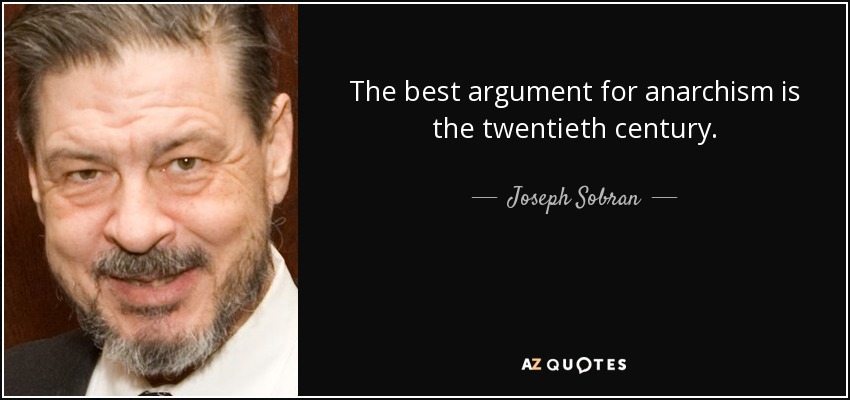
The best argument for anarchism is the twentieth century.
These terrible sociologists, who are the astrologers and alchemists of our twentieth century.
Social historians of the future no doubt will be amused by the fact that we late-twentieth-century Americans found it acceptable to discuss publicly in detail the most intimate aspects of personal life, while maintaining an almost prudish reserve concerning the political significance of family life.
The great crimes of the twentieth century were committed not by money-grubbing capitalists but by dedicated idealists. Lenin, Stalin, and Hitler were contemptuous of money. The passage from the nineteenth to the twentieth century has been a passage from considerations of money to considerations of power.
In my opinion, the most significant works of the twentieth century are those that rise beyond the conceptual tyranny of genre; they are, at the same time, poetry, criticism, narrative, drama, etc.
Space exploration must be undertaken not only out of simple human curiosity but also to further the survival of the species. The twentieth century has seen the unprecedented development and proliferation of magnificent technologies. Many of them, through design, ignorance, or misuse, are capable of destroying life as well as enhancing it. Space exploration alone holds the promise of eventual escape from a dying planet, provided we wisely manage our resources in the meantime and actually survive that long.
If two or three hundred years from now an earthbound civilization is dying ... and they look back at the opportunity that we have here at the close of the twentieth century to move out into space and they see that we didn't do anything with it ... I don't want history to judge us on having blown this opportunity, and I think history will judge us on this more than on any other issue.
Although when Christianity appeared the total population of the planet was only a fraction of that of the twentieth century, most of the earth's surface was quite outside the Mediterranean world, Persia, India, and China.
In the course of his long, turbulent career, W. E. B. Du Bois attempted virtually every possible solution to the problem of twentieth-century racism...scholarship, propaganda, integration, national self-determination, human rights, cultural and economic separatism, politics, international communism, expatriation, third world solidarity.
There is an old song which asserts 'the best things in life are free.' Not true! Utterly false! This was the tragic fallacy which brought on the decadence and collapse of the democracies of the twentieth century; those noble experiments failed because the people had been led to believe that they could simply vote for whatever they wanted...and get it without toil, without sweat, without tears. Nothing of value is free. Even the breath of life is purchased at birth only through gasping effort and pain.
Any page by Paul Goodman will give you not only originality and brilliance but wisdom, that is, something to think about. He is our peculiar, urban, twentieth-century Thoreau, the quintessential American mind of our time.
The twentieth century will be chiefly remembered by future generations not as an era of political conflicts or technical inventions, but as an age in which human society dared to think of the welfare of the whole human race as a practical objective.
Which is to say that culture is not a reflex of political economy, but that society is now a reflex of key shifts in music theory and practice.... [Sampladelia is] the sound made by those early-twentieth-century discoveries in particle physics and relativiity theory, the projection of the minds of Einstein, Heisenbery, and Bohr, their fateful explorations of liquid time, curving space, uncertainty fields and relativity theorems, into densely configured and fully ambivalent android music tracks
With the opening of the second decade of the twentieth century it seemed that the stage was set for the last act in an unquestioned evolutionary drama.
We may be sure that the characteristic blindness of the twentieth century [...] lies where we have never suspected it [...] The only palliative is [...] by reading old books. [...] the books of the future would be just as good [...], but unfortunately we cannot get at them.
It would take 2,000 Vietnam Memorials to list the [Twentieth] century's war dead.
Medical research in the twentieth century mostly takes place in the lab; in the Renaissance, though, researchers went first and foremost to the library to see what the ancients had said.
It is a violation which has obsessed the tyrants of the twentieth century. They do not want simply to kill their opponents, but to liquidate them, to deny that they have ever existed.
Given that the nineteenth century was the century of Socialism, of Liberalism, and of Democracy, it does not necessarily follow that the twentieth century must also be a century of Socialism, Liberalism and Democracy: political doctrines pass, but humanity remains, and it may rather be expected that this will be a century of authority ... a century of Fascism. For if the nineteenth century was a century of individualism it may be expected that this will be the century of collectivism and hence the century of the State.
In the twentieth century the number of people killed by their own governments under authoritarian regimes is four times the number killed in all this century's wars combined.
Why is life at this point in the twentieth century so focused upon the very beginning of life and the very end of life? What about the 80 years we have to live between those two inexorable bookends?
I got good notice from that show, and on the last day of filming Townies, Twentieth Century Fox called wanting to meet with me about a development deal.
In this century the writer has carried on a conversation with madness. We might almost say of the twentieth-century writer that he aspires to madness. Some have made it, of course, and they hold special places in our regard. To a writer, madness is a final distillation of self, a final editing down. It's the drowning out of false voices.
Celibacy is one of the most unnatural things. It has destroyed so many human beings - millions - Catholic monks, Hindu monks, Buddhist monks, Jaina monks, nuns. For centuries they have been teaching celibacy; and the most amazing thing is, even in the twentieth century, not a single medical expert, physiologist, has stood up and said that celibacy is impossible, that in the very nature of things, it cannot happen.
Twenty-first century medicine must not be confined to a twentieth-century bureaucracy.
Follow AzQuotes on Facebook, Twitter and Google+. Every day we present the best quotes! Improve yourself, find your inspiration, share with friends
or simply: