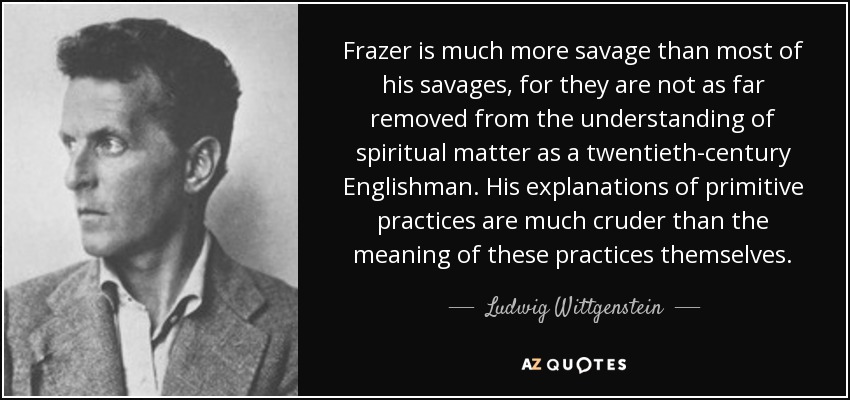
Frazer is much more savage than most of his savages, for they are not as far removed from the understanding of spiritual matter as a twentieth-century Englishman. His explanations of primitive practices are much cruder than the meaning of these practices themselves.
The twentieth century was marked by two broad trends: the regulation of capitalism and the deregulation of democracy. Both experiments overreached.
As the twentieth century began, science equaled a materialistic worldview. As the twenty-first century began, the worldview of science, at least of physics and astronomy, may have traded place with that of religion. Consider Einstein's famous equation E = mc2. Nothing of matter dies but continues on in another form, elsewhere. The church divines and theologians for two thousand years have devised arguments and "proofs" of immortality but nothing equal to this.
The central event of the twentieth century is the overthrow of matter. ...The powers of the mind are everywhere ascendant over the brute force of things.
A championship contender in the early twentieth century needed charisma and a knack for cultivating sponsorship, and Rubinstein was the epitome of the shy and unsocial chess player. Now matter how great his chess skills, he lacked the people skills to be a self-promoter and fund-raiser.
News objectivity is a twentieth-century myth. We only complain about propaganda when we don't agree with it.
Cartoonist Walt Disney has made the twentieth century's only important contribution to music. Disney has made use of music as language.
What happened to poetry in the twentieth century was that it began to be written for the page.
It is surely indisputable that no single leader in the twentieth century exerted as great an influence on the course of world history as Lenin.
Today the governments of Latin America should be ashamed of not havingexterminated the indigenous, at the end of the twentieth century, because weexist at the end of this century. We are not myths of the past, ruins in thejungle, or zoos. We are people and we want to be respected, not to be victims ofintolerance and racism.
Bismarck fought 'necessary' wars and killed thousands, the idealists of the twentieth century fight 'just' wars and kill millions.
Thanks to the discoveries of astronomers in the twentieth century, we now know that the heat death is a myth. The heat death can never happen, and there is no paradox.
The hope for the twentieth century rests on recognition that war and depression are man-made, and needless. They can be avoided in the future by turning from the nineteenth-century characteristics just mentioned (materialism, selfishness, false values, hypocrisy, and secret vices) and going back to other characteristics that our Western Society has always regarded as virtues: generosity, compassion, cooperation, rationality, and foresight, and finding a increased role in human life for love, spirituality, charity, and self discipline.
The Italian historian Armando Petrucci has done more than anyone else to revive interest in public writing. His groundbreaking Public Lettering: Script, Power, and Culture surveys the forms and uses of epigraphic writing from classical antiquity to the twentieth century.
It is arguable that the success of business propaganda in persuading us, for so long, that we are free from propaganda is one of the most significant propaganda achievements of the twentieth century.
The twentieth century was about getting around. The twenty-first century will be about staying in a place worth staying in.
Nevertheless, during the sixty years of the twentieth century many problems have come increasingly into the realm of acceptable public discussion.
In the nineteenth century, which was a dark and inflationary age in typography, man compositors were encouraged to stuff extra space between sentences. Generations of twentieth-century typists were then taught to do the same, by hitting the spacebar twice after every period. Your typing as well as your typesetting will benefit from unlearning this quaint Victorian habit.
Collage is the twentieth century's greatest innovation
In the twentieth century, men -- all of us -- find themselves compelled to commit or condone evil for the sake of preventing an evil believed to be greater. And the tragedy is that we do not know whether the evil we condone will not in the end be greater than the evil we seek to avert-- or be identified with.
Considered in its entirety, psychoanalysis won't do. It is an end product, moreover, like a dinosaur or a zeppelin; no better theory can ever be erected on its ruins, which will remain for ever one of the saddest and strangest of all landmarks in the history of twentieth century thought.
The recently ended twentieth century was characterized by a level of human rights violations unparalleled in all of human history. In his book Death by Government, Rudolph Rummel estimates some 170 million government-caused deaths in the twentieth century. The historical evidence appears to indicate that, rather than protecting life, liberty, and the pursuit of happiness of their citizens, governments must be considered the greatest threat to human security.
Future historians, I hope, will consider the American fast food industry a relic of the twentieth century--a set of attitudes, systems, and beliefs that emerged from postwar southern California, that embodied its limitless faith in technology, that quickly spread across the globe, flourished briefly, and then receded, once its true costs became clear and its thinking became obsolete.
It is the retention by twentieth-century, Atom-Age men of the Neolithic point of view that says: You stay in your village and I will stay in mine. If your sheep eat our grass we will kill you, or we may kill you anyhow to get all the grass for our own sheep. Anyone who tries to make us change our ways is a witch and we will kill him. Keep out of our village.
If the church of today does not recapture the sacrificial spirit of the early church, it will lose its authentic ring, forfeit the loyalty of millions, and be dismissed as an irrelevant social club with no meaning for the twentieth century.
Follow AzQuotes on Facebook, Twitter and Google+. Every day we present the best quotes! Improve yourself, find your inspiration, share with friends
or simply: