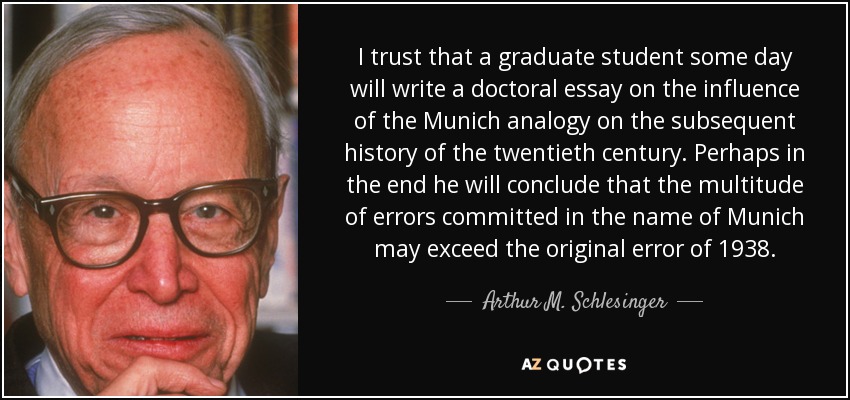
I trust that a graduate student some day will write a doctoral essay on the influence of the Munich analogy on the subsequent history of the twentieth century. Perhaps in the end he will conclude that the multitude of errors committed in the name of Munich may exceed the original error of 1938.
It has been said that the three great develpments in twentieth century science are relativity, quantum mechanics, and chaos. That strikes me the same as saying that the three great developments in twentith century engineering are the airplane, the computer, and the pop-top aluminum can. Chaos and fractals are not even twentieth century ideas: chaos was first observed by Poincare and fractals were familiar to Cantor a century ago, although neither man had the computer at his disposal to show the rest of the world the beauty he was seeing.
The wearing of fabric head coverings in worship was universally the practice of Christian women until the twentieth century. What happened? Did we suddenly find some biblical truth to which the saints for thousands of years were blind? Or were our biblical views of women gradually eroded by the modern feminist movement that has infiltrated the Church
I think it is beyond doubt that H. P. Lovecraft has yet to be surpassed as the twentieth century's greatest practitioner of the classic horror tale.
If you can't say something nice... about an overrated, ungrateful European nation that would have been wiped off the face of the earth twice in the twentieth century if it weren't for the United States and which has given nothing to the culture in the past two hundred years but whine and cheese, both of which are made better in California, then don't say anything at all!
In the nineteenth and twentieth centuries you have these great nation states hurling their young men at one another. The victory was really going to rest on who could do the best job of bringing up their kids to become efficient and effective soldiers. That's pretty grandiose, I guess, but I do think that, and thank God it's been the armies of democracy that have emerged from this as the triumphant armies.
And when you look at the twentieth-century experiment with collectivism-that Ayn Rand, more than anybody else, did such a good job of articulating the pitfalls of statism and collectivism-you can't find another thinker or writer who did a better job of describing and laying out the moral case for capitalism than Ayn Rand.
This filthy twentieth century. I hate its guts.
The twentieth century seems afflicted by a gigantic... power failure. Powerlessness and the sense of powerlessness may be the environmental disease of the age.
Twentieth-century art has allowed me to see things in a cryptic way. I love the butterfly's wings, which disappear when folded and when open leave this brilliant, intense pronouncement of nature, 'Here I am.'
The degeneration of the revolution in Russia does not pass from the revolution for communism to the revolution for a developed kind of capitalism, but to a pure capitalist revolution. It runs in parallel with world-wide capitalist domination which, by successive steps, eliminates old feudal and Asiatic forms in various zones. While the historical situation in the seventeenth, eighteenth and nineteenth centuries caused the capitalist revolution to take liberal forms, in the twentieth century it must have totalitarian and bureaucratic ones.
Widespread caffeine use explains a lot about the twentieth century.
The civilization of the twentieth century cannot be universal except by being a dynamic synthesis of all the cultural values of all civilizations. It will be monstrous unless it is seasoned with the salt of negri-tude, for it will be without the savor of humanity.
Social historians of the future no doubt will be amused by the fact that we late-twentieth-century Americans found it acceptable to discuss publicly in detail the most intimate aspects of personal life, while maintaining an almost prudish reserve concerning the political significance of family life.
The great crimes of the twentieth century were committed not by money-grubbing capitalists but by dedicated idealists. Lenin, Stalin, and Hitler were contemptuous of money. The passage from the nineteenth to the twentieth century has been a passage from considerations of money to considerations of power.
In my opinion, the most significant works of the twentieth century are those that rise beyond the conceptual tyranny of genre; they are, at the same time, poetry, criticism, narrative, drama, etc.
If two or three hundred years from now an earthbound civilization is dying ... and they look back at the opportunity that we have here at the close of the twentieth century to move out into space and they see that we didn't do anything with it ... I don't want history to judge us on having blown this opportunity, and I think history will judge us on this more than on any other issue.
Although when Christianity appeared the total population of the planet was only a fraction of that of the twentieth century, most of the earth's surface was quite outside the Mediterranean world, Persia, India, and China.
In the course of his long, turbulent career, W. E. B. Du Bois attempted virtually every possible solution to the problem of twentieth-century racism...scholarship, propaganda, integration, national self-determination, human rights, cultural and economic separatism, politics, international communism, expatriation, third world solidarity.
In some far-off distant time, when the twentieth century history of primitive computing is just a murky memory, someone is likely to suppose that devices known as logic gates were named after the famous co-founder of Microsoft Corporation
There is an old song which asserts 'the best things in life are free.' Not true! Utterly false! This was the tragic fallacy which brought on the decadence and collapse of the democracies of the twentieth century; those noble experiments failed because the people had been led to believe that they could simply vote for whatever they wanted...and get it without toil, without sweat, without tears. Nothing of value is free. Even the breath of life is purchased at birth only through gasping effort and pain.
Any page by Paul Goodman will give you not only originality and brilliance but wisdom, that is, something to think about. He is our peculiar, urban, twentieth-century Thoreau, the quintessential American mind of our time.
The twentieth century will be chiefly remembered by future generations not as an era of political conflicts or technical inventions, but as an age in which human society dared to think of the welfare of the whole human race as a practical objective.
The greatest bloodbaths in the history of the human race were recorded in the twentieth century in countries that sought to eliminate God, worship, and faith.
We may be sure that the characteristic blindness of the twentieth century [...] lies where we have never suspected it [...] The only palliative is [...] by reading old books. [...] the books of the future would be just as good [...], but unfortunately we cannot get at them.
Follow AzQuotes on Facebook, Twitter and Google+. Every day we present the best quotes! Improve yourself, find your inspiration, share with friends
or simply: