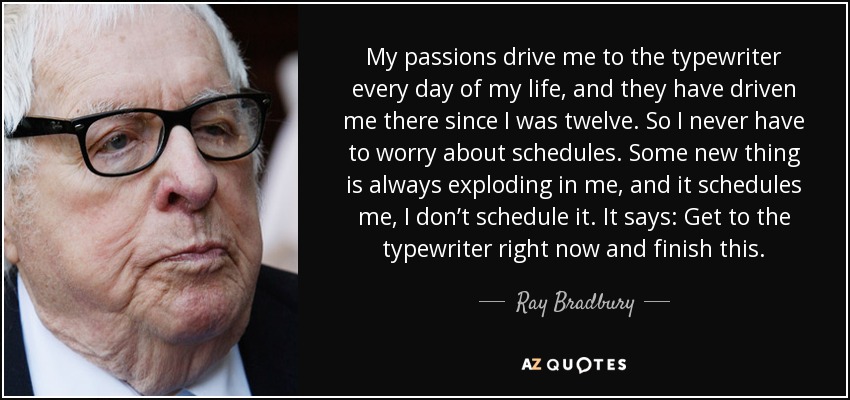
My passions drive me to the typewriter every day of my life, and they have driven me there since I was twelve. So I never have to worry about schedules. Some new thing is always exploding in me, and it schedules me, I don’t schedule it. It says: Get to the typewriter right now and finish this.
I write by ear. I tried writing with the typewriter, but I found it too unwieldy
It took me thirty-six years; and, in some fifty stories, ranging in length from short-shorts to novels, I think I must have touched, in one way or another, on every aspect of computers and computerization. And (mark this!) I did it without ever knowing anything at all about computers in any real sense. To this day, I don't. I am totally inept with machinery... on my typewriter I turn out books at the contemptible rate of one a month
There are moments when I cannot bear this unremitting consciousness. It knows only itself. Awake, I am in a continuum with my dreams. I feel my typewriters, my table, my chair to have that assurance of a solid world, where things take up space, where is not the endless emptiness of insubstantial thought that leads to nowhere but itself. My memories pale as I prevail upon them again and again. They become more and more ghostly. I fear nothing so much as losing them altogether and having only my blank endless mind to live in.
As a writer, you have to believe you're one of the best writers in the world. To sit down every day at the typewriter filled with self-doubt is not a good idea.
Somebody said writing is easy, you just sit down at your typewriter and open a vein. It depends on the book. Some, I have to do quite a lot of research, which I like. Others are much closer to me.
My art school rejection letter arrived as a cold manila fist that closed around my fragile hopes ... The fear was practically edible. Nothing would happen unless I get out and make it happen. Then, as if handling me the keys to the jet pack, my dad bought me a typewriter and a taped message to the inside of its case: "Son - the world is waiting to hear from you".
Ever since I can remember, I've always wanted to tell stories, but I never had the patience to sit down at a typewriter and write short stories or anything like that. I started writing songs as a way of communicating ideas the best way I could.
The typewriter separated me from a deeper intimacy with poetry, and my hand brought me closer to that intimacy again.
When I sit at that typewriter, I have to be frightened of what I'm trying to do. I'm frightened by my own belief that I can actually get a story down on paper.
You have typewriters, presses. And a huge audience. How about raising hell?
If a young aspirant had a modicum of skill and a busy typewriter she or he would sooner or later get a foothold in one of the magazines and a leaping start on the ladder upward.
I always value my large kitchen because it was better to do everything there, you wash up, you do everything, rather than messing up another room and I pop my typewriter just next to it. So I still write now but I was doing more writing when the children were younger.
I have been under considerable pressure to buy at least a laptop computer. I have always turned the suggestions down for the reason that I have never done creative work on a typewriter. There is to me a lack of empathy.
I don't do rewrites. I put all the pages in a pile next to the typewriter.
Mma Ramotswe had a detective agency in Africa, at the foot of Kgale Hill. These were its assets: a tiny white van, two desks, two chairs, a telephone, and an old typewriter. Then there was a teapot, in which Mma Ramotswe – the only lady private detective in Botswana – brewed redbush tea. And three mugs – one for herself, one for her secretary, and one for the client. What else does a detective agency really need? Detective agencies rely on human intuition and intelligence, both of which Mma Ramotswe had in abundance. No inventory would ever include those, of course.
I talk to my typewriter and that is what I've been working on for 40 years-how to write for talking.
I enjoy the process of writing. The torment comes in getting my bottom on the chair and in front of the typewriter.
Writing is simple. First you have to make sure you have plenty of paper... sharp pencils... typewriter ribbon. Then put your belly up to the desk... roll a sheet of paper into the typewriter... and stare at it until beads of blood appear on your forehead.
I write on a computer, but I've run the complete gambit. When I was very young, I wrote with a ballpoint pen in school notebooks. Then I got pretentious and started writing with a dip pen on parchment (I wrote at least a novel-length poem that way). Moved on to a fountain pen. Then a typewriter, then an electric self-correct. Then someone gave me a word processor and I was amazed at being able to fit ten pages on one of those floppy discs.
Every morning I take out my bankbook, stare at it, shudder - and turn quickly to my typewriter.
WHEN YOU LEAVE YOUR TYPEWRITER YOU LEAVE YOUR MACHINE GUN AND THE RATS COME POURING THROUGH.
I view the JVM as just another architecture that Perl ought to be ported to. (That, and the Underwood typewriter...)
When I'm writing it's as if I'm the observer. It's as if that computer screen there -it used to be the typewriter - just kind of dissolves and there's this whirling tunnel of mist and there's a kind of proscenium arch, and then there are my characters, and they say what they say, and I laugh sometimes in surprise at what they say.
I use an IBM Thinkpad. I just use it like a typewriter, but when I started using it in 1987, I thought I won't be able to write anymore, so I thought I'd go back to the typewriter. But you couldn't go back to the typewriter after using the computer.
Follow AzQuotes on Facebook, Twitter and Google+. Every day we present the best quotes! Improve yourself, find your inspiration, share with friends
or simply: