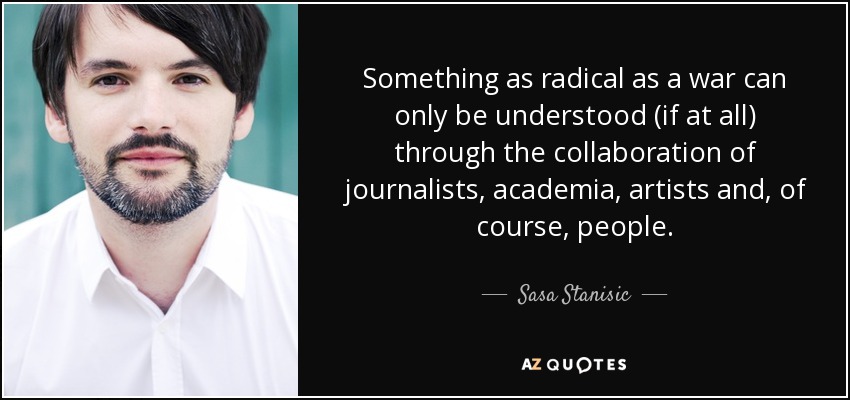
Something as radical as a war can only be understood (if at all) through the collaboration of journalists, academia, artists and, of course, people.
In fact, I always assumed that most everything I read was true, to one degree or another. I couldn't articulate this fact until after I read Tim O'Brien's The Things They Carried and he discussed Happening Truth, Story Truth, and Emotional Truth. I always understood that the facts of The Sun Also Rises or On the Road were the facts as dictated by a certain narrative structure, but because the experiences of those characters echoed my own feelings about the world. I knew there was a Happening Truth behind them.
My early childhood was spent living by the Pacific Ocean. I carry with me something imprinted by that wide, limitless horizon, which I learned connected us to different people and cultures, including my own family's origins in the Arab World and Northern Europe. I understood early that my world was only a small part of a much larger one. That captivated me.
King Hussein of Jordan dedicated his life - I witnessed it in his sleeping as well as waking hours - to trying to break through the impasses keeping people apart. He understood that the security and prosperity of any one of us in this world depends on the security and prosperity enjoyed by others. As Martin Luther King said, "Injustice anywhere is a threat to justice everywhere." In the Middle East, nothing could be more true.
I think we're [me and my son] different. He plans, organizes and intellectualizes more than I do. It wasn't until I worked with Federico Fellini that I understood what my problem was.
There were books everywhere in my house. Books were very present. I just loved books. I never understood reading as anything but a pleasurable activity from a very young age.
And what terrifies me is that we're entering a phase where if you start to speak about this as something that can be understood historically - without any sympathy - you are going to be thought of as unpatriotic, and you are going to be forbidden. It's very dangerous. It is precisely incumbent on every citizen to quite understand the world we're living in and the history we are a part of and we are forming as a superpower.
That old adage, that "music is a universal language", is really true. Even if all of the lyrics are understood, they seem to connect with it really well and in some ways, more so.
Any parent would have reservations if their kid came home dressed like a skinhead, but mine understood that punk kept me focused on something when so many of my friends were out robbing 7-Elevens.
I understood that these trade agreements were going to destroy the middle class of this country. I led the fight against us. That is one of the major differences that we have.
I never understood the low art/high art distinction.
That's just the way people's brains work. If you want to talk about something, you have to reduce it to a form that can be understood. That's one of the reasons I'm not good about boiling down music.
Everything that I talk about, pretty much, are things that I learned or understood over the years.
No reform ever came from the bottom, and it was always people who understood how the ruling class worked who turned out to be the reformers.
Fairly examined, truly understood, No man is wholly bad, nor wholly good.
In every science certain things must be accepted as first principles if the subject matter is to be understood; and these first postulates rest upon faith.
When I came here [to Malaysia] I heard that there is a problem with the concept of pluralism whereby pluralism is understood in a very narrow way, which I think is wrong. This is not to diminish your sense of truth in what you believe but to acknowledge the fact that we live in a world where we need to deal with pluralism. It's a fact.
In fact all the Islamists, that is the reformists not the Salafis, now they all say that they want a civil state, a civil state with Islamic reference points. They are not talking about an Islamic state, or sharia in the way this was once understood in the fight against the colonisers, or just afterwards in the 70's, 80's and 90's.
I'm still committed to the socialist idea because the socialist idea, correctly understood, includes the principles of freedom and social justice. It also includes the recognition of the value of democracy. When we speak about social justice, it means that freedom should be used not only in the interest of profit but also in the interest of the advancement of the people who create all values.
My audience is made up of two groups of people. The first group includes people whose roots are deep in the Christian faith, but for whom the traditional symbols, as traditionally understood, no longer make sense. The other audience is the audience that has left. I call them the Church Alumni Association, citizens of the secular city. They are a bit nostalgic about this faith of their childhood, but they aren't really interested in trotting it out or becoming involved with it again as it is presently organized.
I feel like I understood the language of comics. I had a real fluidity with that medium at a very early age.
To be truly seen and understood - in all our innocence and glory and yes, our brokenness, too - is to be delivered into the spiritual ethers where both seen and seer are healed.
I think it is now widely understood that the so-called "War on Drugs" has largely been a failure. Too many people have developed criminal records for smoking marijuana. Too many people have gone to jail for nonviolent crimes. So I think it's important for us to rethink the war on drugs.
[Nelson] Mandela was very keen not to be understood as an exceptional person.
My son is now fourteen, and from the moment he was born, I understood that forevermore my heart would be walking around outside my body.
Follow AzQuotes on Facebook, Twitter and Google+. Every day we present the best quotes! Improve yourself, find your inspiration, share with friends
or simply: