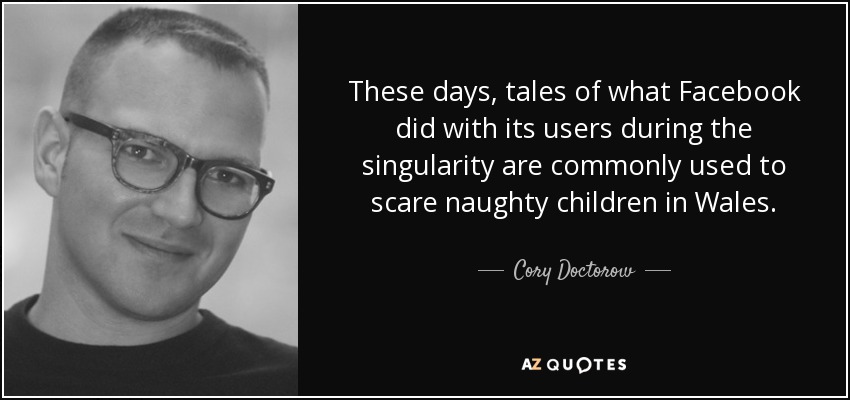
These days, tales of what Facebook did with its users during the singularity are commonly used to scare naughty children in Wales.
The ultimate goal of a habit-forming product is to solve the user's pain by creating an association so that the user identifies the company's product or service as the source of relief.
UNIX has a philosophy, it has 25 years of history behind it, and most importantly, it has a clean core. It strives for something - some kind of beauty. And that's really what struck me as a programmer. Operating systems that normal home users are used to, such as DOS and Windows, didn't have any way of life. Nobody tried to design Windows - it just grew in random directions without any kind of thought behind it. [...] I don't think Microsoft is evil in itself; I just think that they make really crappy operating systems.
What is clear is that users own their data and should have control of how their data is used.
My videos are coming from the perspective of someone who bought the device, used it and is giving impressions on the actual usage. Sometimes 2 different behind-the-scenes engienering decisions will yield the same user experience, in which case I won't even mention it.
Cell phones have gotten so small, you can't tell who's a cell phone user and who's a schizophrenic.
Steve Jobs' ability to focus in on a few things that count, get people who get user interface right, and market things as revolutionary are amazing things.
I favor strategies that encourage industry to include some sort of key recovery capability in their systems which would also address user requirements for access.
Ironically, the main task of chess software companies today is to find ways to make the program weaker, not stronger, and to provide enough options that any user can pick from different levels and the machine will try to make enough mistakes to give him a chance.
The choosing among words is made by every user of the language, and not exclusively by professional speakers and writers.
The companies that get innovation right, again and again, are the ones that feel what their customers feel. That is true user-centered innovation
With Windows 8, Microsoft is trying to gain market share in what has been dominated by the iPad-type device. But a lot of those users are frustrated. They can't type. They can't create documents.
With software products, it is usual to find that the software has major `bugs' and does not work reliably for some users... The lay public, familiar with only a few incidents of software failure, may regard them as exceptions caused by exceptionally inept programmers. Those of us who are software professionals know better; the most competent programmers in the world cannot avoid such problems.
UNIX is a user-friendly operating system. It just picks its friends more carefully than others.
Art made by the people for the people, as a joy to the maker and the user.
Start by putting yourself in your users' shoes. Why are they coming to your site? If you look at most Web sites, you'd presume that the answer is "User is extremely bored and wishes to stare at a blank screen for several minutes while a flashing icon loads, then stare at the flashing icon for a few more minutes."
When you were growing up, your mom and dad told you to look both ways before crossing the street or not to get into a car with a stranger. It's the same with the internet. We have a big responsibility and a huge role in bringing all the stakeholders to the table - users, parents, educators, law enforcement, government organisations.
Today Facebook went public, just as Myspace's last user went private.
I think healthy competition is good for business, and really at the end best for end-users. Just think about what Android would have been if it was not for iPhone - a better blackberry?
Every hour spent investigating a drug user or seller is an hour that could have been used to find a missing child.
Knowledge resides in the user and not in the collection. It is how the user reacts to a collection of information that matters.
Persuading through Simplifying - Using computing technology to reduce complex behavior to simple tasks increases the benefit/cost ratio of the behavior and influences users to perform the behavior.
When I started out in Facebook, it had only 20 people. I saw it grow to a thousand employees and from five million users to over a billion users. I saw it evolve from a service that served college students to one that served the world.
Popularity is the product of two factors: (a) how compelling material you offer, and (b) how easy it is to access it. Host free pirated movies and users will flock to the site, even if it's difficult to use.
Simpler companies are user centered. They adapt to the needs of day-to-day decision makers.
Follow AzQuotes on Facebook, Twitter and Google+. Every day we present the best quotes! Improve yourself, find your inspiration, share with friends
or simply: