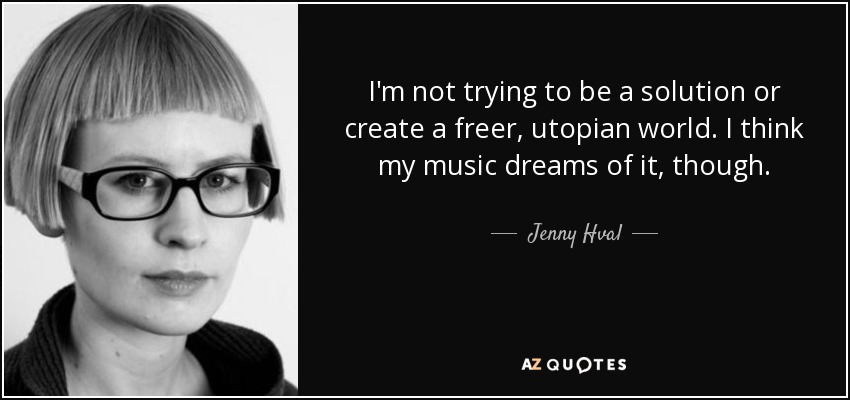
I'm not trying to be a solution or create a freer, utopian world. I think my music dreams of it, though.
What begins as a Utopian vision, always - always - ends in bloodshed. Because you have to force a utopia on a free people. Free people want to pursue their own happiness, but a one-size-fits-all approach requires herding the free, against their will, into the state's idea of what's right. Then it's not utopia.
The whole notion that you can equalize opportunity in things that matter is utopian.
Democracy begins in human conversation. A democratic conversation does not require elaborate rules of procedure or utopian notions of perfect consensus. What it does require is a spirit of mutual respect-people conversing critically with one another in an atmosphere of honesty and shared regard.
I'm an anxious person in general, but something about being pregnant and awaiting the release of my first book, The Monsters Of Templeton, made me into an insane anxious person. I didn't sleep at night. I ended up sleeping all day. In a strange way I felt like the world was going to end. I found myself so deeply depressed at times that I started to read about happiness, and that took me into books about idealism and utopianism. Reading books about people who tried to build utopian societies of different kinds gave me a kind of lift.
Reading about utopianism, and eventually creating characters with their own utopian ambitions, was the way I learned to live with being a pregnant person, to stave off the sense of incipient disaster. You're bringing a person into this overcrowded world, knowing they're one day going to die and there's nothing you can do about it.
There is this fashionable progressive notion that everything is so completely political that the idea we could have some sort of neutral legal process is practically utopian - because we all know that the more money you have, the more rights you can exercise in this society. But I don't think that you deal with income inequality by limiting the First Amendment rights of affluent people. I'd rather see people screw around with the tax code to redistribute wealth a little bit than screw around with the First Amendment.
Fiction is always a utopian task, in that there's an ideal you hold in your head as you write which inevitably fails in the moment of creation, in the insufficiency of words to convey meaning, or in the way the work is completed in the reader's head.
One thing that struck me about going to those tech conferences was all the enthusiasm for free culture, and remixing, and social media, but people's greatest ambition was to be sponsored by Chipotle or something equivalent to that. It was this weird mix of collaborative, utopian claims and this total acquiescence to commercial imperatives.
The vision shared by both [French utopian] Charles Fourier and Robert Owen was for an entire town to fit into one structure. Owen's design for what he called a "parallelogram" was essentially to have a whole city in one building, laid out around a huge quadrangle. Fourier's scheme was to build a massive Versailles-like structure that he called a "phalanstery." In both cases they had these architectural dreams that we now recognize as pretty unappealing.
Utopian fiction is really boring. I had to read a lot of it, and it's not that much fun. But they're fascinating to me as historical documents. Cabet [Icaria's founder and author of the utopian novel, Travels in Icaria], is writing in the 1830s, and his idea of the perfect society reveals a lot about his time. But his book is uniquely bad.
The fatal flaw of most utopian visions is that they're fundamentally static, and that's not a comfortable place for humans to live. Fourier was very good at imagining a utopia that is constantly changing and very busy, but a vision of paradise that would have been most tantalizing to an underfed overworked factory worker in 1840 doesn't have much appeal in fiction because it's not a story.
The thing that had fueled these utopian communities was a literal belief, and not just a general sense of optimism, that the earth was about to become a paradise. That idea cannot hold water after the war.
So there's that change of general consciousness, and then there's this boom after the war, this expansion into the West. It was like the 1950s. The American economy was pumping at top speed. The kinds of people who would move into these communities and organize their lives around a utopian dream now had dreams about the West.
The dreams get anchored in aged wisdom not some utopian fantasy.
I'm not an activist by nature. I am suspicious of Utopian thinking and equally suspicious of its alternate.
When you have a vision of where you need to go, it sounds utopian. But when you get to the tipping point, your understanding switches.
Maybe the realisation of the full human potential is the utopian thing. Maybe that is our collective struggle, is to find a way to get there. But right now it seems like we're duplicating what was written in the Bible, a millennium ago, which is "An eye for an eye." Revenge policy; "If you hit me, we'll hit you back worse"; ad infinitum.
I still believe in what I believed in for 20 years as a Socialist in Parliament, and being a Socialist is not the same as being a utopian.
I gravitate towards the utopian potentials of digital space (post race, post gender, post human etc.), but understand that people live in real bodies that experience real consequences based on how they are gendered, sexed, raced and classed.
Captain Fantastic touches on that [division]. You meet this family that lives off the grid in the woods and you go, "Oh, it's some kind of liberal utopian fantasy. The enemy is gonna be all these conservative types that they'll probably run into, and that's going to be the story."
The idea that Bentham and Mill were maximizers is the greatest stretch of all. They were progressivists, committed to improving the societies in which they lived, not utopian maximizers.
In my imaginary utopian world there would be a greater allegiance between music writers and musicians.
These Utopian idealists like the Clintons who think they really do have the answers. They think they're following the best minds of their generation, but they're not the best minds. They don't realize that they may be the worst minds of their generation.
Wherever you go, whether it be a college campus or the New York Times or ABC News or Venezuela or Cuba or the former Soviet Union, it's amazing how the speech codes and the trying to shut up dissent is a defining aspect of the left because they believe so firmly in their utopian ideals that anyone who would disagree with that utopia is an enemy of the state, and they treat them as such.
Follow AzQuotes on Facebook, Twitter and Google+. Every day we present the best quotes! Improve yourself, find your inspiration, share with friends
or simply: