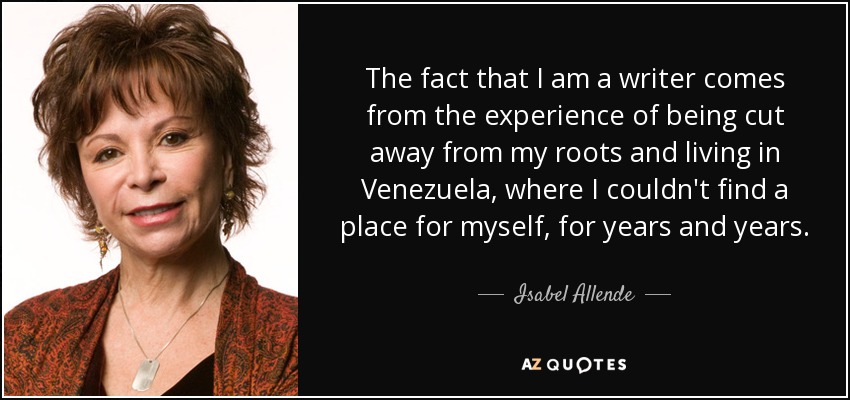
The fact that I am a writer comes from the experience of being cut away from my roots and living in Venezuela, where I couldn't find a place for myself, for years and years.
The fact is ... that when totalitarian nations like China and Saudi Arabia play ball with U.S. business interests, we like them just fine. But when Venezuela's freely elected president threatens powerful corporate interests, the Bush administration treats him as an enemy.
What happened in Cuba, just to cut to the chase, their death rate from diabetes went down 50%, their death rate from heart attacks and stroke went down approximately 30% and all-cause mortality went down 18% while they adhered to the system. Then they opened up their pipeline again from Venezuela, and their health improvements went away.
That is, I think that what I do, that democracy in Venezuela hasn't really worked well since the [Ugo] Chávez era and that it has gotten even worse since the last elections, in which the Maduro government lost control of the House, of the country's legislature.
I concern myself with Venezuela. However, some rightwing movements are transforming me into a pawn in the domestic politics of their countries, by making statements that are groundless.
We have also seen an economic crisis that is very serious within Venezuela, we are seeing cutbacks, I believe even more are coming in terms of electricity. Government employees no longer work on Fridays, and that has not been enough.
I think that you hear more opposition to the government in Venezuela than you would here in the United States. That's in the TV, in the radio and in the print media.
We need more American energy. It keeps wealth at home. It keeps our wealth from ending up in Venezuela and Saudi Arabia. It creates jobs at home.
Venezuela is another place I'd like very much to go, which is proving very difficult. I have not been there to make a show and I'd like to, very much.
What Chavez has done [in Venezuela] is that he has brought extreme poverty to an end.
I love Gustavo Dudamel and I love what he does for classical music, and I love what he comes out of, El Sistema and the old man Abreu. When we were in Venezuela, I had the chance to go to his building. He had, like, five or six orchestras playing of kids from the hood playing, like, Mahler's third symphony and Shostakovich fifth and Beethoven. Man, it's unbelievable. I mean, they could play.
Being born in Cuba, a country where freedom of speech is non-existent, it's startling to observe how Venezuela, where I was happily raised, is fast becoming Cuba's mirror image: Dismantling of fundamental democratic rights deserved by its people and citizens of the world.
My mother teaches high school English, and she's an artist and a poet and a sculptor, she's published twelve poetry books. I grew up in a household in Venezuela with living, breathing art installations that were the way that she used to express herself, a highly creative environment where ideas were celebrated, where artistic expression was celebrated. Seeing her as somebody who was always able to have a creative output - if she felt sad, she wrote a poem, if she felt happy, she made a sculpture - I think for me, there was an early interest in finding outlets for my passions.
Strong countries and strong presidents talk to their adversaries. That's what Kennedy did with Khrushchev. That's what Reagan did with Gorbachev. That's what Nixon did with Mao. I mean think about it. Iran, Cuba, Venezuela - these countries are tiny compared to the Soviet Union. They don't pose a serious threat to us the way the Soviet Union posed a threat to us. And yet we were willing to talk to the Soviet Union at the time when they were saying we're going to wipe you off the planet.
Wherever you go, whether it be a college campus or the New York Times or ABC News or Venezuela or Cuba or the former Soviet Union, it's amazing how the speech codes and the trying to shut up dissent is a defining aspect of the left because they believe so firmly in their utopian ideals that anyone who would disagree with that utopia is an enemy of the state, and they treat them as such.
I've worked with farmers in Zimbabwe who've lost their lands. I've worked with people in Venezuela, under threat of kidnappings, whose external world is unstable. But they have very strong social connections with their family and friends. And as a result, they're able to maintain a greater level of happiness and optimism than I've seen from bankers, consultants, or salespeople who are on the road all the time, who follow jobs separated from their families, and, as a result, find themselves missing out on the happiness that comes from those very connections that they severed.
Scientists habitually moan that the public doesn't understand them. But they complain too much: public ignorance isn't peculiar to science. It's sad if some citizens can't tell a proton from a protein. But it's equally sad if they're ignorant of their nation's history, can't speak a second language, or can't find Venezuela or Syria on a map.
I can honestly say from my experience, my family and I had to start from scratch. We left Venezuela back in 1998 and sold the few things we had to come to America in search of the American dream. We went through really tough times. There were moments where we were wondering are we going to make it.
Patriots don't go to Russia. They don't seek asylum in Cuba. They don't seek asylum in Venezuela. They fight their cause here. Edward Snowden is a coward. He is a traitor. And he has betrayed his country. And if he wants to come home tomorrow to face the music, he can do so.
We're proud of Venezuela and Venezuelan baseball. People in America don't realize it, but we've got 25, 30 million people here, and so many of us love baseball. This is a great place to look for talent.
I grew up in Venezuela, and when I was 14-years-old, my parents decided to sell everything and come to America. Five of us lived in a two bedroom house. It wasn't a sad truth, it was just the way it was [at the time]. That feeling is so universal for every immigrant.
One of the things you can learn from a figure like Venezuela's Hugo Chavez is that if you take all the resources of the state for yourself, you don't build much of a constituency and you have to rely on repression, and repression is difficult in the modern world.
Venezuela has gone from being a democratic country 15 years ago to being totally not a democracy today. Usually that de-democratization doesn't take the form of a heavy handed police state.
Throw in neglect and politicization of the judicial system and you see the result: soaring rates of cocaine trafficking through Venezuela and worsening corruption of institutions.
Chavez's oil is unimportant for Bolivia... We are not dependent on Venezuela. We complement each other. Venezuela shares its wealth with other countries, but that doesn't make us subordinate.
Follow AzQuotes on Facebook, Twitter and Google+. Every day we present the best quotes! Improve yourself, find your inspiration, share with friends
or simply: