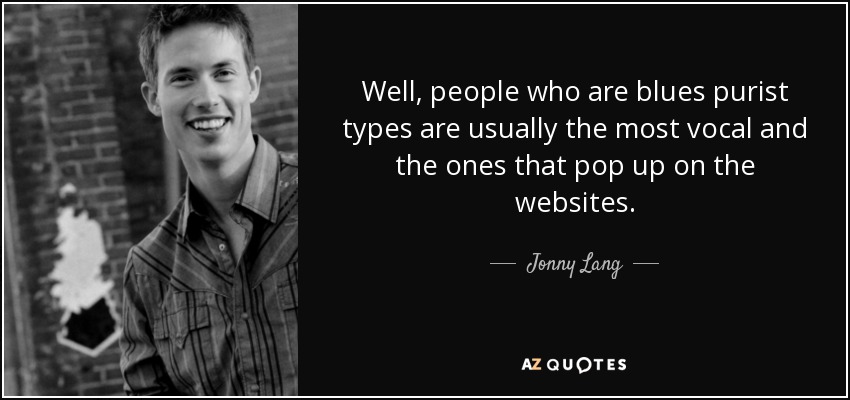
Well, people who are blues purist types are usually the most vocal and the ones that pop up on the websites.
For me, when I want to be emotionally moved by a vocal, I don't want to hear auto tune on it, I want to hear the beautiful imperfections.
A different drumbeat or some vocal overdub could completely transform the song.
After so many years of whispery, DIY vocals, there's this new generation of voices that are really starting to burst through the seams.
I've always been very vocal about my religion. It's a big part of who I am.
I want the feeling where you don't really know what to do with yourself - in the vocals, in the production. Everything.
I used to do more melodic stuff, and I used to do more actual rap - like traditional hip hop vocals. I think my method of storytelling has led me to this point, at which I want to pare down my style. I think I give the lyrics more thought, and then when I try to perform the lyrics over the track I'll try it over and over again, and eventually the lyrics will sink into the track by the way I project them.
It's hard to sing really well when you're playing an instrument, but it'd be great to try and sing really well and have vocal effects and one drummer on a real drum-kit, and one on an electronic kit.
When you've got insane drums and a lot of guitar, it's really hard to mix the vocals, to mix it all well.
I always believe that every song tells a story, so the last thing I want to do is edit out like the meat of the story. I would pick songs based off a), whether I felt like I could do anything with them, and b) whether I felt like I could keep the story intact. And then you sit in with one of the piano players and one of the vocal coaches and kind of work out your arrangements that way.
speaking with, uh, about the vocal choreography, one of the first groups that I worked with was a group called the Cadillacs, which was uh, an exceptionally talented group. They all moved well and they sort of established Cholly Atkins's style. In other words they basically put me on the map, and everybody would look at them and see their choreography and they wanted to know who did it, so they would tell them.
So it would be a happy marriage between the movement and the vocal and uh, this is the thing that you give a lot of consideration to.
In vocal choreography you had to give a lot of consideration to the fact that you were working with singers and not dancers. But you had to make singers look like they were dancers, and to make the movements as natural as possible, and there to be an association with the movement, uh, somewhat to what the lyric was saying.
In the last war, people became vocal from the right-wing point of view: if you're liberal, then you're a traitor.
When you do a remix, obviously you get a beautiful melody, you get the beautiful vocals - everything is already set up. You already have a base, which means all I gotta to do is create the music behind, 'cuz it's already beautiful.
I've never used the word jamming. It's a matter of finding a great song and learning the chords, then slightly altering the vocal melody, and matching a classic chord progression with another chord progression.
It's one thing having a great song, but I think for me if you take it to the next level... say you had a guitar and a vocal, and the song was amazing but the vocalist wasn't that great and it just was a guitar and vocal acoustic track, switching that to something like an amazing voice singing the exact same song with the instrumentation being really nice and lush or unique in some way and interesting and diverse... I think it's all about the instrumentation and textures in the sound.
I just used to love the sound of especially a female vocal like Ella Fitzgerald for example, it's just that empowering self-control that can make a whole room go silent. I fell in love with that sound.
When I do my vocal warm-ups everyone calls me the dolphin because I do stupid siren noises.
If there's a strong melodic thing somewhere, whether that's in a vocal or in a guitar part or a sample. Something that sticks in your brain, that seems to be something that works.
And my voice now is a struggle, it's a daily struggle to keep it up. Gravity has begun to fight the vocal cords the way it does with everybody. So I have a vocal therapist, and we record the sessions and I use them on tour every day.
It [my vocal] didn't sound like what I wanted to hear; the vibrato isn't what I liked anymore. So I got myself to an ear, nose and throat guy who does a lot of work with singers, and I was hoping there was a big wart on my vocal cords or something and they could scrape it off and I could have the voice I wanted. But he said, "No, for 71, that's your voice."
If I'm not mistaken, I believe it was written beforehand. And it just happened in rehearsals Basically giving each person their vocal-line and I ended up getting that line! I'm so grateful I did because it was really special to sing that and you feel something when you sing it it's a very distinct piece that fits perfectly in the production.
My tastes range all over the place, from vocal standards to Motown to 70s funk & soul to 80s pop to film scores to artists like R.E.M., Ben Folds, Prince, Annie Lennox, the Police, Elvis Costello, Cat Stevens, the Ditty Bops, local bands that friends of mine are in, and the list goes on... I have no single favorite genre or artist.
There are definite vocal trends for every generation as well as accents and I'm not talking about regionalisms.
Follow AzQuotes on Facebook, Twitter and Google+. Every day we present the best quotes! Improve yourself, find your inspiration, share with friends
or simply: