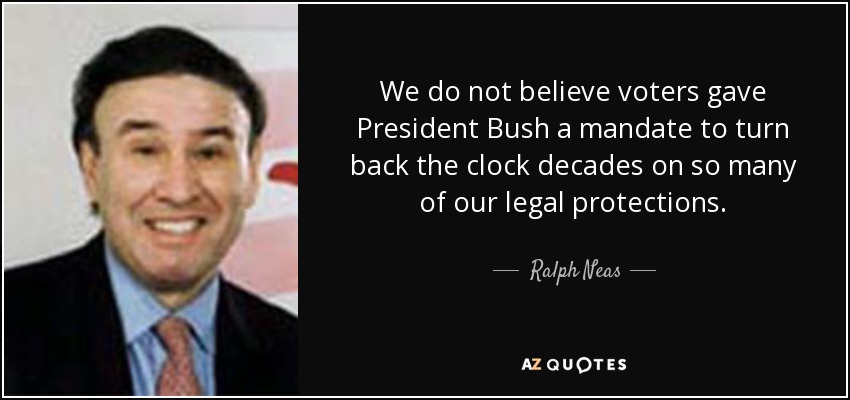
We do not believe voters gave President Bush a mandate to turn back the clock decades on so many of our legal protections.
The data shows pretty clearly that how voters watch video programming is dramatically changing and reinforces the need for political campaigns to better match their communications outreach efforts to the voters’ changing media habits.
A Harris poll I've seen says only 12 percent of the electorate names taxes as one of the most important issues facing the nation. Voters put tax cuts dead last, behind education, Social Security, health care, Medicare and poverty.
The basis for building a Christian society is evangelism and missions that lead to a widespread Christian revival, so that the great mass of earth's inhabitants will place themselves under Christ's protection, and then voluntarily use his covenantal laws for self-government. Christian reconstruction begins with personal conversion to Christ and self-government under God's law; then it spreads to others through revival; and only later does it bring comprehensive changes in civil law, when the vast majority of voters voluntarily agree to live under biblical blueprints.
People depend on the Open Internet to connect and communicate with each other freely. Voters need it to inform themselves before casting ballots. Without prompt corrective action by the Commission to reclassify broadband, this awful ruling will serve as a sorry memorial to the corporate abrogation of free speech.
The morality of a [political] party must grow out of the conscience and the participation of the voters.
Republicans ought to propose conservative answers to the concerns that are uppermost on most voters’ minds. The libertarian-populist method seems to be to start with the solutions and then to imagine that voters have the relevant concerns. And while many of the proposed solutions have great potential appeal to conservative voters, few would do much to expand their ranks.
'Elections have consequences,' President Obama said, setting his new policy agenda just three days after taking office in 2009. Three elections later, the president's party has lost 70 House seats and 14 Senate seats. The job of Republicans now is to govern with the confidence that elections do have consequences, promptly passing the conservative reform the voters have demanded.
No subject was more important in the 2014 elections than healthcare, and Republicans in Congress should waste no time in taking decisive action in response to the voters' demands. Obamacare has escalated costs, disrupted coverage, and introduced bad incentives throughout our healthcare system. Congress must repeal Obamacare and send the president a replacement package of reforms that protects freedom and focuses on the real problem with American healthcare - affordability.
The Obama damage is two-fold. First, his success relied on a coalition that likely will not survive, or at least survive at full strength, without Obama himself on the ticket. Secondly, Obama drove a significant portion of white voters away from the Democratic Party.
In the end, no single group will mean defeat for the Democrat and victory for the Republican in 2016. But President Obama's troubling legacy - a weakened coalition and growing ranks of alienated white voters - could mean a serious post-presidential hangover for Democrats.
Unhappy voters thought the anemic economy, Obamacare, the collapse of U.S. foreign policy, the scandals in government, and the incompetent handling of everything from the Islamic State to Ebola were the only real issues. Democrats' refusal to acknowledge them did not make these failures go away.
After three elections, voters finally caught on that Obama's faults were not in the stars, but in himself. They apparently tired of the usual distractions from a dismal presidential record.
As Democratic losses mounted in Senate races across the country on election night, some liberal commentators clung to the idea that dissatisfied voters were sending a generally anti-incumbent message, and not specifically repudiating Democratic officeholders. But the facts of the election just don't support that story.
Voters replaced Democratic senators with Republicans in Arkansas, Colorado, Iowa, North Carolina, Montana, South Dakota, West Virginia, and likely in Alaska, and appear on track to do so in a runoff next month in Louisiana. At the same time, voters kept Republicans in GOP seats in heavily contested races in Georgia, Kansas, and Kentucky. That is at least ten, and as many as a dozen, tough races, without a single Republican seat changing hands. Tuesday's voting was a wave alright - a very anti-Democratic wave.
In the end, Tuesday's vote represented a repudiation of virtually every notion Democrats embraced in recent weeks as they tried to disregard the growing evidence that they were headed for a historic defeat. Now, the vote is in, and the voters' message can no longer be discounted.
Some Democrats and their advocates in the press believe Obamacare, a year into implementation, is no longer much of a factor in the midterm elections. But no one has told Republican candidates, who are still pounding away at the Affordable Care Act on the stump. And no one has told voters, especially those in states with closely contested Senate races, who regularly place it among the top issues of the campaign.
Polls suggest that more and more, opposition to Obamacare is based on voters' personal experience, and not just on what they have heard or read about the law.
That does almost nothing to address voters' concerns, which remain a potent factor in the campaign. The bottom line is, there's a reason Republicans keep pushing so hard against Obamacare: So far, it's working.
As a former U.S. attorney general under President Reagan, and a former Ohio secretary of state, we would like to say something that might strike some as obvious: Those who oppose photo voter-ID laws and other election-integrity reforms are intent on making it easier to commit vote fraud.
That conclusion is inescapable, given the well-established evidence that voter-ID laws don't disenfranchise minorities or reduce minority voting, and in many instances enhance it, despite claims to the contrary by Mr. Holder and his allies. As more states adopt such laws, the left has railed against them with increasing fury, even invoking the specter of the Jim Crow era to describe electoral safeguards common to most nations, including in the Third World.
The Democratic Party's problem is that voters don't believe the president's claims that the economy is thriving. Even people with jobs feel apprehensive. Paychecks are flat, growth anemic, and people are worried about their children's prospects. Mr. Obama had a 38% approval on handling the economy in the Sept. 9 Fox News poll. In the Sept. 7 NBC News/Wall Street Journal poll, 67% believe America is on the wrong track.
To win in November, Republican candidates must show they are in touch with voter concerns about growth, jobs, paychecks, government spending and debt. The only way to do this is by offering specific, persuasive ideas.
Writing recently in the New York Times, David Brooks noted correctly if belatedly that conservatives disdain for liberal intellectuals had slipped into disdain for the educated class as a whole, and worried that the Republican Party was alienating educated voters. I couldn't care less about the future of the Republican Party, but I do care about the quality of political thinking and judgment in the country as a whole.
Every Republican that I know of ran on the full repeal of Obamacare...The voters have spoken.
Follow AzQuotes on Facebook, Twitter and Google+. Every day we present the best quotes! Improve yourself, find your inspiration, share with friends
or simply: