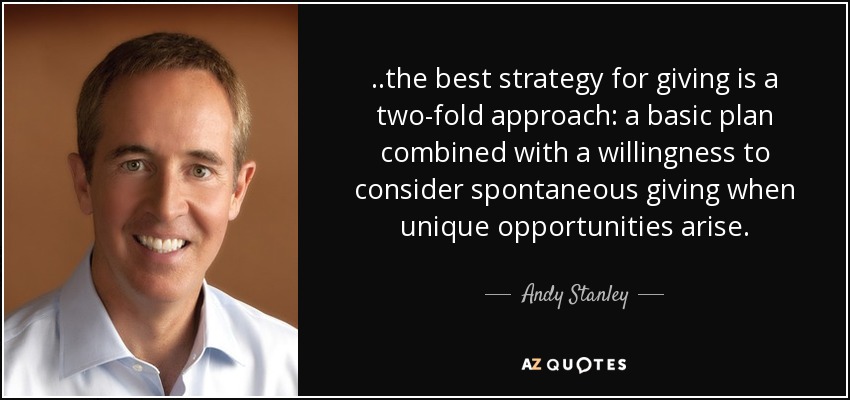
..the best strategy for giving is a two-fold approach: a basic plan combined with a willingness to consider spontaneous giving when unique opportunities arise.
When I was 15 years old I felt totally confident I would become a world champion and the greatest bodybuilder in the world. The same was true of show business - I knew that one day I would make more money than anyone else in the industry and I did. For that you need the willingness to work and do everything it takes to make the vision turn into reality.
I do interview senior candidates at the home office or many of our hotel or restaurant General Manager candidates. My two favorite questions are "Tell me about a failure in your career, what you learned from it, and how you've leveraged this lesson" and "All of us are misperceived at one time or another. What's the most common way you're misperceived in the workplace and why?" Both of these questions require a certain amount of self-awareness and a willingness to not give pat, normal answers that we offer experience in interviews.
Nothing has changed in Russia since Ivan the Terrible when it comes to the divide between the people and the state. The state demands a sacred willingness to make sacrifices from the people.
I've maintained old friendships, like with people I knew in the nineteen-seventies, but have lost the knack for meeting new people. This has a lot to do with my writing schedule. I don't want to be disturbed, and the willingness to be disturbed is, I think, part of being a good friend.
God picks you up. You don't pick yourself up. You're the one who knocked you down or even if somebody else knocked you down, your willingness to believe that what they said had value, was your conspiring with them, with their effort to knock you down - I've never been able to get myself up and I've noticed that every time I ask God to pick me up - he does.
You need conviction in your own beliefs, and the willingness to ignore others naysaying.
Statesmen exhibit five key commitments: 1) A commitment to principles above politics; 2) An ability to compromise without abandoning principle; 3) A commitment to truth over spin; 4) A commitment to courage over cowardice; and 5) A commitment, or willingness, to give up power.
I should do the things that make me feel cool and smart. As I get older, I'm realizing more and more that it doesn't really matter if I'm good at it, it just matters that I try. My own effort, my own willingness, are becoming what's appealing to me.
A player's character is a crucial factor I look into before committing to signing them. They also need to show a willingness to learn, regardless of age and experience; that's very important to me.
As a parent, the goal is not to get to the other end. It's just simply to protect the children that you're responsible for - and protect their hearts - and, wherever they're headed, to get (them) there safely. That involves patience, time and willingness to listen.
But the problems of perpetuating a hierarchical society go deeper than this. There are only four ways in which a ruling group can fall from power. Either it is conquered from without, or it governs so inefficiently that the masses are stirred to revolt, or it allows a strong and discontented Middle group to come into being, or it loses its own self-confidence and willingness to govern.
Nothing helps us build our perspective more than developing compassion for others. Compassion is a sympathetic feeling. It involves the willingness to put yourself in someone else's shoes, to take the focus off yourself and to imagine what it's like to be in someone else's predicament, and simultaneously, to feel love for that person. It's the recognition that other people's problems, their pain and frustrations, are every bit as real as our own-often far worse. In recognizing this fact and trying to offer some assistance, we open our own hearts and greatly enhance our sense of gratitude.
The strengths a young person finds in adults at this time-their willingness to let him experiment, their eagerness to confirm him at his best, their consistency in correcting his excesses, and the guidance they give him-will codetermine whether or not he eventually makes order out of necessary inner confusion and applies himself to the correction of disordered conditions. He needs freedom to choose, but not so much freedom that he cannot, in fact, make a choice.
Courage is the willingness to speak the truth about what you see and to own what you say.
The only thing that makes people and organizations great is their willingness to be not great along the way. The desire to fail along the way to reaching a bigger goal is the untold secret of success.
It is not blood that makes you Irish but a willingness to be part of the Irish Nation.
I think judicial temperament is a willingness to step back from your own committed views of the correct jurisprudential approach and evaluate those views in terms of your role as a judge. It's the difference between being a judge and being a law professor.
Courage is willingness to take the risk once you know the odds. Optimistic overconfidence means you are taking the risk because you don't know the odds. It's a big difference.
Success is a function of persistence and doggedness and the willingness to work hard for twenty-two minutes to make sense of something that most people would give up on after thirty seconds.
To watch an American on a beach, or crowding into a subway, or buying a theatre ticket, or sitting at home with his radio on, tells you something about one aspect of the American character: the capacity to withstand a great deal of outside interference, so to speak; a willing acceptance of frenzy which, though it's never self-conscious, amounts to a willingness to let other people have and assert their own lively, and even offensive, character. They are a tough race in this.
That is the trouble with many inventors; they lack patience. They lack the willingness to work a thing out slowly and clearly and sharply in their mind, so that they can actually "feel it work." They want to try their first idea right off; and the result is they use up lots of money and lots of good material, only to find eventually that they are working in the wrong direction. We all make mistakes, and it is better to make them before we begin.
The challenge for UNFPA is to help countries as we always have with no agenda of our own; with sensitivity towards unique cultural values; with an infinite willingness to work with whatever is positive; and with a determination to help countries and people turn universal principles into concrete action.
Forgiveness and the release of the past open the creative flow of life, supporting all levels of mind, heart, body, emotion, and spirit. This energy flow determines the state of our health, our desire to create and procreate, our willingness to develop our gifts, and how we use or deny the life force that we are given as human beings. . . . by choosing to let go of the past, our fears, and our negative patterns or reactions to life, we are suddenly funded with a resurgence of life force, which propels us into a newfound way of being and a very different way of understanding the world.
We have tried everything to get rid of suffering. We have gone everywhere to get rid of suffering. We have bought everything to get rid of it. We have ingested everything to get rid of it. Finally, when one has tried enought, there arises the possibility of spiritual maturity with the willingness to stop the futile attempt to get rid of it and, instead, to actually experience suffering. In that momentous instant, there is the realization of that which is beyond suffering, of that which is untouched by suffering. There is the realization of who one truly is.
Follow AzQuotes on Facebook, Twitter and Google+. Every day we present the best quotes! Improve yourself, find your inspiration, share with friends
or simply: