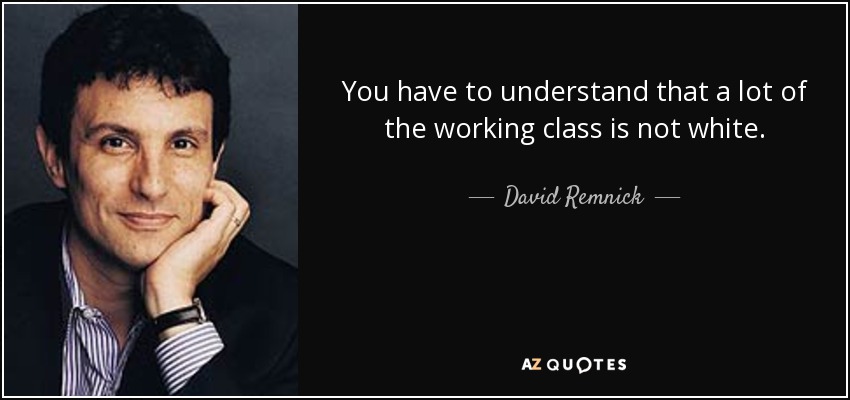
You have to understand that a lot of the working class is not white.
Donald Trump is targeting the traditional Republican voters, the average person with an average income, the working class, a certain group of entrepreneurs and those people who embrace traditional values.
The issues that I think matter, that I think resonate with the voters are, No. 1, defending our freedoms, defending the Constitution and the Bill of Rights. No. 2, lifting the boot of Washington off of the back of the necks of small businesses so that people can have jobs again, wages can come back again, fighting for the working class, you are getting hammered by Washington. And, No. 3, keeping this country safe, a strong commander in chief we can trust to keep us safe. That's what I'm looking for.
People were, in good faith perhaps, writing history books about the Indian working class, Indian peasantry, et cetera, and at no point did Communists make an entry, not even to be criticized. They were essentially being whitewashed from history.
We come from the future, essentially, because we have all these ideas about gender equality, sexual freedom, and these are not shared by the working class, the peasantry among whom we work.
Marx's own illusion was to think that the working class movement, which he devoted his life to creating and strengthening, would both be socially and politically successful in the industrial nations of Western Europe, and that it would develop an entirely new way of human social life that would retain and even enhance the productive benefits of capitalism while overcoming the inhumanity and exploitation of capitalist social relations. Marx himself had no solutions to these problems. His object of study was capitalism itself.
Solidarity among the male and female workers, a general cause, general goals, a general path to that goal - that is the solution to the "woman" question in the working-class environment.
Clearly no working class movement ever came about that was able to do what Marx was hoping for.
I think in all small towns, all kind of working class communities around the world. They are kind of similar.
What Franklin Roosevelt did, which really offended them, was he strengthened the labor unions - made it possible for them to strike. The oligarchs were furious because the working class was not supposed to have any power at all.
White working-class voters or working-class voters have felt abandoned, have felt, in many senses, disparaged by the political leadership of America.
I can write a story in working-class Stockholm Swedish, but I'm not going to assume I can perform the same feat with Cockney. I'll focus on adventures in story, themes and structure instead.
There's a ton of stuff we can do to help the economy and help the American people, and the aspirational working class of the American people.
The rise of globalization, the rise of finance capital, the elimination of the manufacturing base, the decimation of the working class, particularly in terms of those who had some comforts that approximated what the middle class had.
Bernie Sanders talks about socialism in Scandinavia, and he's correct to point to the huge victories the working class has won there through struggle, such as socialized medicine, free college education, and paid family leave. But if you talk to working people in Sweden or Norway today, you will find out that many of those past gains have been eroded and some virtually eliminated, including massive under-funding of healthcare and other public services and a return to for-profit systems that are unaffordable to working class people.
The way we look at nineteenth-century English social realism and appreciate the working classes of the emerging industrial revolution.
I'm just working class. I can pay the bills most of the time, usually from royalties.
The thing about this [Donald] Trump phenomenon is that there's a lot of good stuff in it; the anti-elitism, the concern for working class jobs.
I think in the '50s, the percentage of Americans employed by the private sector who were in unions was above 30 percent. And now it's in the single digits, so it plummeted. And with the plummeting of unions came the weakening of an organized working-class voice in politics.
The biggest issue for me is whether large numbers of Americans can begin to think that government can actually help make the country a fairer place. And that's partly a matter of policies that achieve results in terms of reducing inequality and raising middle-class and working-class incomes, which have been flat for decades. But it's also symbolic and rhetorical, it's whether Hillary Clinton can - or whoever's president - can persuade Americans that it's happening and that they can begin to trust their elected officials a little bit more and their institutions of government a little bit more.
There was a bridge to the 21st century, and yet, somehow, for very large number of Americans, it was unclear how you got from one place to the other, from being a manual working-class man to being some part of a Brooklyn-based sharing economy.
We don't have enough folks who grew up in working class rural communities.
My parents weren't in the arts, but we grew up in Balmain, which at that time was an artistic, bohemian suburb of Sydney. It's a lot more gentrified now. It was very working class, pubs on every corner because it's right by the water so a lot of the guys on the ships and the boats used to go and drink there. It's very posh now.
I think there are many people in the working class who say, you know what? Yes, maybe we are better off than we were eight years ago, but I am still working two or three jobs, my kid can't afford to go to college, I can't afford child care, my real wages have been going down for 40 years. The middle class is shrinking. Who's standing up for me?
When you have powerful unions, you have a working class that is politicized.
Follow AzQuotes on Facebook, Twitter and Google+. Every day we present the best quotes! Improve yourself, find your inspiration, share with friends
or simply: