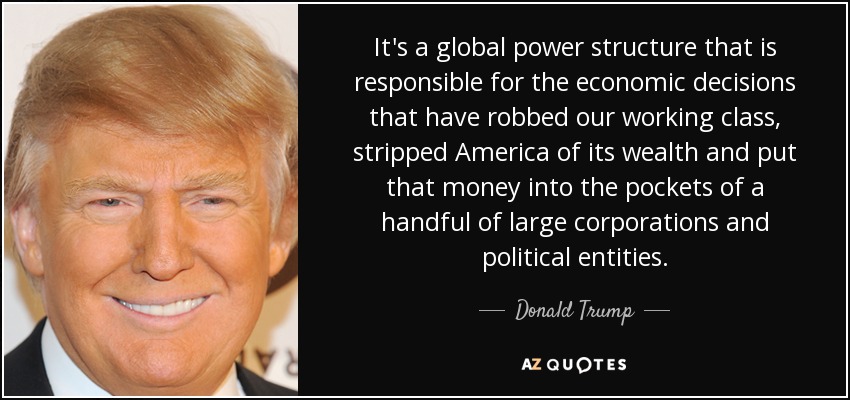
It's a global power structure that is responsible for the economic decisions that have robbed our working class, stripped America of its wealth and put that money into the pockets of a handful of large corporations and political entities.
Our tragedy today is not just that millions of people who called themselves communist or socialist were physically liquidated in Vietnam, Indonesia, Iran, Iraq, Afghanistan, not just that China and Russia, after all that revolution, have become capitalist economies, not just that the working class has been ruined in the United States and its unions dismantled, not just that Greece has been brought to its knees, or that Cuba will soon be assimilated into the free market - it is also that the language of the Left, the discourse of the Left, has been marginalised and is sought to be eradicated.
Policies are designed to undermine working class organization and the reason is not only the unions fight for workers' rights, but they also have a democratizing effect. These are institutions in which people without power can get together, support one another, learn about the world, try out their ideas, initiate programs, and that is dangerous. That's like a referendum in Greece. It is dangerous to allow that.
A lot of people who voted for Trump, working class people, voted for Obama in 2008. They were seduced by the slogans "hope" and "change." They didn't get hope, they didn't get change, they were disillusioned. This time they voted for another candidate who is calling for hope and change and has promised to deliver all kinds of amazing things.
I am sure that the experience of growing up in the heart of the working class and learning from my parents, and especially from my grandmother (who also worked on a barge boat as a cook and a servant for rich folks in Manhattan, Newport, Grosse Point, and Sewickley, all havens of the very rich), that life was not especially fair and always full of bad possibilities, helped shape my future take on life. Then what really transformed my thinking was the war in Vietnam and trying to be a good teacher.
The Vietnam War was so obviously evil and bore down most heavily upon working class youth that it made me think about things more deeply than I had before. It disillusioned me completely and forever about the government. And it made me aware that the media and the government lied almost as a matter of course. But it also opened my eyes to what was really going on in America.
Of course we can talk about the radical potential of youth. But in the U.S. it is still the case that most youth are conservative and not very sympathetic to the working class.
The main dividing line is still race. This is the issue that must be focused upon in all working class organizations.
We both [with Donald Trump] share a desire to ensure that governments are working for everyone and particularly that governments are working for ordinary working families and working-class families. And I think that's important. That's what I've spoken about.
I had this idea for a long time to make a film about a poet in Paterson named Patterson. I wanted him to be working class. Eventually I thought a bus was a perfect visual way to move him, to drift him through the city, to have a measured kind of routine lifestyle. And all these things kind of congealed into the film "Paterson" eventually.
I was born in Oakland and grew up, probably about five miles from Oakland, in Hayward. And Hayward was OK. Like, Hayward wasn't - very much a working-class area and had definitely went through a decline and is now, seemingly, coming back around, which is nice to see.
Well, first of all I think that we have to be careful with terms like the working class, obviously. When [Karl] Marx wrote about the working class he was writing about something much more bounded than we're talking about.
The truth is that the antiwar movement was powered by the working class. The students were the ones that got the media and so forth, but it was the soldiers on the ground who really energized the antiwar movement in the late Sixties.
Whether or not the working class came to Chicago in 1969 in the Days of Rage is not a measure of their commitment to stopping the war or to seeing life in certain way. There were very few of us who were there, and those of us that were had an illusion about ourselves.
Organizing the working class in England or the U.S. or any other advanced capitalist country has been a daunting challenge.
One question is: Who is the working class today, and how has it changed? Where are we in that? I don't have a knee-jerk kind of 1930s thing about we must build the unions and that's the way to the future. I'm writing this book right now called Pallin' Around, and the subtitle is: "Talking to the Tea Party." And frankly I find talking to the Tea Party exhilarating, I love it.
Who's the big government guy? These labels are nonsense. And the Tea Party, if you want to call them working class, you know, a working-class insurgency from below, they are a mass of contradictions; they don't have a single consistent viewpoint; but part of their impulse is to be wary of government.
In Cairo, these young men hanging around in the street, we're told these guys are lazy, they're uneducated, they don't care, they don't have any political instincts - just like the working class in America, apparently - and then suddenly what the hell happened? What was that? They changed the world by changing themselves. Now is that over? No. Is the civil rights movement over? No. These movements have not accomplished what they set out to accomplish.
Whole ideology of consumption almost to the point of religion. Whether it's the consumption of entertainment or the consumption around buying things, we're so caught up with our appetites that we don't have a clear distinction about what we need and what we just want. Plus, the decline of trade unions is a factor. When you have powerful unions, you have a working class that is politicized.
I love the working class, and everyone from it that I've met, and think they're incredible witty, inventive - there's a lot of poetry there. A lot of rough stuff as well. What there is, too, is an awful lot of expressiveness and intelligence and originality down there. And a lot of thwarted intelligence.
We were very - we were a working family, and my father had this very simple philosophy, simple working class approach. If you spoke to my father and said, "Mr Smith across the road, what do you think of Mr Smith?", he'd only - he'd only say a couple of words. He'd say, "He's a worker", and that meant this bloke got up in the morning, went out, worked, brought his money home, fed his wife and kids, housed them, got them to school, educated them, made sure they were safe and all that. It had so much connotations to it.
I grew up in the suburbs, a calm suburb, without tension, with working-class and middle-class people mixed together.
The dominant, almost general, idea of revolution - particularly the Socialist idea - is that revolution is a violent change of social conditions through which one social class, the working class, becomes dominant over another class, the capitalist class. It is the conception of a purely physical change, and as such it involves only political scene shifting and institutional rearrangements
The future and the hope for the middle class church lies in the renewal of its lifeblood, which is only possible if the church succeeds in winning the working class.
The greatest historical events in the twentieth century - in fact, in all of human history - have been the overthrow of capitalism and establishment of societies run by and for the working class in the two great communist revolutions in Russia and China.
Follow AzQuotes on Facebook, Twitter and Google+. Every day we present the best quotes! Improve yourself, find your inspiration, share with friends
or simply: