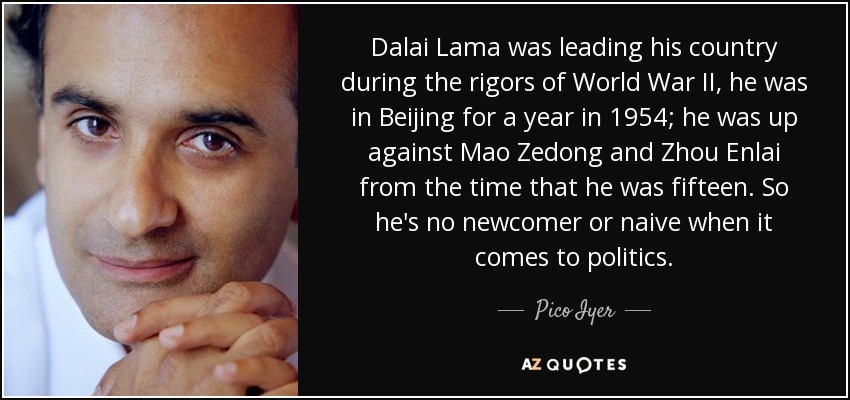
Dalai Lama was leading his country during the rigors of World War II, he was in Beijing for a year in 1954; he was up against Mao Zedong and Zhou Enlai from the time that he was fifteen. So he's no newcomer or naive when it comes to politics.
I've read a lot of war writing, even World War I writing, the British war poetry of Wilfred Owen and Siegfried Sassoon, Robert Graves's memoir "Goodbye to All That," and a civilian memoir "Testament of Youth" by Vera Brittain .
Since I was a kid. I had this series by Ballantine Books about the history of World Wars I and II. In my 20s, it was the Vietnam War literature of novelists like Tim O'Brien, Philip Caputo, and Tobias Wolff, and then nonfiction such as "A Bright Shining Lie" by Neil Sheehan and "The Best and Brightest" by David Halberstam . Those are the two best histories of Vietnam.
However, there is a fundamental difference between the issue related to Japan's history and our negotiations with China. What is it all about? The Japanese issue resulted from World War II and is stipulated in the international instruments on the outcomes of World War II, while our discussions on border issues with our Chinese counterparts have nothing to do with World War II or any other military conflicts. This is the first, or rather, I should say, the second point.
If someone is willing to reconsider the results of World War II, let us discuss this. But then we will have to discuss not only Kaliningrad, but also the eastern lands of Germany, the city of Lvov, a former part of Poland, and so on, and so forth. There are also Hungary and Romania on the list.
We Jews had more power than you Americans had during the War [World War I].
There is no question that, in 1980, Ronald Reagan had been portrayed as a war-monger, somebody who couldn't do anything off a script. And the one debate with President Jimmy Carter, he stood toe-to-toe and reassured people that he wasn't bound and determined to start World War III on the spot and could make a coherent statement.
After the First World War, it was, like, let's form the League of Nations, we have to learn to work together. It's the only way we're going to survive. And now it's like we're undoing these very fragile institutions that were built after the First and Second World Wars that were about nations working on a kind of global diplomacy for our mutual benefit. And we're undoing them at such rapid-fire pace.
Growing up after the Second World War in a Jewish family, I really understand that, and have members of my family who are very committed to this concept. My grandfather's first name was Israel and he thought it was his country. In my own sense of this issue as an American Jew, I have been on both sides of this. At this point I think it is very important for there to be separation of religion and state. It's not good for Jews. It's not good for Muslims. It's not good for Christians. The marriage of state and religion is inherently problematic.
As president, I will ramp up enforcement of trade rules by appointing a new chief trade prosecutor and tripling the number of enforcement officers. We will work with both parties to pass the biggest investment new good paying jobs since World War II.
I can only tell you this and I used to speak about it all the time, we have a Navy that hasn't been in this position since World War I.
We have an Army that hasn't been in this position since World War II, in terms of levels and in terms of readiness and in terms of everything else. We are not capable like we have to be.
On healthcare we are the prisoner of our past. The way we got to develop any kind of medical insurance program was during World War II when companies facing shortages of workers began to offer healthcare benefits as an inducement for employment. So from the early 1940s healthcare was seen as a privilege connected to employment. And after the war when soldiers came back and went back into the market there was a lot of competition, because the economy was so heated up.
As [John] Tolkien himself said, the story [Lord of the Ring ] is not allegorical. He said so when people tried to make analogies to World War II and the fight against Hitler and his fascist coalition.
In fact, the big steps forward for advertising, especially after World War I were when government just began employing the tools of advertising for its own purposes to get people to join the army and other things.
My plan is based on growing the economy, giving middle-class families many more opportunities. I want us to have the biggest jobs program since World War II, jobs in infrastructure and advanced manufacturing.
Things have gotten openly more extreme in the last few years. I was lecturing in Hungary, whose prime minister, Victor Orban, is an example of this trend. All over Budapest, statues have been replaced, museum exhibits have been redone, to turn ethnic Hungarians, not Jews, into the prime victims of the Germans during World War II. Five years ago, who would have thought this possible?
When I first went to jail in 1960 with seven classmates trying to use their public library against the backdrop of my father being a veteran of World War II, not being able to use - having to sit behind Nazi on American military bases, I lost my fear of jails and death.
There is a myth that the New Deal programs on their own pulled the US out of the Great Depression and created the conditions for the economic boom after World War II. As an economist, I can tell you, that is not true. In reality, it was mainly World War II that launched the boom - the massive war mobilization, the horrifying destruction and death caused by it, and then the reconstruction in its aftermath. he US was the only advanced capitalist country that was not bombed during the war.
We [with Shindzo Abe] should understand that the results of that terrible tragedy of the 20th century, namely World War II, are enshrined in corresponding international documents, and finding a way to settle all disputes without destroying the entire foundation of international law that evolved as a result of World War II is a highly delicate task. Therefore, I would like to reiterate that we cannot second-guess the course, let alone the outcome of our negotiations.
Following World War II, the U.S. was the architect of the UN system, and the world financial system, and the Human Rights Declaration, and of course the United Nations is based here in New York City. But, unfortunately, especially in the last decade, the U.S. really has been turning its back on international agreements and the set of agencies and procedures that they create as a means for governing the world.
Honestly, I really didn't want to take on World War II France, but when I came across the story of a nineteen-year-old Belgian woman who created an escape route out of Nazi-Occupied France, I was hooked.
I had read a lot of books on World War II, but I didn't know that downed airmen had hiked over the frozen peaks of the Pyrenees Mountains in shoes that didn't fit, in clothes that weren't warm enough, with German and Spanish patrols searching for them.
Adolf Galland said that the day we took our fighters off the bombers and put them against the German fighters, that is, went from defensive to offsensive, Germany lost the air war. I made that decision and it was my most important decision during World War II. As you can imagine, the bomber crews were upset. The fighter pilots were ecstatic.
Since the end of the World War II, the United States has fought three "small" wars...we lost all three of them and for the same reason-hubris.
Follow AzQuotes on Facebook, Twitter and Google+. Every day we present the best quotes! Improve yourself, find your inspiration, share with friends
or simply: