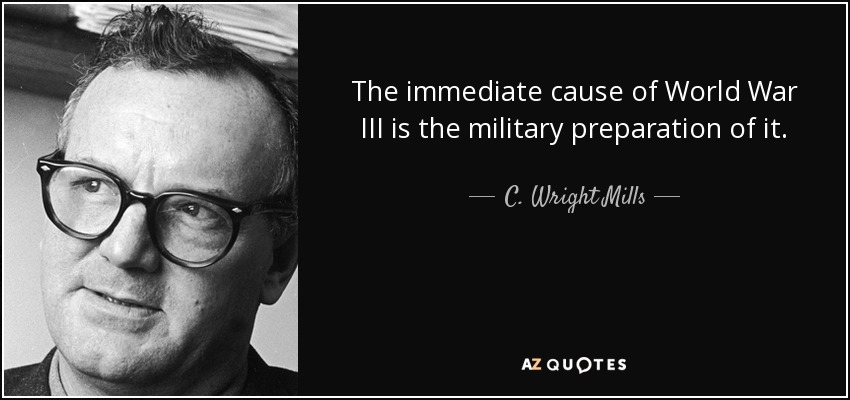
The immediate cause of World War III is the military preparation of it.
Growing up in the shadow of Johnson Space Center and moving to Texas to welcome our last moon mission home, I wanted to be an astronaut. Combined with my love for Navy history and World War II flight ops, and unsatisfying degrees in college and law school, I joined the Navy and became a naval aviator.
My great uncle Pvt. Tommy Rooney, USMC, was killed on Guam during the Pacific Campaign in World War II. I was named after him, so I always thought about him and wearing the uniform. The JAG Corps gave me that opportunity after law school.
German people get very uptight if you mention World War II. Germans today feel that what's past is past, new generations don't really remember it.
Most people experience history as one damn fact after another in high school. But if you can wonder, "Wow, what if the US hadn't gotten involved in World War II?", you can become enthralled by the imaginary possibilities.
It was Harry Patch, who was the last living World War I veteran; and by veteran I mean someone who actually fought in the war, he didn't just happen to be in the army at that time, in the Great War. And when the Iraq War started, he was interviewed, and they said, well what do you think of this? And he said, in a very sad voice, "Well, that's why my mates died. We thought we were going to end all that sort of thing."
I'm sort of optimistic about what we could do, but I'm very pessimistic about what we will do. I can't tell you that Al Gore's 10-year plan is impossible. I'm old enough to remember the Second World War - if we had a World War II-type mobilization, we might accomplish Gore's plan. In 1940 we were making tens of thousands of automobiles, and in 1941 we were making tens of thousands of airplanes. We mobilized as a nation. If we get that kind of mobilization as a nation or globally, then we could solve a lot of these problems.
I don't feel I was "born American," but my homeland was denied to me after the end of World War II and I craved something I could identify with.
The end of World War I also marked the end of bourgeois culture. An inner emptiness developed that, in the 19th and 20th centuries, paved the way for two ideologies that dragged Europe and the world into an abyss and plunged it into a catastrophe.
Greatest generation came through some stuff that we can't even imagine - the Depression, World War I - and all they wanted after that was a breather and a calm and a quiet life, and they get us.
Although the United States lost a quarter of a million men and women, civilians and soldiers, in World War II, that's considerably less than the Russians lost in soldiers at the Battle of Stalingrad alone. It's important to convey to countries and to people and to generations who have no experience of the 20th century as it was lived in Europe just how catastrophic it was.
Woodrow Wilson was the president of the United States in 1920, and he was made a fool of - his wife almost divorced him - because he wouldn't support women's suffrage. He was president during World War I, but I look back upon him as a coward. Because he knew the right thing to do - the right of women to vote was an idea whose time had come a long time before then, when a lot of women were put into prison or persecuted because they fought for it.
The sort of commercial parameters of classical music changed after the [World War II] , and the whole industry became more backward-looking.
In one sense, I have always felt glad to have had the war [World War II] in my childhood, because, as a result, nothing that has happened in the world since then has ever seemed quite so bad. On the other hand, I never entirely got over my feeling of being cheated when the promised era of peace in a wonderful "post-war world" failed to materialize. I could not understand how, after all that, people could ever even think of fighting again. And I still can't.
England Their England by AG Macdonell which was written in the thirties and is about a young Scotsman who's got shell shocked during the First World War I love it.
'Our parents' generation had it a lot tougher than we did. They had to live through the Depression, World War II, and then they had to, you know, try to pick up the pieces of their lives and bring up their children. And, it was a great example for us. I guess we grew up with a certain amount of the ethics our parents had, which is, you know: work hard, make your own way, be independent.
I hate to say it, but I had a great time in World War II.
Two factors explain our success. One, MIT's renaissance after World War II as a federally supported research resource. Two, the mathematical revolution in macro- and micro-economic theory and statistics. This was overdue and inevitable, MIT was the logical place for it to flourish.
With respect to the creation of the program, I introduced the bill in September 1945, immediately after the end of the war with Japan, in August of that year. A number of considerations, of course, entered into my decision to introduce the bill, growing from my own experience as a Rhodes scholar and the experiences our government had had with the first Word War debts, [Herbert] Hoover's efforts in establishing the Belgian-American Education Foundation after World War I, [and] the Boxer Rebellion indemnity.
Among the men who fought on Iwo Jima, uncommon valor was a common virtue.
The kind of group mentality that we had lived under since the Second World War is starting to erupt, and the craving for individualism is now much stronger. It's not as taboo anymore, as it was when I was younger.
"Red Dawn" was a movie made in 1984 I think about World War III. If you have not seen it and plan on watching it, you want to close your eye and cover your ears but not really. You can figure it out.
A lot of times when I ask people what their apocalyptic fantasy life is like, they'll immediately say something like, "Oh, what I think is going to kill us is climate change or World War IV," and that's not what I'm interested in at all. The point is not about winning a bet about what's going to happen. The point is about the human action of examining the possibility, the kind of obsessive imagining about it.
There's no other way to learn about it, except through documentaries. I encourage documentarians to continue telling stories about World War II. I think documentaries are the greatest way to educate an entire generation that doesn't often look back to learn anything about the history that provided a safe haven for so many of us today. Documentaries are the first line of education, and the second line of education is dramatization, such as The Pacific.
My favorite period is World War II, and I'm in the middle of writing my fourth novel set in that era.
Follow AzQuotes on Facebook, Twitter and Google+. Every day we present the best quotes! Improve yourself, find your inspiration, share with friends
or simply: