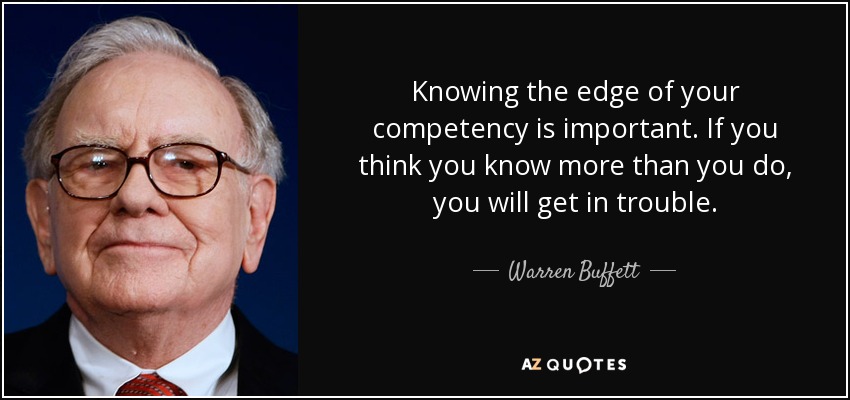
Knowing the edge of your competency is important. If you think you know more than you do, you will get in trouble.
Eventually we realize that not knowing what to do is just as real and just as useful as knowing what to do. Not knowing stops us from taking false directions. Not knowing what to do, we start to pay real attention. Just as people lost in the wilderness, on a cliff face or in a blizzard pay attention with a kind of acuity that they would not have if they thought they knew where they were. Why? Because for those who are really lost, their life depends on paying real attention. If you think you know where you are, you stop looking.
I wonder which is worse-the death, not knowing what comes after, or the wedding, when you think you know, but you're wrong.
I ask the fundamental question of rationality: Why do you believe what you believe? What do you think you know and how do you think you know it?
As soon as you think you know someone else's truth better than they do, you are in deep water.
As you get older and you realize you really don't know as much as you think you know, you listen more. Because then you think, now I need to be more receptive to the things I don't know. That's how you learn.
You think you know yourself, the world. You believe you've got a bead on everybody else's bullshit, but what about your own?
I think unknowing is the most important theological idea for me. Unlearning the things you think you know.
In your teens, you think you know everything, and you know nothing. By your thirties, you're sure you know nothing, but you're happy with that.
Adults always wonder what to say and how to say it when they're talking to a child. You want to be wise, but all you are is a child yourself in a larger body. Nothing is ever what it seems. The things that you think you know are never certain. I know that now. I wish that I didn't, but I do.
It was great fun, to learn anew. You think you know enough, but you don't. You must open up; let it in. be receptive, admit what you don't know, which few are willing to do. Start from square one. Again!
You make a movie and it's like convincing people to go on an expedition with you. You think you know where it's going to end up, and you're hoping and guessing. But, when people trust you and get involved, based on that trust, it's a really nice feeling to be able to have everything pay off.
Impressionism means taking inspiration directly from nature, trusting your senses rather than what you think you know.
But then life is never neat, it is made up of doors and trapdoors. You move down baroque corridors, and even when you think you know which door to open, you still need to have the courage to choose.
Traditional scientific method has always been at the very best, 20 - 20 hindsight. It's good for seeing where you've been. It's good for testing the truth of what you think you know, but it can't tell you where you ought to go.
I love to start characters in a place where you think you know them. We can make all kinds of assumptions about them and think they have no redeeming qualities, but like everyone, they're complex.
You think you know who you are and then other people have these other ideas.
Just when you think you know something, it gets turned around and challenged in some way. But those changes are welcome because you end up learning more.
You’re never ready for the truth. No matter how much you think you know, it always takes you by surprise.
Miffed, I poked him in the chest. 'You think you know everything?' His hands caressed my back. 'Not everything, but some things. I knew without a doubt I'd fallen in love when we met. Then I knew I'd do anything to make you feel the same way.
When you sit quietly and let go of every false self-definition , of everything you think you know about who you are, and then be what's left, what remains is the untarnished presence of who you've always been and still really are.
Disability doesn't make you exceptional, but questioning what you think you know about it does.
I think, one thing that I've really come to appreciate about my parents as I've got older is you know, how wise they really were. As a kid when I was growing up, as any kid, you think you know every thing and I was no different to that. I had different opinions on a lot of different things then them but the way they raised me, in hindsight, they were right.
As a kid when I was growing up, as any kid, you think you know every thing and I was no different to that.
You think you know me, but I'm not sure that even I know who I am anymore.
Follow AzQuotes on Facebook, Twitter and Google+. Every day we present the best quotes! Improve yourself, find your inspiration, share with friends
or simply: