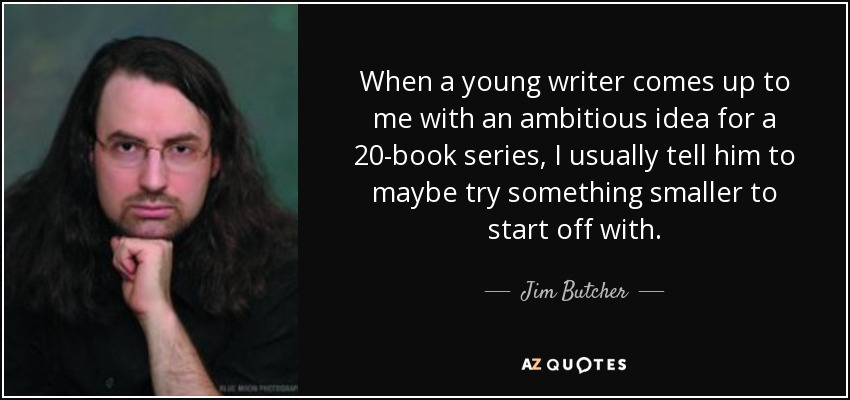
When a young writer comes up to me with an ambitious idea for a 20-book series, I usually tell him to maybe try something smaller to start off with.
Young writers need to be encouraged to write - just write - with no restrictions on form, style or content.
The biggest pitfall to avoid is not writing. Not writing is really, really easy to do, especially if you're a young writer. The hope that elves will come in the night and finish it for you, is a very common one to have. That is my main recommendation - you have to write, and you have to finish what you write and beyond that, it's all detail.
Young writers take themselves very seriously in college.
Young writers only take off when they find their subjects. Since almost everyone has a family and stories about family, that is often a place to start.
I started my professional career before the blogosphere existed in any sort of meaningful way. I think that my approach as a writer was certainly freer because I wasn't worried, I didn't have commenters on me right from the get-go. I didn't have this instant-reaction culture that young writers have to deal with now. I had different things - I was listed in the phone book and people would look me up and call me and yell at me, but that was about as bad as it got.
I also liked it when professors assigned us stories that they love. In general, I liked workshops more when they were more than just a workshop, when the professor took the time to actually guide us as young writers and teach us things it took them a long time to figure out on their own. I could probably write ten pages on this question.
Nobody tells young writers it's okay if you're not very good, you'll get better. So I just thought I'm not very good, so I should try to do every other thing besides writing. That's how I ended up being a hitchhiker, a world traveler, and a mathematician.
What I didn't realize when I was in school and what I suspect a lot of young writers today don't get either is that you have to create the world that you want to exist in as an artist.
When you're a young writer and you look at people praising a big hefty anthology that has uncovered a long lost genre, it can be disorienting to look inside it and think, "But what it's uncovered still isn't me. What does this mean? Do I not belong in this genre, or is there more of the genre yet to find?"
If I had a script that I was ready to shoot tomorrow, I'd work on it every day until we got into production as soon as possible, but I don't have that script yet, so I'm trying to find and support writers, really young writers and hopefully come across a story that I wanna tell one day.
It's true that the young who now flock to script writing, or producing and directing, to fulfill the demands of these new devices would, in an earlier period, have been submitting to magazines and working on their first novels. But even in the midst of all these "digital products," the wonder of it is that there are still so many young writers who continue to believe in the venerable print novel as the corridor to fame and fortune.
When I was a kid and a young man I read everything. When I was about 23, I was incredibly lucky in that I wound up with several book review columns, which meant that I had to read huge amounts of stuff that was outside my experience and outside my comfort zone. I think every young writer should be forced to read the kind of stuff they would not normally read for pleasure.
My main strength as a young writer was that I had no fear of making mistakes. I knew I would and I knew I could and would learn from them.
Follow AzQuotes on Facebook, Twitter and Google+. Every day we present the best quotes! Improve yourself, find your inspiration, share with friends
or simply: