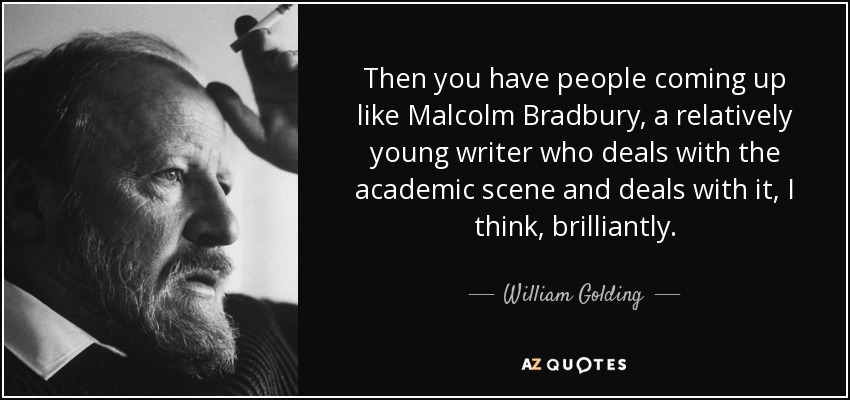
Then you have people coming up like Malcolm Bradbury, a relatively young writer who deals with the academic scene and deals with it, I think, brilliantly.
Of course at that point I had no idea that the adventure was only beginning and that the struggle and the rejections were to pile before me, a typical young writer, in an implacable mountain. But I was on my way.
That's my gutsy advice to any young writer: write only about what you know well.
And so, when I was a young writer I always worked hard on imagery, and I knew that the roots of imagery were the senses - and that if my readers could feel, taste and see what I was talking about, I would be able to tell them a story.
This is what drives a young writer out of his head, this feeling that nothing is being said.
The best young writers are convinced they need blurbs from famous writers before an editor will even read the first page of a manuscript. If this is true, then the editorial system that prevails today stinks. And let's start reforming it.
Elizabeth Searle writes with intelligence, passion and wit. She's one of the best young writers around.
When people ask, "Is there any advice you'd give a young writer?," I say write short stories. They afford lots of failure. Pastiche is a great way to start.
I've grown up on a diet of metaphors. If young writers would find those writers who can give them metaphors by the bushel and the peck, then they'll become better writers - to learn how to capsualize things and present them in metaphorical form.
The writer learns to write, in the last resort, only by writing. He must get words onto paper even if he is dissatisfied with them. A young writer must cross many psychological barriers to acquire confidence in his capacity to produce good work-especially his first full-length book-and he cannot do this by staring at a piece of blank paper, searching for the perfect sentence.
A lot of young writers wait for inspiration. The inspiration only hits you at the desk.
Young writers find their first audience in little magazines, and experimental writers find their only audience there.
The beating of drums, which delights young writers who serve a party, sounds to him who does not belong to the party line like a rattling of chains, and excites sympathy rather than admiration.
For me writing is a long, hard, painful process, but it is addictive, a pleasure that I seek out actively. My advice to young writers is this: Read a lot. Read to find out what past writers have done. Then write about what you know. Write about your school, your class, about your teachers, your family. That's what I did. Each writer must find his or her own kind of voice. Finally, you have to keep on writing.
When a young writer deliberately tries to create an effect, the result is often a little self-conscious and overdone. But why is it so hard for us to glory in what the writer has tried to do, or even in the very fact that the writer has deliberately tried to do something?
I really don't want to encourage young writers. Keep them down and out and silent is my motto.
My advice to young writers would be to write every day, even if it is only a few words. Get yourself on the habit of writing and it will become a lifelong one. And find a place to write where you are physically comfortable. You can't concentrate if you aren't. Ernest Hemingway could only write standing up, and Truman Capote could only write lying down!
I always ask young writers, 'Are you certain you want to be a writer? If you're absolutely sure, then do it.' If you really want to write, writing has to take precedence over everything else, except for taking care of your loved ones. It has to be more important than any possession, more important than fame. We hear about just a few writers who get famous, but most of them don't. It's got to mean more than that.
Advice to young writers? Always the same advice: learn to trust our own judgment.
All of us ambitious young writers hoped to have a cover story in Esquire, of course. The idea was to write the best, most entertaining article that you can.
But it's clear to me that us slow-poke writers are a dying breed. It's amazing how thoroughly my young writing students have internalized the new machine rhythm, the rush many of my young writers are in to publish. The majority don't want to sit on a book for four, five years. The majority don't want to listen to the silence inside and outside for their artistic imprimatur. The majority want to publish fast, publish now.
In my travels I am often asked if college stifles young writers. In my opinion, it doesn't stifle them enough.
Young writers take themselves very seriously in college.
Young writers only take off when they find their subjects. Since almost everyone has a family and stories about family, that is often a place to start.
I started my professional career before the blogosphere existed in any sort of meaningful way. I think that my approach as a writer was certainly freer because I wasn't worried, I didn't have commenters on me right from the get-go. I didn't have this instant-reaction culture that young writers have to deal with now. I had different things - I was listed in the phone book and people would look me up and call me and yell at me, but that was about as bad as it got.
Follow AzQuotes on Facebook, Twitter and Google+. Every day we present the best quotes! Improve yourself, find your inspiration, share with friends
or simply: