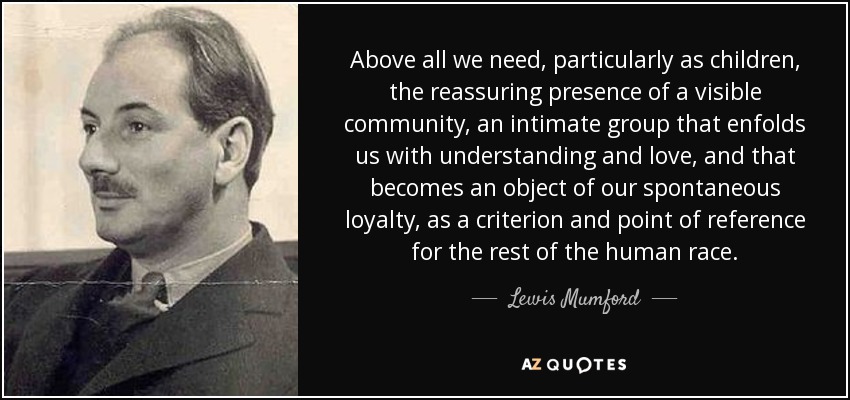
Above all we need, particularly as children, the reassuring presence of a visible community, an intimate group that enfolds us with understanding and love, and that becomes an object of our spontaneous loyalty, as a criterion and point of reference for the rest of the human race.
I would die happy if I knew that on my tombstone could be written these words, "This man was an absolute fool. None of the disastrous things that he reluctantly predicted ever came to pass!"
If there are favourable habitats and favorable forms of association for animalsand plants, as ecology demonstrates, why not for men? If each particular natural environment has has its own balance; is there not perhaps an equivalent of this in culture?
Without fullness of experience, length of days is nothing. When fullness of life has been achieved, shortness of days is nothing. That is perhaps why the young have usually so little fear of death; they live by intensities that the elderly have forgotten.
Moment to moment, it turns out, is not God's conception, or nature's. It is man conversing with himself about and through a piece of machinery he created."We effectively became "time-keepers, and then time-savers, and now time-servers" with the invention of the clock."
By fashion and built-in obsolescence the economies of machine production, instead of producing leisure and durable wealth, are duly cancelled out by the mandatory consumption on an even larger scale.
Man's Chief purpose is the creation and preservation of values; that is what gives meaning to our civilization, and the participation in this is what gives significance, ultimately, to the individual human life.
Virtue is not a chemical product...it is a historic product, like language and literature; and this means that if we cease to care about it, cease to cultivate it, cease to transmit its funded values, a large part of it will become meaningless, like a dead language to which we have lost the key.
Geneva has the sleepy tidiness of a man who combs his hair while yet in his pyjamas.
Everyone aimed at security: no one accepted responsibility. What was plainly lacking, long before the barbarian invasions had done their work, long before economic dislocations became serious, was inner go. Rome’s life was now an imitation of life: a mere holding on. Security was the watchword – as if life knew any other stability than through constant change, or any form of security except through a constant willingness to take risks
New York is the perfect model of a city, not the model of a perfect city.
However far modern science and techniques have fallen short of their inherent possibilities, they have taught mankind at least one lesson; nothing is impossible.
Every work of art is an abstraction from time; it denies the reality of change and decay and death.
When art seems to be empty of meaning, as no doubt some of the abstract painting of our own day actually does seem, what the painting says, indeed what the artist is shrieking at the top of his voice, is that life has become empty of all rational content and coherence, and that, in times like these, is far from a meaningless statement.
Iron and coal dominated everywhere, from grey to black: the black boots, the black stove-pipe hat, the black coach or carriage, the black iron frame of the hearth, the black cooking pots and pans and stoves. Was it a mourning? Was it protective coloration? Was it mere depression of the senses? No matter what the original color of the paleotechnic milieu might be it was soon reduced by reason of the soot and cinders that accompanied its activities, to its characteristic tones, grey, dirty-brown, black.
Unfortunately, once an economy is geared to expansion, the means rapidly turn into an end and "the going becomes the goal."
(The processes are) doubly ruinous: they impoverish the earth by hastily removing, for the benefit of a few generations, the common resources which, once expended and dissipated, can never be restored; and second, in its technique, its habits, its processes, the paleotechnic period is equally inimical to the earth considered as a human habitat, by its destruction of the beauty of the landscape, its ruining of streams, its pollution of drinking water, its filling the air with a finely divided carboniferous deposit, which chokes both life and vegetation.
He who touches the soil of Manhattan and the pavement of New York, touches, whenever he knows or not, Walt Whitman.
Order and creativity are complementary.
Nothing about his life is more strange to [man] or more unaccountable in purely mundane terms than the stirrings he finds in himself, usually fitful but sometimes overwhelming, to look beyond his animal existence and not be fully satisfied with its immediate substance. He lacks the complacency of the other animals: he is obsessed by pride and guilt, pride at being something more than a mere animal, built at falling short of the high aims he sets for himself.
To the extent that the scientist's capacity for pursuing the truth depends upon costly apparatus, institutional collaboration and heavy capital investment by government or industry he is no longer his own master.
Today, the notion of progress in a single line without goal or limit seems perhaps the most parochial notion of a very parochial century.
The last step in parental love involves the release of the beloved; the willing cutting of the cord that would otherwise keep the child in a state of emotional dependence.
What plethora of material goods can possibly atone for a waking life so humanly belittling, if not degrading, as the push-button tasks left to human performers?
By his very success in inventing labor-saving devices, modern man has manufactured an abyss of boredom that only the privileged classes in earlier civilizations have ever fathomed.
Follow AzQuotes on Facebook, Twitter and Google+. Every day we present the best quotes! Improve yourself, find your inspiration, share with friends
or simply: