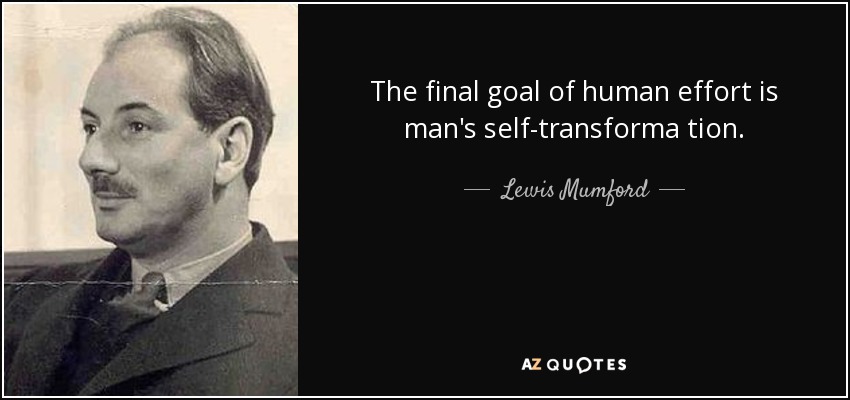

The final goal of human effort is man's self-transforma tion.
War is the supreme drama of a completely mechanized society.
Idealism and science continue to function in separate compartments; and yet 'the happiness of man on earth' depends upon their combination.
Misery, mutilation, destruction, terror, starvation and death characterize the process of war and form a principal part of the product.
The artist does not illustrate science; ... [but] he frequently responds to the same interests that a scientist does, and expresses by a visual synthesis what the scientist converts into analytical formulae or experimental demonstrations.
To curb the machine and limit art to handicraft is a denial of opportunity.
Unfortunately, once an economy is geared to expansion, the means rapidly turn into an end and "the going becomes the goal." Even more unfortunately, the industries that are favored by such expansion must, to maintain their output, be devoted to goods that are readily consumable either by their nature, or because they are so shoddily fabricated that they must soon be replaced. By fashion and built-in obsolescence the economies of machine production, instead of producing leisure and durable wealth, are duly cancelled out by the mandatory consumption on an even larger scale.
Nothing is unthinkable, nothing impossible to the balanced person, provided it comes out of the needs of life and is dedicated to life's further development.
The Fujiyama of Architecture?at once a lofty mountain and a national shrine.
The self holds both a hell and a heaven.
The physical lot of surviving workers had notably improved, with unemployment insurance, social security, and the new health services, while their children's school education was assured by the government-operated schools: in addition, they had, for intellectual or emotional stimulus and diversion, the radio and the television. But the work itself was no longer as various, as interesting, or as sustaining to the personality.
The mind reproduces itself by transmitting its symbols to other intermediaries, human and mechanical, than the particular brain that first assembled them.
The wonder is not that so much cacophony appears in our actual individual lives, but that there is any appearance of harmony and progression.
The settlement of America had its origins in the unsettlement of Europe. America came into existence when the European was already so distant from the ancient ideas and ways of his birthplace that the whole span of the Atlantic did not widen the gulf.
Genuine [economic] value lies in the power to sustain or enrich life
When vitality runs high, death takes men by surprise. But if they close their eyes to this possibility, what they gain in peace they lose in sensibility and significance.
In war, the army is not merely a pure consumer, but a negative producer.
Nothing endures except life: the capacity for birth, growth, and renewal.
This metropolitan world, then, is a world where flesh and blood is less real than paper and ink and celluloid.
We have lost faith in the formal powers of the mind, not, as some suppose, because our universe is too difficult to grasp, but because we lack the inner principle of order.
The cycle of the machine is now coming to an end. Man has learned much in the hard discipline and the shrewd, unflinching grasp of practical possibilities that the machine has provided in the last three centuries: but we can no more continue to live in the world of the machine than we could live successfully on the barren surface of the moon.
Faith in the creative process, in the dynamics of emergence, in the values and purposes that transcend past achievements and past forms, is the precondition of all further growth.
Every new baby is a blind desperate vote for survival: people who find themselves unable to register an effective political protest against extermination do so by a biological act.
Neither democracy nor effective representation is possible until each participant in the group...devotes a measurable part of his life to furthering its existence.
The humanities and science are not in inherent conflict but have become separated in the twentieth century. Now their essential unity must be re-emphasized, so that twentieth-century multiplicity may become twentieth-century unity.
Follow AzQuotes on Facebook, Twitter and Google+. Every day we present the best quotes! Improve yourself, find your inspiration, share with friends
or simply: