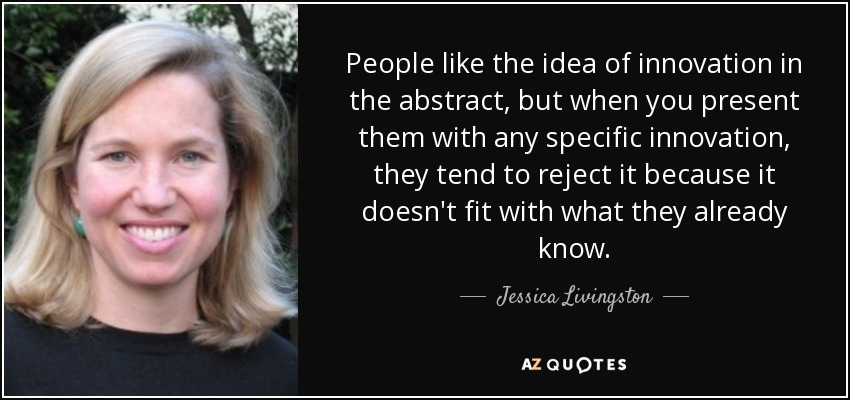
People like the idea of innovation in the abstract, but when you present them with any specific innovation, they tend to reject it because it doesn't fit with what they already know.
Information doesn’t deserve to be free. It is an abstract tool; a useful fantasy, a nothing. It is nonexistent until and unless a person experiences it in a useful way.
Algebraic geometry seems to have acquired the reputation of being esoteric, exclusive, and very abstract, with adherents who are secretly plotting to take over all the rest of mathematics. In one respect this last point is accurate.
Language [can] be expressed . . . by movements of the hands and face just as well as by the small, sound-generating movements of the throat and mouth. Then the first criterion for language that I had learned as a student—it is spoken and heard—was wrong; and, more important, language did not depend on our ability to speak and hear but must be a more abstract capacity of the brain. It was the brain that had language, and if that capacity was blocked in one channel, it would emerge through another.
Abstract thinking leads to greater creativity... But in our businesses and our lives, we often do the opposite. We intensify our focus rather than widen our view.
[Photography] puts a human face on issues which, from afar, can appear abstract or ideological or monumental in their global impact.
We feel the beauty of nature because we are part of nature and because we know that however much in our separate domains we abstract from the unity of Nature, this unity remains. Although we may deal with particulars, we return finally to the whole pattern woven out of these.
Freedom is not merely a word or an abstract theory, but the most effective instrument for advancing the welfare of man.
I am convinced that abstract form, imagery, color, texture, and material convey meaning equal to or greater than words.
The southern German has the imagination and emotionality to subscribe to a fanatic ideology, but he is ordinarily inhibited from excesses by his natural humaneness. The Prussian does not have the imagination to conceive in terms of abstract racial and political theories, but when he is told to do something, he does it.
A mathematician is an individual who calls himself a 'physicist' and does 'physics' and physical experiments with abstract concepts.
When a person you love dies, it doesn’t feel real. It’s like it’s happening to someone else. It’s someone else’s life. I’ve never been good with the abstract. What does it mean when someone is really truly gone?
Joy Rains has a gift. A gift for explaining abstract concepts like meditation through clever analogies and metaphors. FOR THE FIRST TIME in my hectic, harried life I actually UNDERSTAND how meditation is supposed to work and WHY I should give it a TRY!
Our relationship with places is a close bond, intricate in nature, and not abstract, not remote at all: It's enveloping, almost a continuum with all we are and think.
In ordinary life, we are not aware of the unity of all things, but divide the world into separate objects and events. This division is useful and necessary to cope with our everyday environment, but it is not a fundamental feature of reality. It is an abstraction devised by our discriminating and categorising intellect. To believe that our abstract concepts of separate 'things' and 'events' are realities of nature is an illusion.
The one object of fifty years of abstract art is to present art-as-art and as nothing else, to make it into the one thing it is only, separating and defining it more and more, making it purer and emptier, more absolute and more exclusive - non-objective, non-representational, non-figurative, non-imagist, non-expressionist, non-subjective. the only and one way to say what abstract art or art-as-art is, is to say what it is not.
The big shock of my life was Abstract Expressionism - Pollock, de Kooning, those guys. It changed my work. I was an academically trained student, and suddenly you could pour paint, smear it on, broom it on!
I am dominated by one thing, an irresistible, burning attraction towards the abstract. The expression of human feelings and the passions of man certainly interest me deeply, but I am less concerned with expressing the motions of the soul and mind than to render visible, so to speak, the inner flashes of intuition which have something divine in their apparent insignificance and reveal magic, even divine horizons, when they are transposed into the marvellous effects of pure plastic art.
But nobody is visually naive any longer. We are cluttered with images, and only abstract art can bring us to the threshold of the divine.
Everybody enjoys the freedom he deserves, which is measured by the stature and dignity of his person or by his function, and not by the abstract and elementary fact of merely being a 'human being' or a 'citizen'.
While it may be impossible to 'disprove' the existence of some 'Higher Power' or abstract Creator, it is entirely possible — through analysis and research — to find discrepancies within the ancient, organized religious traditions that support the idea of a specific God.
Passion isn't something that lives way up in the sky, in abstract dreams and hopes. It lives at ground level, in the specific details of what you're actually doing every day.
A man's knowledge may be said to be mature, in other words, when it has reached the most complete state of perfection to which he, as an individual, is capable of bringing it, when an exact correspondence is established between the whole of his abstract ideas and the things he has actually perceived for himself. His will mean that each of his abstract ideas rests, directly or indirectly, upon a basis of observation, which alone endows it with any real value; and also that he is able to place every observation he makes under the right abstract idea which belongs to it.
An old essay by John Updike begins, 'We live in an era of gratuitous inventions and negative improvements.' That language is general and abstract, near the top of the ladder. It provokes our thinking, but what concrete evidence leads Updike to his conclusion ? The answer is in his second sentence : 'Consider the beer can.' To be even more specific, Updike was complaining that the invention of the pop-top ruined the aesthetic experience of drinking beer. 'Pop-top' and 'beer' are at the bottom of the ladder, 'aesthetic experience' at the top.
We think about the world in all ways we experience it ; we think visually, we think in sign, we think kinesthetically, we think in abstract term, we think in movement. Creativity is the process of having original ideas that have value.
Follow AzQuotes on Facebook, Twitter and Google+. Every day we present the best quotes! Improve yourself, find your inspiration, share with friends
or simply: