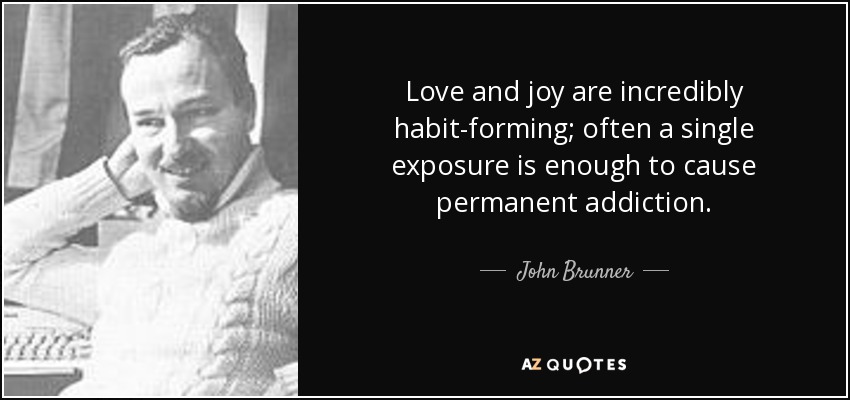
Love and joy are incredibly habit-forming; often a single exposure is enough to cause permanent addiction.
Of what use is the universe? What is the practical application of a million galaxies? Yet just because it has no use, it has a use - which may sound like a paradox, but is not. What, for instance, is the use of playing music? If you play to make money, to outdo some other artist, to be a person of culture, or to improve your mind, you are not really playing - for your mind is not on the music. You don't swing. When you come to think of it, playing or listening to music is a pure luxury, an addiction, a waste of valuable time and money for nothing more than making elaborate patterns of sound.
Our growing addiction to the Internet is impairing precious human capacities such as memory, concentration, pattern recognition, meaning-making, and intimacy. We are becoming more restless, more impatient, more demanding, and more insatiable, even as we become more connected and creative. We are rapidly losing the ability to think long about any- thing, even those issues we care about. We flit, moving restlessly from one link to another.
If Republican legislators succumb to their political addiction to compromise for the sake of getting something passed, no matter how odious, they'll be laying out the red carpet of inevitability for socialized care. Once government gets its foot in the door, more government control is unavoidable.
The welfare system is the breeding ground of crime, addiction and radical politics.
My mum thought my TV and film addiction was laziness. If you're an immigrant, you know you'll never be an accepted part of society, but you hope your children will be, and you try to make them essential to the community in a practical way - being a doctor or a lawyer. Acting was beyond their comprehension.
I was an addict. That's why, ... I tell you, addiction is a very cunning enemy.
Our president's latest energy initiative was to go to Saudi Arabia and beg King Abdullah to give us a little relief on gasoline prices. I guess there was some justice in that. When you, the president, after 9/11, tell the country to go shopping instead of buckling down to break our addiction to oil, it ends with you, the president, shopping the world for discount gasoline.
Most memoirs about alcoholism, promiscuity, and addiction are deep, sobering tales full of scars that will never heal and include alarming statistics and reflection about recovery.This is not one of those memoirs.
I am on an emotional roller coaster ride to survive and to conquer obesity, not only for myself but also for everyone that battles some kind of addiction.
I don't know a family that isn't touched by some sort of addiction.
My greatest struggle is to coexist while watching the people I love choose less than life-supporting paths via drugs, alcohol, or poor lifestyle decisions. There is so much to life; my heart breaks watching someone held captive by addiction.
My characters' addictions are what makes them a bit stylized or "grotesque" - not just in appearance but through what drives them. Addiction is what threatens stability and normalcy and yet it seems very much a part of being human - at least we are all a bit obsessive and compulsive. Aren't all humans driven by mad desires for one thing or another?
It's not just that we all as individuals should reevaluate our relationship with our devices - maybe you should, on a personal level - but in terms of balancing the micro and the macro and the personal and the structural, it's actually a bigger issue than you and your phone addiction.
From personal experience, I completely agree that it is often easier to go for monotone sadness. When I was starting out, I wrote a gazillion short stories that ran the gamut of human suffering - drug addiction, child abuse, terminal illness, loved ones dying by all manner of misfortune, etc. In hindsight, it's clear that I mistook the power of the situation for the power of the story.
We all know to feel sympathy for those who've suffered from drug addiction, child abuse, and terminal illness, so the set up elicits an emotional response that the story itself very well may not earn. Energy generated by the fiction itself is likely to produce more light.
I knew as a young boy that addiction and alcoholism afflict people - good, loving people - in profound ways, and that some people - usually from those rare "normal" families that I longed for as a child and as an adult wonder if they even exist - didn't understand this and sort of looked down their noses at people suffering with addiction.
I felt that if people understood the struggle of recovery, then some of the stigma of addiction might be reduced because the audience would understand in a palpable way that addiction is a disease that tells the afflicted, despite years or even decades of heartbreaking evidence to the contrary, that using will make things better.
The roots of addiction can be seen in our search for happiness in something outside of our self, be it drugs, relationships, material possessions.
For years I was so busy building walls I did not see I was imprisoning myself behind them, and did not recognize this pattern as being addiction. My addictive thinking and behavior became the bars of my cell. Denying feeling empty inside, I constantly looked for new things to acquire, people to be around, substances to take, and new goals to achieve in order to feel better about myself. Over the last four decades I have focused on healing my addictive mind and helping others do the same.
I think the addiction stuff, because I was already sort of outed in my family as a sexual person: as a sexually-adventurous and sexually-conflicted person and sexually-driven person. They already knew that about me. They knew that about me when I was eleven. My parents very consciously tried to provide an environment that would protect me from becoming a drug addict.
I have been tested in many ways, personally, I have beaten breast cancer, I buried a child to addiction. Professionally, you cannot go from being a secretary of nine-person real estate firm to the chief executive of the largest technology company in the world without having been tested over and over and over.
You don't need to hide the fact that you're in recovery, but you don't have to share your history of addiction with acquaintances at work, either.
As you feel increasingly comfortable around your friends, I think it's more than fine to share the basic details of your heroin addiction with them. If they seem receptive, you can feel free to talk about it in further detail; if they seem judgmental or uncomfortable, you can move on to other topics.
I treasure my mornings. I get up early and ignore everything work-related for the first few hours. It's just me and my coffee addiction.
Follow AzQuotes on Facebook, Twitter and Google+. Every day we present the best quotes! Improve yourself, find your inspiration, share with friends
or simply: