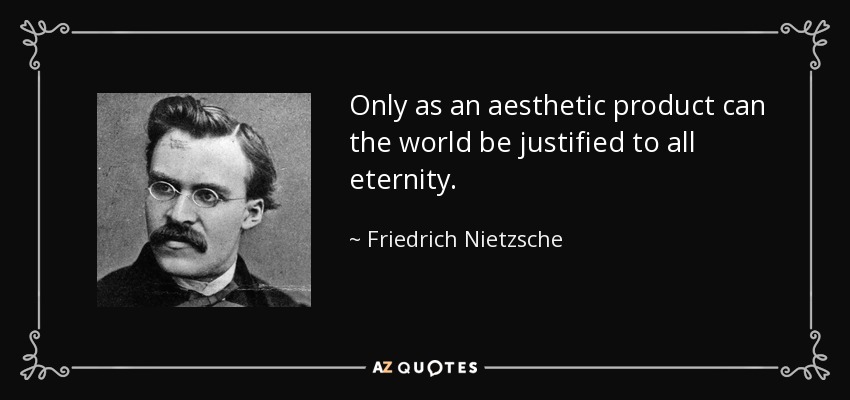
Only as an aesthetic product can the world be justified to all eternity.
The principle objectives in life are love, the creation and enjoyment if aesthetic experience, the pursuit of knowledge. Love comes a long way first.
...aesthetic values are changed under the influence of sexual emotion; from the lover's point of view many things are beautiful which are unbeautiful from the point of view of him who is not a lover, and the greater the degree to which the lover is swayed by his passion the greater the extent to which his normal aesthetic standard is liable to be modified.
You could say that clinical depression is an incapacity to aesthetic response. It's like there's a constant agreement within ourselves, a kind of mutual understanding between ourselves and the world.
There's an aesthetic theme, which is cities at two o'clock in the morning. Not cities packed with people going out to clubs and dancing but desolate, empty streets. It's off-putting but there's a strange comfort to it as well, that desolate urban environment.
It's so important what you're doing in your life. It's tremendously important to the work, and no aesthetic theories take that into account.
It's [Into the Badlands] something that's very, very different and I think that's why it divided critics initially because they didn't understand it or get it. They didn't understand or have a knowledge of what we were trying to do. Bringing in the Asian martial arts aesthetic to American television. For us, these are the people who will make the show a hit or a failure in future seasons. So it's for us to respect them and interact and see what they have to say.
That became my aesthetic - a very Chekhovian, American realist aesthetic in the tradition of Raymond Carver, Richard Ford, and Tobias Wolff. The perfectible, realist story that had these somewhat articulate characters, a lot of silence, a lot of obscured suffering, a lot of manliness, a lot of drinking, a lot of divorces. As my writing went on, I shed a lot of those elements.
I'm kind of still down with Virg Woolf on this one: "women must kill the aesthetic ideal through which they themselves have been 'killed' into art."
I think that there is a purity aesthetic, like "I just make art because I'm an artist and I can't help it. I don't care what the critics say." But different mediums have a different relationship with the public. If you're in a performing medium it's hard not to place some weight on whether or not people come to your shows, or whether or not they're enjoying them.
When you're spending that much time by yourself in your car looking at landscapes, it's desolate. Most of the other people around you are invisible in their own cars. You're driving past houses where maybe once in a while somebody is out, but that's about it. So I was interested in that aesthetic and I decided I wanted to write an apocalyptic narrative, but the more I thought of it, it seemed bizarre and untenable to me to pick one, so I just didn't.
It's not like you're being fake, it's just the way you color it, like a guitar player uses pedals or different effects. That's why I get so mad about people who are down on vocal reverb. It's not a crutch, people, it's an aesthetic choice!
I certainly think there are things that impressed me as a child about the church. The smells and the sounds and the pagaentry of it remained with me. The aesthetic I really love. I think a lot of my sense of melody comes from singing those hymns and doing the renaissance music and stuff.
The collection under my name is an exciting opportunity to really express my own aesthetic and connect with a very different consumer.
The idea of recontextualizing images from different eras to express larger ideas about modern times was very exciting to me. That archival aesthetic is the foundation of my filmmaking style.
What liberates the imagination is the sense that work in its theory and practice holds aesthetic possibilities, that jobs can be elegantly conceived and gracefully done. This sense of beauty unlocks feelings of pleasure and love and breaks down the barrier between worker and work and commit to work not merely the "thinking" consciousness but the full resources of mind.
Nature supplies the game of chess with its implements; science with its system; art with its aesthetic arrangement of its problems; and God endows it with its blessed power of making people happy.
Eisner mentioned he was uncomfortable calling Kirby someone with heavy artistic intent. I paraphrase, but Eisner felt Jack was mostly concerned with hitting his page count, telling good stories, and keeping his family fed. Not pursuing some aesthetic ideal - to seek that motive in Kirby's work was, he suggested, misguided. I happened to be holding the original artwork to the Devil Dinosaur #4 double-splash, which I turned around and showed Eisner - who took a moment, and said something uncharacteristic: “Okay, I might be wrong.
Among the few I have indicated, is there no dynamic man of action, the rebel who will help determine the aspect of the collective expression of tomorrow? Ponder this question and know that to make beautiful creations for the sake of their aesthetic value will have no social significance tomorrow, will be nonsensical self-gratification. Every era contains the conditions for providing a rebel.
Since the Greeks the predominant attitude of thinkers towards intellectual activity was to glorify it insofar as (like aesthetic activity) it finds its satisfaction in itself, apart from any attention to the advantages it may procure. Most thinkers would have agreed with Renan's verdict that the man who loves science for its fruits commits the worst of blasphemies against that divinity. The modern clercs have violently torn up this charter. They proclaim the intellectual functions are only respectable to the extent that they are bound up with the pursuit of concrete advantage.
Man's chief difference from the brutes lies in the exuberant excess of his subjective propensities his preeminence over them simply and solely in the number and in the fantastic and unnecessary character of his wants, physical, moral, aesthetic, and intellectual. Had his whole life not been a quest for the superfluous, he would never have established himself as inexpugnably as he has done in the necessary.
Some people', Miss R. said,'run to conceits or wisdom but I hold to the hard, brown, nutlike word. I might point out that there is enough aesthetic excitement here to satisfy anyone but a damned fool.
Even the nonreligious may exercise aesthetic judgment in matters of religion, and indeed our age has given the unbelieving a sophisticated taste in religious literature.
In fact, the influence of Schoenberg may be overwhelming on his followers, but the significance of his art is to be identified with influences of a more subtle kind - not the system, but the aesthetic, of his art. I am quite conscious of the fact that my Chansons madécasses are in no way Schoenbergian, but I do not know whether I ever should have been able to write them had Schoenberg never written.
In avant garde drama ... primitivism goes hand in hand with aesthetic experimentation designed to advance the technical progress of the art itself by exploring fundamental questions: What is a theatre? What is a play? What is an actor? What is a spectator? What is the relation between them all? What conditions serve this best?
Follow AzQuotes on Facebook, Twitter and Google+. Every day we present the best quotes! Improve yourself, find your inspiration, share with friends
or simply: