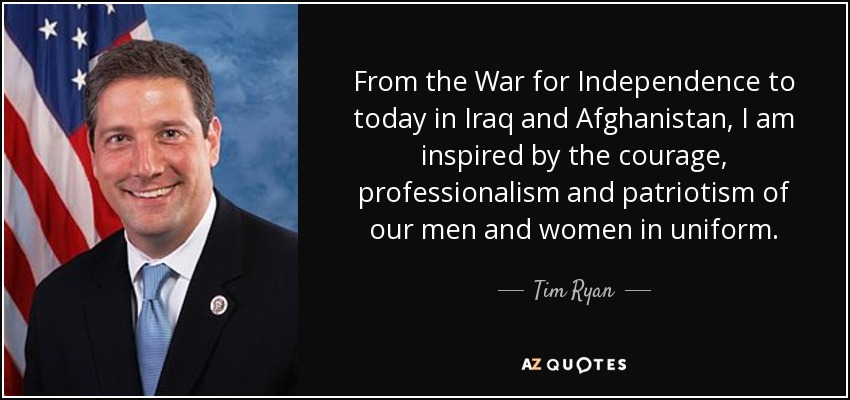
From the War for Independence to today in Iraq and Afghanistan, I am inspired by the courage, professionalism and patriotism of our men and women in uniform.
The other problem is that the priority of many soldiers in Iraq or Afghanistan is operational security: not getting killed. Now that is a very valid priority, but it has to be balanced against many other priorities, especially not killing too many locals in the process.
I was in Afghanistan and then obviously in Iraq. And I realized that you can't control life. You can do a lot to prepare. You can train, and at the end of the day there's an element that's always going to be beyond your control.
Yes and no. Because America has only about 1 percent of the population serving in the military, it is hard for many civilians to understand the sacrifices military families make. However, my experience is that after the Vietnam War, the public learned that they should support the military whether or not they support the war. You've seen that outpouring of support for the veterans of both Iraq and Afghanistan.
The president made clear when he was a candidate for this office and when he took this office, that unfortunately prior to his taking office, because of the focus on Iraq, and the U.S. efforts there, that the original war, if you will, in Afghanistan had been neglected, the strategy there was unclear, and that it was not properly resourced.
The U.S. couldn't play a military role in different areas like Iraq and Afghanistan without huge quantities of oil. So a shortage or disruption in oil would not only damage the U.S. economy; it would undercut American military supremacy.
To understand Afghanistan, you have to face the stress the average Afghan deals with.
It would be very hard to bring a wife to Afghanistan. In America, I'd have no problem with her doing whatever she wanted, but in Afghanistan, that's not the case.
First of all, we occupied Afghanistan and Iraq and I'm not even talking about the past occupation of them, I'm just talking about currently. And we all know that occupations, in military terms, comes down basically to policing, so you have an army basically functioning as a police force in these foreign territories as part of foreign policy. I'm not knocking that down, I'm just observing.
In the occupation in Afghanistan, there are tragedies as well. It's not as bad as in Iraq because there are fewer American troops. But, as I describe in the book, going out on patrol and coming into a village, the soldiers found a stash of documents and decided this was Taliban propaganda.
But in Afghanistan, the general rule was that since you were fighting the Taliban, which was not a lawful government force, the Geneva Conventions did not apply. And that led to a lot of excesses in Afghanistan, excesses like Abu Ghraib that were already well-publicized.
One is the goals of 9/11 itself, of that attack was to draw the United States into Afghanistan to fight a counterinsurgency as the Soviets had done before them.
The drones are really interesting - how have the troops withdrawn from Afghanistan? Because we've upped the drone strikes and most of the country doesn't even really know what that means or who we're killing or... it's such a new weapon that we don't know what the long term impacts of that kind of military action is going to be.
I would not like to be in President Obama's position in making choices on Afghanistan.
think that the external situation has also changed somewhat. The reduction of U.S. and NATO forces in Afghanistan has, in a sense, reduced how inflamed the situation on the Pakistani border regions was and is.
I think that the first point to be made is there is no "solution" in Afghanistan. Solution I put in quotes. We live in an op-ed culture, which is to say, you always need to have a solution. The last third of that op-ed piece needs to say, "Do this, this, this and this." There is no this, this, this, and this, that will make Afghanistan right.
OK, so $1 trillion is what it costs to run the federal government for one year. So this money's going to run through September of 2016. Half of the trillion dollars goes to defense spending and the Pentagon. The other half goes to domestic spending - everything from prisons to parks. So there's also about 74 billion in there that goes to the military operations that we have ongoing in Iraq and Afghanistan and Syria.
John Walker Lindh, a twenty-year-old American studying in Pakistan, was captured in Northern Afghanistan fighting for the Taliban. Experts call it the worst semester abroad program ever.
We took out the safe haven in Afghanistan, but now there is, undoubtedly, a larger safe haven and we must rise to this occasion in collaboration and with alliances to confront it, and invest in the future much better human intelligence so we know what the next steps are.
It is clear that several countries, in the Balkans for example, need to be considered countries of safe origin. But others like, in my opinion, Eritrea, undoubtedly need to be considered a country of origin with a valid claim to asylum. And with a third group of states, like Nigeria for example, each individual case needs to be evaluated. Then there are also very controversial cases like Afghanistan. In any case, united European action is needed. This argument for Europeanization may sound utopian, but there is no alternative.
We have a strong military deployment in Iraq and Afghanistan. In countries like Syria, we need a diplomatic breakthrough to end the war. In Libya, the country must first of all be stabilized to stop IS. This means supporting the Libyan government, including in terms of security. We don't want to repeat the mistakes of the past in that country. The situation is extremely dangerous and the next days could be decisive.
The president [Barack Obama] decided to leave more troops than he had originally planned in Afghanistan. We have a very cooperative government there, with Ashraf Ghani and his top - his top partner, Abdullah. And they are doing their very best. And the Afghan army is actually fighting. The Afghan army is taking heavy losses defending Afghan territory.
We believe that introducing surface-to-air missiles in Syria is going to change the balance of power on the ground. It will allow the moderate opposition to be able to neutralize the helicopters and aircraft that are dropping chemicals and have been carpet-bombing them, just like surface-to-air missiles in Afghanistan were able to change the balance of power there.
After the revolution of 1979, Iran embarked on a policy of sectarianism. Iran began a policy of expanding its revolution, of interfering with the affairs of its neighbors, a policy of assassinating diplomats and of attacking embassies. Iran is responsible for a number of terrorist attacks in the Kingdom, it is responsible for smuggling explosives and drugs into Saudi Arabia. And Iran is responsible for setting up sectarian militias in Iraq, Pakistan, Afghanistan and Yemen, whose objective is to destabilize those countries.
I mean, you can agree or disagree with Iraq or Afghanistan, but by the way, now the great campaigning cause out there is the absence of intervention in Syria. And then in Libya, it's partial intervention. And that doesn't really explain why some countries that have literally nothing to do with the interventions in the Middle East end up getting targeted.
Follow AzQuotes on Facebook, Twitter and Google+. Every day we present the best quotes! Improve yourself, find your inspiration, share with friends
or simply: